Predicting Jet Noise for NASA’s Low Boom Flight Demonstrator
Overview
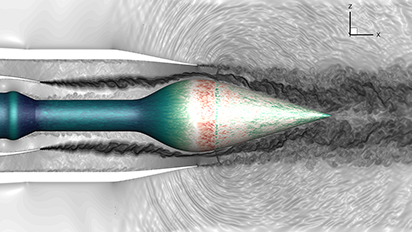
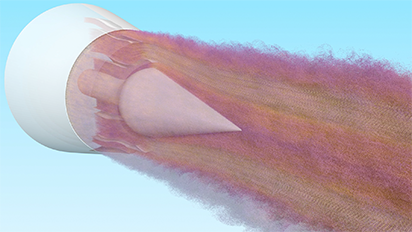
NASA’s Commercial Supersonics Technologies (CST) project addresses the development of tools, technologies, and knowledge to help eliminate the technical barriers to practical commercial supersonic flight, with a focus on reducing the noise created by jet engines typically used for such aircraft designs. The Launch Ascent and Vehicle Aerodynamics (LAVA) team in the NASA Advanced Supercomputing (NAS) Division at NASA’s Ames Research Center utilizes high-fidelity scale-resolving computational fluid dynamics (CFD) tools to predict jet noise—some of the loudest noise generated by humans—on a full flight configuration. We are working closely with researchers from NASA’s Glenn Research Center to better understand jet noise and evaluate noise reduction technologies like chevron nozzles, multi-stream nozzles, internally lobed mixers, and jet-surface interaction noise.
Project Details
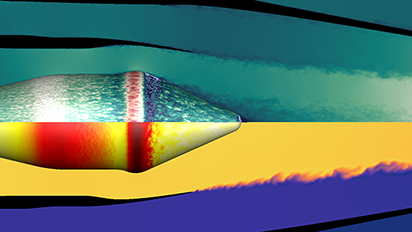
Under CST’s Transformational Tools and Technologies Project, we performed scale-resolving simulations with the NAS-developed LAVA solver to predict jet acoustics for NASA’s Low Boom Flight Demonstrator (LBFD). This included using both hybrid Reynolds-Averaged Navier-Stokes/Large-Eddy Simulation (RANS/LES) and Wall-Resolving Large-Eddy Simulation (WMLES) methods on validation cases with increasing complexity, such as jet-surface interaction noise, multi-stream, and chevron nozzle designs. As a first step, we developed best practices and assessed the uncertainties, strengths, and drawbacks of each simulation methodology. In order to better quantify uncertainties, we generated an extensive database comprising several simulations in static and in-flight vehicle conditions, and carefully compared them with experimental data. We then applied our lessons learned to a complex configuration, including several jet noise reduction technologies like internally lobed mixers, plugs, and multi-streams.
The supercomputers at the NAS facility are instrumental in enabling next-level, large-scale computational aeroacoustics.
Results and Impact
By improving WMLES capabilities within the LAVA solver framework, we were able to successfully predict jet noise as well as jet-surface interaction noise. Great performance improvements were made, reducing the overall simulation time by about 65x, and reducing the runtime from weeks to hours. The findings from these simulations have already resulted in new insights and additional experimental investigations of certain flow phenomena, performed in collaboration with researchers at NASA Glenn. These code improvements have also enabled the generation of a database with several static and in-flight flow configurations. By increasing the output of scale-resolving simulations from a few per year to several per month, we have a better understanding of the uncertainties and strengths of WMLES for jet noise predictions. Gaining confidence in the predictive capabilities of hybrid RANS/LES for jet noise is another step toward vehicle certification by analysis.
Why HPC Matters
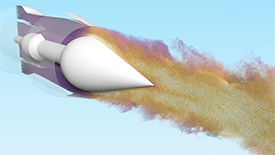
The supercomputers at the NAS facility are instrumental in enabling next-level, large-scale computational aeroacoustics. Due to the nature of the broadband noise generated by jets, it is necessary to run our simulations with a very small timestep over long periods. This required computational tools that can use modern computer hardware very efficiently. Additionally, new load balancing features developed at NAS have enabled strong scaling, and we were able to use about 128 AMD Rome nodes on the Aitken supercomputer at NAS for 250-million-grid-point grid systems, resulting in simulation wall-times of less than two hours to predict broadband noise. These improvements, in combination with upgrades and algorithm improvements, resulted in a reduction in simulation times of more than 65x since 2019. Each simulation generates hundreds of terabytes of data that is then analyzed in the frequency domain. For this, special post-processing tools have been developed that reduce the costs of accessing data on disk and help go beyond what traditional data analysis tools offer.
What's Next
While great emphasis has been put on making the numerical tools as efficient as possible—gaining speedups of more than 6500%, the manual mesh generation effort is still the biggest bottleneck to increase turnaround times for generating larger databases. The mesh generation for complex configurations utilizing curvilinear meshes is labor intensive and can take an experienced engineer days or weeks of meshing. Ongoing work within the LAVA solver framework is focused on applying WMLES to a mesh paradigm that enables automated meshing, reducing the mesh generation time from weeks to minutes on a modern workstation.
More Information
- Computational Framework for Launch Ascent and Vehicle Aerodynamics (LAVA)
- Jet Noise Prediction using Hybrid RANS/LES with Structured Overset Grids
- Hybrid RANS/LES Simulation of Jet Surface Interaction Noise
- Jet Noise Prediction with Large-Eddy Simulation for Chevron Nozzle Flows
- Jet Noise Prediction for Chevron Nozzle Flows with Wall-Modeled Large-Eddy Simulations
- Hybrid RANS/LES of Jet Surface Interaction Noise
Researchers
- Gerrit-Daniel Stich, NASA Ames Research Center Please enable Javascript to see email address.
- Aditya Ghate, NASA Ames Research Center Please enable Javascript to see email address.
- Jeffrey Housman, NASA Ames Research Center Please enable Javascript to see email address.
- Cetin Kiris, NASA Ames Research Center Please enable Javascript to see email address.