Simulating the Launch Environment at NASA’s Kennedy Space Flight Center
Overview
To support upcoming NASA Artemis missions from Launch Complex 39B (LC-39B) at NASA’s Kennedy Space Center (KSC), the Launch Ascent and Vehicle Aerodynamics (LAVA) team in the NASA Advanced Supercomputing (NAS) Division has developed a new computational fluid dynamics (CFD) approach for accurately simulating the launch environment, including its water-based sound suppression system. Estimation of acoustic loads (air pressure and vibrations caused by sound) during liftoff is necessary for the design and certification of the agency’s vehicles and flight instruments.

Common semi-empirical methods of estimating loads have built-in conservatism to account for uncertainty, which means that all instruments and vehicles need to be certified for a larger range of vibrations than what might be necessary, leading to excessive increases in weight, cost, schedule, and technical burdens. Utilizing this new CFD capability—which is both high-order accurate and provably robust—the LAVA team has been working to demonstrate its ability to make accurate acoustic load predictions. This tool allows for refined predictions of the launch environment, reducing the uncertainty associated with traditional methods. Given a future of increasing NASA and commercial launch missions, the opportunities for a well-validated and robust multiphase CFD tool are numerous.
Project Details
Starting in 2020, KSC Exploration Ground Systems (EGS) supported the use of LAVA’s multiphase flow simulation capabilities to study the extreme launch environment conditions computationally, including modeling the Scale Model Acoustic Test (SMAT), a 5% scale test meant to represent the Space Launch System (SLS) and Mobile Launcher (ML) at LC-39B. The algorithm has been verified using manufactured solutions to demonstrate the correct implementation of the solver and the high-order convergence rate (a detailed description of the mathematical model and the numerical scheme can be found in the paper by Wong, et al.). A milestone of the EGS project was the validation of the new solver against measured test data from the scale test SMAT. These simulations required careful preparation due to their complexity, and ultimately the numerical results showed excellent agreement with test data. This effort has been extended and tasked by the NASA Engineering and Safety Center (NESC) to reduce simulation turnaround time by improving the scalability of the LAVA multiphase solver for high-performance computing.
Results and Impact
The multiphase results from this work and new computational capabilities will give a more complete picture of the extreme conditions the launch environment experiences and will help NASA reduce mission risk—increasing safety and potentially saving significant amounts of time and money.
The LAVA team performed simulations of the SMAT and compared mean pressure signals at many sensor locations. The numerical and experimental signals demonstrated excellent agreement. Additionally, the team is using the validated solver to provide ignition overpressure protection estimations for the SLS at LC-39B. By refining the model of the launch environment to include the water effects from the sound suppression system, a more accurate prediction of loads on the vehicle, mobile launcher, tower structures, and flame trench was achieved. The multiphase results from this work and new computational capabilities will give a more complete picture of the extreme conditions the launch environment experiences and will help NASA reduce mission risk—increasing safety and potentially saving significant amounts of time and money. The collaboration between engineers at KSC and the researchers at NAS also represents a great opportunity to advance the agency’s modelling and simulation capabilities for the launch environments of future space flight missions.
Why HPC Matters

Each of the LAVA team’s high-resolution simulations of the launch environment at LC-39B used approximately 400–500 million grid cells and ran several weeks on 8,000 cores of either the Electra supercomputer’s Intel Xeon Skylake or Aitken’s Intel Xeon Cascade Lake processors. Because these simulations are time dependent, they generate roughly 400 terabytes of data for each run. Visualization of these results give insight into the complicated flow conditions, and required reliable data storage, high-performance data I/O, and powerful visualization tools, which were provided by the Visualization & Data Analysis team within NAS—who are always striving to get the greatest possible utilization from computational resources to support NASA missions.
What's Next
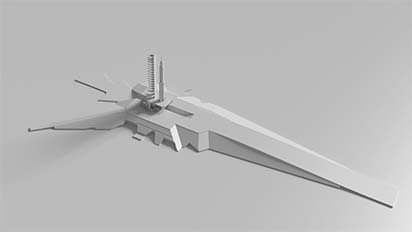
The LAVA team’s researchers have been working on refactoring the software’s Cartesian infrastructure, and early performance testing shows a speedup of more than 2x. Reducing the turnaround time for these launch environment simulations is essential to providing insights to NASA engineers and to enhance mission safety. The goal is to provide crucial CFD information for designs in a reasonable turnaround time to accommodate launch pad modifications, changes to the water-based sound suppression system, and new vehicle.
More Information
- NASA, Supercomputing, and the Artemis Moon Mission
- A Positivity-Preserving High-Order Weighted Compact Nonlinear Scheme for Compressible Gas-Liquid Flows
Researchers
- Jordan Angel, NASA Ames Research Center Please enable Javascript to see email address.
- Scott Neuhoff, NASA Ames Research Center Please enable Javascript to see email address.
- Michael Barad, NASA Ames Research Center Please enable Javascript to see email address.
- Cetin Kiris, NASA Ames Research Center Please enable Javascript to see email address.