Simulating the Many Personalities of Our Sun
Overview
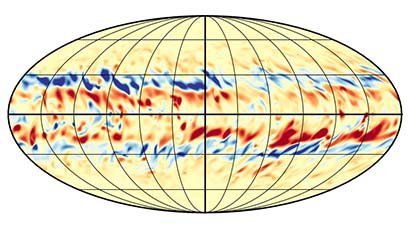
The calling card of solar physics is the global dynamo, the process by which the Sun generates its remarkably ordered magnetism in a highly turbulent environment. The signature of this calling card is an 11-year cycle wherein sunspots (dark spots visible on the solar surface) appear first at mid-solar latitudes, then at sites closer to the equator, in a pattern that resembles butterfly wings. This phenomenon is indicative of a dynamo in the solar interior: an active, magnetized fluid that self-excites magnetism and regenerates it against resistive dissipation (the process through which magnetic energy is lost by “dissipating” into thermal energy).
However, there are many other cyclic features of solar magnetism, two of which we consider in this project: hemispheric asymmetry, which is the persistent preference of solar magnetism to be strong in the Northern or Southern hemispheres on decades-long time scales; and active longitudes, which are solar longitudes that tend to be more active than others, generally with opposite polarity on opposite sides of the Sun. Using state-of-the-art three-dimensional magnetic fluid simulations on NASA’s high-performance computing resources, we developed models that capture these behaviors, as well as the striking propagation of magnetic flux toward the poles. Our simulations suggest that the Sun may be a chaotic dynamical system residing in a state of bistability—a bifurcation regime in which two distinct dynamos can operate simultaneously or in tandem.
Project Details
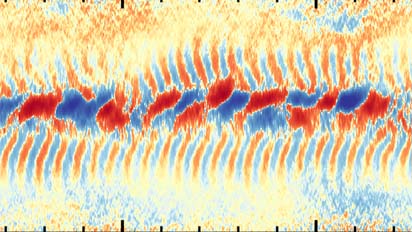
We ran three simulations of a rotating, convecting, magnetized spherical shell that self-consistently produces dynamo action, using the open-source Rayleigh code, which is a highly scalable, parallelized Fortran 90 software for 3D, fully nonlinear, magnetohydrodynamic fluid simulations. The model uses a shell that is similar in depth and aspect ratio to the solar convection zone, and we force solar luminosity through the shell via a fixed internal heating function, which drives the convection. Our three dynamo models have successively higher magnetic Prandtl numbers (the ratio of momentum diffusivity to thermal diffusivity), thus exploring how dynamo behavior—cycle period, amplitude, and irregular variability—change with increased magnetic turbulence.
Results and Impact
Simulations like ours show the essential role played by the agency’s advanced computing infrastructure in solving big problems like the very complex and often chaotic solar dynamo.
Several of the simulations achieved remarkable dynamo behaviors similar to observed features of the solar cycle. In particular, a highly regular cycling system of four “magnetic wreaths”—coherent tubes of magnetic flux that wrap all the way around the shell in a large torus or donut shape—steadily migrate toward the solar equator and regularly reverse their polarity, similar to the butterfly pattern. At the same time, the poloidal magnetic field is transported poleward, another observed feature of the butterfly pattern. The phenomenon eventually bifurcates: the system of four wreaths persists and cycles, but a new system of partial wreaths, each of opposite polarity, coexists superimposed on the original system. The partial wreath system has many of the observed features of active longitudes (remaining basically stationary in a rotating frame) and hemispheric asymmetry (existing only in one hemisphere at a time). Our models provide major insights into how the solar dynamo operates and shows that our Sun potentially exists in a “bistable” state, where these structures cycle superimposed on one another.
Why HPC Matters
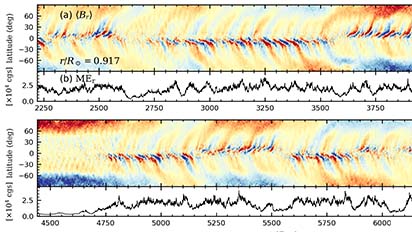
These simulations require high-performance computing resources, often running for weeks at a time and using upward of 4,000 core processors on NASA’s Pleiades supercomputer. Similarly, they produce terabytes of data, which is only possible to analyze on a system with large amounts of memory and dedicated analysis nodes like the Lou data analysis nodes at the NASA Advanced Supercomputing facility. Simulations like ours show the essential role played by the agency’s advanced computing infrastructure in solving big problems like the very complex and often chaotic solar dynamo.
What's Next
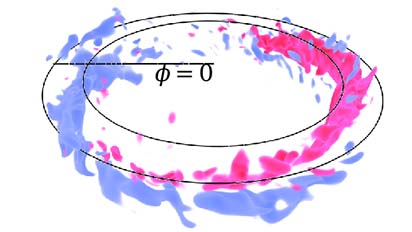
Currently we are in the process of extending these simulations to include a self-consistently generated tachocline of shear at the base of the solar convection zone. The tachocline is the region where the differentially rotating convection zone (fast equator, slow poles) transitions to solid-body rotation in the stable interior, and is often thought to be an essential ingredient to the dynamo. It is difficult to simulate due to the many varieties of fluid instabilities and dynamo-generators existing there, on a wide range of length scales. NASA’s supercomputing resources offer us a unique way to approach the longstanding tachocline problem.
More Information
- Exploring Bistability in the Cycles of the Solar Dynamo through Global Simulations
- Dynamo States with Strikingly Different Symmetries Coexisting in Global Solar Simulations
- The Sun May Have a Dual Personality, Simulations Suggest
Researchers
- Loren I. Matilsky, JILA / University of Colorado Boulder Please enable Javascript to see email address.
- Juri Toomre, JILA / University of Colorado Boulder Please enable Javascript to see email address.