How Many Galaxies Do You Need to Make One Milky Way?
Overview
Over the last 50 years, astronomers have pieced together a picture of how galaxies form and evolve into the majestic spirals and elegant ellipticals we see today. Surprisingly, the vast majority of the matter that goes into making galaxies is unseen by our most powerful telescopes. What we think of as a galaxy—its stars and the interstellar gas they illuminate—occupies only the small center of much more massive “dark halos” composed of yet-to-be-explained cold dark matter. Galaxies' dark halos are up to ten times larger in size, and 1,000 times greater in volume, than the familiar luminous galaxy regions shown by NASA’s Hubble Space Telescope. Yet, we now believe that dark halos are filled with stars and gas that usually evade detection, but may play vital roles in determining the visible parts of galaxies.
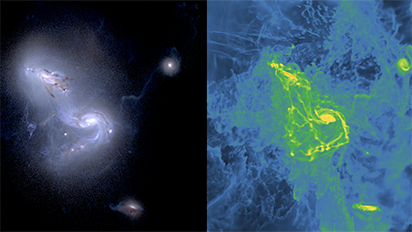
Observations made with Hubble and other telescopes show that galaxies are surrounded by faint outskirts of stars and gas. These stellar and gas halos appear to encode a detailed “fossil record” of information about a galaxy’s history that we cannot otherwise access. The halo stars are thought to have formed mainly in smaller, neighboring galaxies that were shredded by gravitational forces during mergers—sometimes into complex streams that wrap the main galaxy multiple times and persist for billions of years. The gas halos are formed from a combination of gas stripped from merger partners and the energetic ejecta of stars in the main galaxy.
Our FOGGIE (Figuring Out Gas & Galaxies in Enzo) collaboration produces extremely high-resolution and realistic simulations of galaxies to interpret data gathered from observations and make predictions for the difficult-to-observe parts of galaxies. Using the Enzo Adaptive Mesh Refinement (AMR) cosmological hydrodynamics code, we simulated the stellar and gaseous halos of six Milky Way-like galaxies on the Pleiades supercomputer at the NASA Advanced Supercomputing (NAS) facility in order to interpret data from Hubble and make detailed theoretical predictions for NASA’s upcoming James Webb and Nancy Grace Roman Space Telescope missions.
Project Details
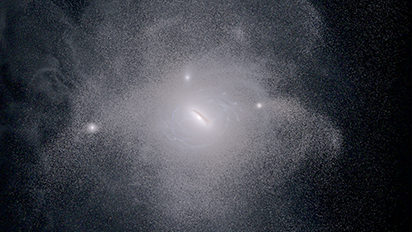
The FOGGIE simulations combine three aspects to examine the evolution of stars and gas through cosmic time: extremely high resolution in the diffuse gas surrounding galaxies; relatively low-mass stellar particles; and shortly spaced outputs. The high gas resolution is needed to accurately track the flows of gas into and out of the galaxy, and the low-mass stellar particles are particularly important for modelling galaxies' stellar halos. Each stellar particle in our simulation actually represents a population of stars born at the same time and in the same location, which minimizes computational cost. While high-mass galaxies (like those shown in the top figure) can be well represented by millions of such stellar particles, even when each particle represents more than 1,000 actual stars, this method presents a challenge for smaller galaxies (like those shown in the second figure), which often contain only 1,000–100,000 stars. In order to resolve the low-mass galaxies that ultimately contribute their stars to the stellar halos around more massive galaxies, we have to run our simulations with much less massive stellar particles—and therefore many more of them.
The FOGGIE simulations are resource-intensive runs at every stage: creating the initial conditions, evolving the galaxies over the full 13.7-billion-year sweep of cosmic time, and visualizing and analyzing the results are all made possible by NASA’s HPC resources.
Results and Impact
Our simulations reveal that the stellar halo of a single Milky Way-like galaxy is made up of stars formed in nearly 100 other galaxies that have merged with or been accreted by this central behemoth. Most of the galaxies that contributed these stars are more than 100 times less massive than the Milky Way analog. Using the synthetic data generated from these simulations, we make predictions for how to detect and disentangle these stellar halos around the Milky Way and other nearby galaxies. In particular, NASA's upcoming Roman Space Telescope will have the resolution and sensitivity of the Hubble Space Telescope, but it will view 100 times as much of the sky at a time, enabling a detailed look at the stellar halos of dozens of nearby galaxies for the first time.
Why HPC Matters
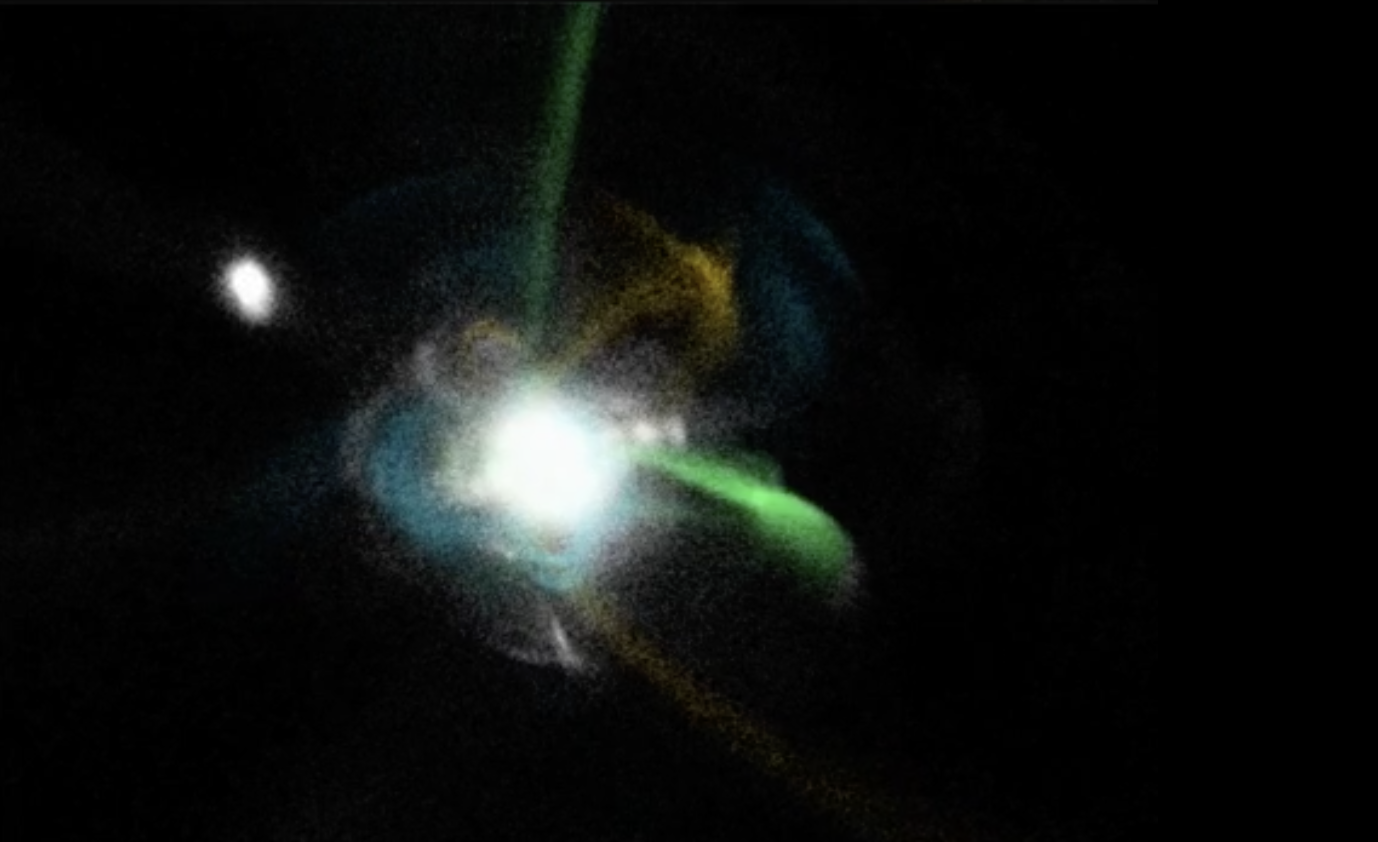
The FOGGIE simulations are resource-intensive runs at every stage: creating their intiial conditions, evolving the galxies over the full 13.7-billion-year sweep of cosmic time, and visualizing and analyzing the results. Each simulation—with approximately 50-100 million resolution elements tracing the gas and about 100 million stellar particles, each of which tracks its own composition and dynamics—ran for approximately 12 to 18 months of wall-clock time using 512 cores on the Pleiades supercomputer, totalling several million node-hours. The NAS facility's mass storage system is also important for enabling analysis: each output can be 15-30 gigabytes, and with 2,500 outputs per run, it's crucial to have access to hundreds of terabytes of space with fast I/O in order to analyze the detailed time evolution of the galaxies and their halos.
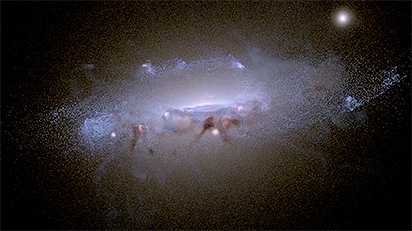
In addition, the NAS Visualization team uses significant resources to visualize our simulations—an important final process that allows us to compare them with observations of the real universe. The visualizations include realistic treatments of how starlight is absorbed and scattered by the cosmic dust that lies between the stars and our telescopes—requiring hundreds of gigabytes of RAM and about 1,000 processor-hours.
What's Next
The next step for the FOGGIE team is to study more galaxies of different sizes in larger cosmic volumes. To do this, we are transitioning to the Enzo-E code, an updated version of Enzo that is scalable to thousands of processors.
More Information
Researchers
- Molly Peeples, Johns Hopkins University/Space Telescope Science Institute Please enable Javascript to see email address.
- Anna Wright, Johns Hopkins University Please enable Javascript to see email address.
- Jason Tumlinson, Johns Hopkins University/Space Telescope Science Institute Please enable Javascript to see email address.