Predicting Orion Ascent Abort Acoustic Environment to Enhance Astronaut Safety
Overview
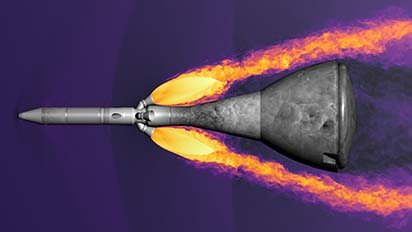
NASA’s Artemis Program aims to transport humans to interplanetary destinations such as the Moon—and eventually Mars—and return them safely back to Earth via the Orion crew module. NASA’s Orion will carry the first woman and next man to land on the Moon, and will enable sustained presence on and around the Moon. An integral part of ensuring safe spaceflight is Orion’s Launch Abort System (LAS). This state-of-the-art crew escape system is attached to the top of the spacecraft and can outrun a speeding rocket to quickly pull astronauts to safety in case of an emergency during launch. The LAS is then jettisoned once the spacecraft has safely reached low-Earth orbit.
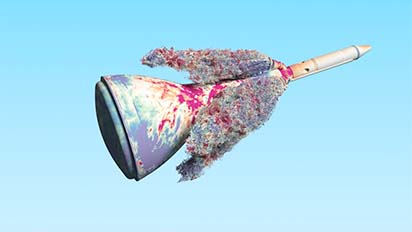
To propel the crew module away to safety, the LAS uses a solid rocket motor that produces four large high-speed exhaust plumes that flow along the sides of Orion, generating extremely strong acoustic vibrations. Abort could be triggered at any stage during an Artemis launch—while on the launch pad, or during the various parts of the ascent trajectory before reaching space. The vehicle’s altitude, velocity and attitude when abort is triggered plays an important role in the strength and spatial distribution of the acoustic vibrations the plumes generate. It is important to understand the effect of these factors to ensure the safety of the system, and accordingly, the safety of the astronauts.
The scale-resolving simulation of the near-hypersonic abort scenario at the edge of the atmosphere is unprecedented in two respects: it pushes the boundaries of our CFD capability because of the extremely low pressure and density, and it provides the first and only source of data on vibration levels for such a scenario.
Project Details
The Launch, Ascent, and Vehicle Aerodynamics (LAVA) team at NASA’s Ames Research Center has closely collaborated with the Orion Loads and Dynamics team at Johnson Space Center since 2017 to help characterize the vibrations imparted by the LAS abort motor plumes onto the LAS structure. During this time, the team has run multiple simulations for various launch abort scenarios using the cutting-edge LAVA computational fluid dynamics (CFD) software. During this past year, the team investigated the sensitivity of predicted vibration levels to altitude across a range of abort scenarios:
- A high-altitude, near-hypersonic abort corresponding to the last chance to abort before reaching space.
- A lower-altitude, supersonic abort scenario otherwise identical to the early burn segment of the Ascent Abort 2 (AA-2) flight test.
- A lower-altitude, high-angle-of-attack, transonic abort scenario otherwise comparable to one wind tunnel test case with a 6%-scale model and heated helium plume studied in the 11x11-foot Transonic Wind Tunnel at Ames in 2011.
Results and Impact
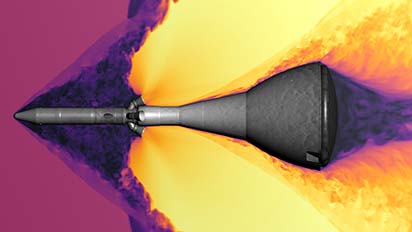
The scale-resolving simulation of the high-altitude, near-hypersonic abort scenario at the edge of the atmosphere was unprecedented in two respects: it pushed the boundaries of our CFD capability because of the extremely low pressure and density environment, and it provided the first and only source of data on vibration levels for such an abort scenario. The latter two simulations showcased reductions in the amount of high-performance computing (HPC) resources required, and in overall turnaround time, thanks to improvements we made to LAVA’s parallel efficiency and scaling. All three simulations contribute toward better understanding the effect of altitude on vibration levels and their spatial distribution over the vehicle. These CFD predictions help reduce uncertainty for abort scenarios that are difficult or too expensive to test—like the high-altitude, near-hypersonic abort—further helping to reduce risk and ensure the safety of astronauts when using the LAS.
Why HPC Matters

The simulations were performed with an adapted Cartesian mesh with 700 to 900 million cells and completed for approximately 500,000 time steps corresponding to at least 0.5 seconds of real time. The high-altitude abort scenario was simulated using 100 AMD Rome nodes, corresponding to 12,800 cores total, on NASA’s Aitken supercomputer for 19 days using our production LAVA software. The latter two simulations were completed using our pre-production, high-efficiency LAVA solver and were able to complete more time integration on fewer resources and in a shorter turnaround time, corresponding to an overall speedup factor of 2.2. Each of the latter simulations utilized 100 Intel Skylake nodes—totaling 4,000 cores—on NASA’s Electra supercomputer for 14 days, with each generating nearly 200 terabytes of data. Completing such detailed simulations in such a short turnaround time requires the entire stack to be optimized—from the CFD application all the way to the individual compute nodes, their network interconnections, and the disk storage arrays. These large-scale simulations would not be possible without the HPC experts at the NASA Advanced Supercomputing facility.
What's Next
Orion’s first flight is scheduled to lift off in 2022. The Orion Loads and Dynamics team is using the CFD predictions and the lessons learned from them to augment wind tunnel, ground test, and flight test data in order to help reduce uncertainty of the vibrations on the vehicle, help finalize the LAS design with prime contractor Lockheed Martin, and ultimately enhance the safety of astronauts during a potential launch abort. The LAVA team will continue developing the aeroacoustics capability within the LAVA framework to better serve NASA’s broader goals across aeronautics and human exploration projects. Our ongoing focus is to bring to production the latest version of LAVA, where we have refactored and optimized the entire code base for high throughput without sacrificing portability to various HPC architectures.
More Information
- NASA, Supercomputing, and the Artemis Moon Mission
- Computational framework for launch, ascent, and vehicle aerodynamics (LAVA)
- Orion Ascent Abort Test 2 (AA-2) Fact Sheet
Researchers
- Francois Cadieux, NASA Ames Research Center Please enable Javascript to see email address.
- Michael F. Barad, NASA Ames Research Center Please enable Javascript to see email address.
- James C. Jensen, NASA Ames Research Center Please enable Javascript to see email address.
- Cetin Kiris, NASA Ames Research Center Please enable Javascript to see email address.