Pushing the Boundaries of Simulation to Explore the Earth
Overview
The NASA Global Earth Observing System (GEOS) model supports an array of complex Earth system simulation and data assimilation capabilities. With GEOS, NASA scientists can uniquely explore the compromise between scientific complexity and increased model resolution. Efficiently using available computational resources requires extensive scientific development within each GEOS model component, as well as optimized frameworks for comprehensively coupling and executing these components.
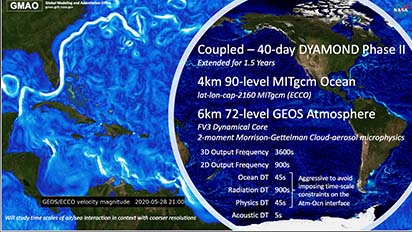
GEOS capabilities are demonstrated within an array of global, cloud-resolving, 40-day simulations for the international DYAMOND Initiative: DYnamics of the Atmospheric general circulation Modeled On Non-hydrostatic Domains. Phase II of the DYAMOND Initiative is focused on northern hemisphere winter simulations with atmosphere-ocean coupling. GEOS is one of several models worldwide used to contribute simulations to the project.
Project Details
Scientists used GEOS to submit multiple simulations to DYAMOND Phase II, which covers the period from January 20 to March 1, 2020. These simulations include: 1) a coupled 4-kilometer (km) ocean and 6-km atmosphere with interactive two-moment aerosol cloud microphysics; 2) a 3-km, 181-level atmosphere with single-moment 6-phase cloud microphysics including 1-km global carbon emissions for chemistry transport; and 3) a 1.5-km, 181-level atmosphere with simple parameterized chemistry.
High-end computing (HEC) platforms at the NASA Center for Climate Simulation (NCCS) and the NASA Advanced Supercomputing (NAS) Division are providing essential resources for preparing our modeling systems for emerging HEC systems and exploring new science developments.
Results and Impact
The results of the DYAMOND Phase II experiment highlight the success of NASA GEOS models in simulating the Earth at high levels of complexity and resolution. In this project, we improved the representation of convection, precipitation, aerosols, carbon, and chemistry in the NASA GEOS model. These simulations produce multiple petabytes of data, thus extending the GEOS legacy of pushing the boundaries of simulation and computing to explore the Earth system.
The NASA GEOS model continues to be a valuable tool for advancing the understanding of our home planet and the intricate interactions of global and regional processes. These simulations also demonstrate the computing and data resources that will be needed to continue such research and development milestones on future computing platforms.
Why HPC Matters
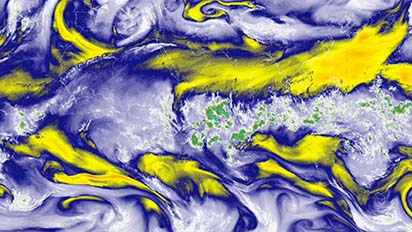
High-end computing (HEC) platforms at the NASA Center for Climate Simulation (NCCS) and the NASA Advanced Supercomputing (NAS) Division are providing essential resources for preparing our modeling systems for emerging HEC systems and exploring new science developments. GEOS configurations for DYAMOND required up to 39,400 Intel Xeon Skylake computational cores. Configurations over the coming decade will require scalability approaching millions of cores, targets for which exposing additional parallelism within GEOS becomes essential. Partnerships with the NCCS and NAS support our exploration of traditional hybrid parallelism approaches within GEOS today and prepare our models for future HEC platforms by exposing new depths of parallelism within our model components.
What's Next
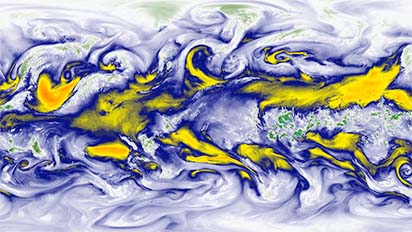
NASA is now using high-resolution GEOS simulations to explore the interactions of more than 200 chemical species within a composition forecast (CF) system known as GEOS-CF. Scientists are currently preparing GEOS-CF for 3-km global simulations, the highest-resolution, complex, global composition forecasts to date.
More Information
- The DYAMOND Initiative
- GEOS DYAMOND Phase II
- GEOS DYAMOND Phase II: Interactive Globe Visualizations
Researchers
- William Putman, NASA Goddard Space Flight Center Please enable Javascript to see email address.