Convection in High-Resolution Global Solar Simulations
Overview
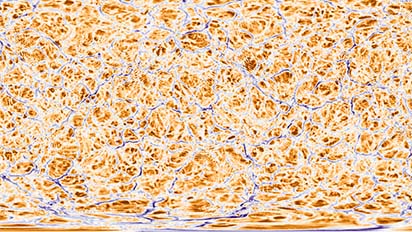
The convection zone of our Sun consists of the upper 30% of the solar interior and is characterized by jets of rising and falling plasma driven by the heat generated in the core. These jets, along with solar rotation, are responsible for the majority of solar activity, including differential rotation and meridional circulation—which ultimately drive the solar dynamo and generate the Sun’s magnetic field. Researchers at the New Jersey Institute of Technology and NASA’s Ames Research Center are working together to use 3D global models of the Sun to help improve the understanding of these driving mechanisms, as part of an effort to simulate the evolution of the Sun and other stars inside some of the most powerful computers in the world.
Project Details
We used the 3D global hydrodynamic code EULAG to simulate the convective action of plasma flows throughout the solar interior. As these plasma flows rise and fall to various heights, their turbulent expansion and contraction works to form convective cells, which can be seen on the Sun’s surface through high-resolution observations made by NASA’s Solar Dynamics Observatory. Our simulations exhibit similar patterns of multiscale convection generated by a solar-like density stratification, with the upper boundary of convective cells penetrating surface layers, as we see in solar observations. Convective scales continuously shrink with height to sizes compatible with reports of giant cells on the solar surface.
With the ever greater increases in computing power, it has become possible to run simulations that allow us to explore the vastly different scales found in the solar interior.
Results and Impact
Turbulent convection is a complex and chaotic process that can be difficult to characterize. However, increasing the resolution of solar models is continuously bringing us closer to our goal. Our simulations offer the ability to study convection at different heights and scales throughout the solar interior—which is absolutely essential if we want to fully understand these interconnected processes. Our models replicate the multiscale structure of convective cells, which show larger cells breaking into smaller ones as we move towards the model surface. This result coincides with our theoretical understanding of convection, but has been elusive in global 3D models of solar convection up to this point, especially at lower resolutions. The Implicit Large Eddy Simulation turbulence model used in this project allows for higher resolutions than can be currently achieved using Direct Numerical Simulation or Large Eddy Simulation approaches.
Why HPC Matters
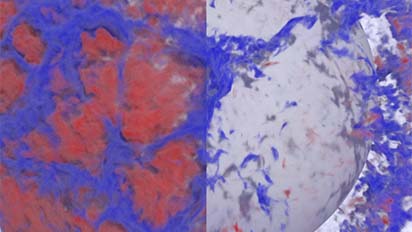
Our high-resolution, 3D global models, which run on the massively parallel high-end computing systems at the NASA Advanced Supercomputing facility at Ames, offer a window into the chaotic turbulent structures responsible for shaping multiscale convection on the Sun. With the ever greater increases in computing power, it has become possible to run simulations that allow us to explore the vastly different scales found in the solar interior. The high-resolution model used in this project consists of a 1024x512x512 three-dimensional mesh that computes the evolution of solar plasma on 1,024 processors running in parallel on the Pleiades supercomputer. The model is run for hundreds of hours in order to simulate continuous solar convection.
What's Next
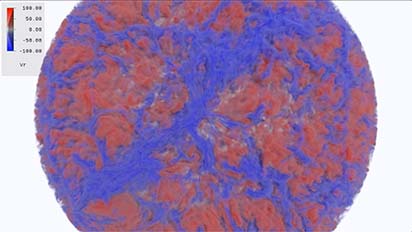
We plan to continue extending our model to simulate regions increasingly closer to the solar surface in order to better understand the internal dynamics that shape observed scales of convection. As our focus nears the solar atmosphere, the drop in density creates increasingly fast plasma jets that become more difficult to simulate. However, it is important to understand these regions, as they can hold important information about the nature of internal solar dynamics, as well as how the Sun’s magnetic field is shaped.
Researchers
- Andrey Stejko, New Jersey Institute of Technology Please enable Javascript to see email address.
- Gustavo Guerrero, Universidade Federal de Minas Gerais Please enable Javascript to see email address.
- Alexander Kosovichev, New Jersey Institute of Technology Please enable Javascript to see email address.