Turbulence Resolving Simulations for Aircraft Certification by Analysis
Overview
The role of computational fluid dynamics (CFD) is advancing beyond design and optimization, and toward Certification and Qualification by Analysis (CQbA) in order to alleviate the high financial burden of wind tunnel and flight testing. There is growing interest in expanding the scope of high-fidelity numerical modeling to target specific areas of aeronautics characterized by large regions of separated aerodynamic flows. High-lift vehicle simulations pose a major challenge for current CFD algorithms and closure models due to the highly chaotic nature of separated flows in these configurations. Separated flows have length and time scales that are strongly influenced by the vehicle geometry, and legacy models involving Reynolds-Averaged Navier-Stokes (RANS) solutions that rely on calibration often fail in these flow types and narrow the scope of vehicles able to be accurately modeled. The accurate prediction of both aerodynamic loads at the maximum lift flow state (CLmax), as well as the onset of stall, are critical goals for CQbA, as envisioned in the NASA Transformational Tools and Technologies program and the agency’s CFD 2030 report. In order to address the current CFD software shortcomings, the Launch Ascent and Vehicle Aerodynamics (LAVA) group at NASA’s Ames Research Center has been performing research on the development and assessment of cutting-edge numerical technologies.
Project Details
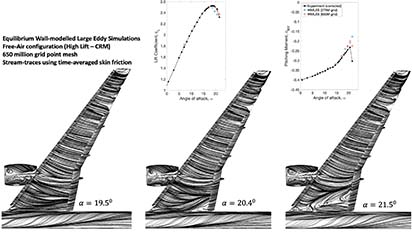
The group has been investigating the High-Lift Common Research Model (HL-CRM) and has used it as a benchmark for the development and assessment of scale-resolving algorithms such as Wall-Modelled Large-Eddy Simulations (WMLES) within the LAVA software framework. Previous efforts focused on high-lift aircraft configurations have highlighted three drawbacks of RANS solutions: an early onset and highly exaggerated outboard separation, resulting in outboard stall; lack of any inboard corner flow separation, resulting in inaccurate inboard stall predictions; and a strong sensitivity of the steady state solution to initialization procedures, suggestive of multiple non-physical roots to the governing systems. Using LAVA scale-resolving simulations, the group at Ames has shown that the WMLES method does not suffer from the same drawbacks. A key objective of this project is to assess the method’s predictive capabilities to test its technological readiness for use in CQbA.
Results and Impact
LAVA large-eddy simulations using equilibrium wall modeling have shown remarkable agreement with experimental observations in terms of the aerodynamic loading and the stall onset mechanism for angles beyond CLmax, including the pitch break phenomenon, which indicates a large inboard separation starting at the juncture of the aircraft’s wing and fuselage. This was computationally verified by employing a series of model grid refinements with variations in wall-normal resolution and cell aspect ratios. Additionally, the large pressure gradients experienced on the vehicle’s outboard slats and near-main element leading edge at CLmax have also led to improvements in non-dissipative numerical methods, which can now be applied to a much wider range of flow types with coarser curved geometry grids.
The amount of NAS resources required to perform the LAVA WMLES work in 2021 alone underscores the importance and need for the continuous advancement of high-end computing resources within the agency.
The LAVA group’s current research using WMLES is focused on addressing some oddities seen with the HL-CRM geometry inside a virtual wind tunnel environment related to floor boundary layers and the flow physics responsible for “free-air” deviations employed in CFD. These simulations will provide additional insight for future virtual wind tunnels, especially for experiments employing a side-wall mounted model. The WMLES work has been instrumental to the project, guiding grid modifications and numerical changes for other modeling methods—such as Delayed Detached Eddy Simulations—by identifying flow regions and causes for RANS closure model failures that LES-type treatments can mitigate.
Why HPC Matters
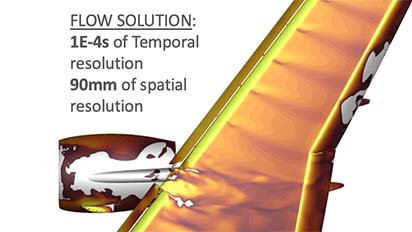
Scale-resolving algorithms such as WMLES typically employ a very large number of spatio-temporal degrees of freedom and therefore require more computational resources than typical RANS methods. This means that WMLES for realistic geometries and configurations requires a computational infrastructure that can use the hardware very efficiently, as well as demonstrate strong scaling to very low cell-counts per processing core. The group aimed to ensure the high-lift configuration was able to achieve computational efficiency close to theoretical limits on the Pleiades, Electra, and Aitken supercomputers at the NASA Advanced Supercomputing (NAS) facility at Ames. Their work included developing new load balancing features, enabling excellent scaling and allowing the group to run 275-million-grid-point grid systems on 128 of Aitken’s AMD Rome nodes, resulting in simulation turnaround times of less than eight hours for several of angles of attack. The amount of NAS resources required to perform the LAVA WMLES work in 2021 alone underscores the importance and need for the continuous advancement of high-end computing resources within the agency.
What's Next

Between 2020 and 2021, LAVA WMLES models employing structured curvilinear overset grid systems have been demonstrated successfully on three fundamental aircraft flow types: a wing-fuselage corner flow separation, or juncture flow; a shock-induced flow separation and buffet at transonic Mach numbers; and a geometry induced flow separation near CLmax and the onset of a high angle of attack stall phenomenon. The single bottleneck for this work has been the generation of high-quality, curvilinear, body-fitted meshes needed for accurate large-eddy simulations. In order to alleviate this bottleneck, ongoing work on LAVA WMLES will focus on employing automated mesh generation, in addition to the development of immersed boundary capabilities.
Researchers
- Aditya Ghate, NASA Ames Research Center Please enable Javascript to see email address.
- Gaetan Kenway, NASA Ames Research Center Please enable Javascript to see email address.
- Gerrit-Daniel Stich, NASA Ames Research Center Please enable Javascript to see email address.
- Cetin Kiris, NASA Ames Research Center Please enable Javascript to see email address.