Examining the Dynamics of the “Dark Genome” in Response to SARS‑CoV‑2 Infection
Overview
Pathogenic human viruses such as SARS‑CoV‑2, the virus that causes COVID‑19, are able to interact with host cells, hijacking their metabolic pathways to facilitate their own replication. Accumulated evidence shows that human viruses can accomplish this by selectively modifying the host’s genomic output, using direct or indirect mechanisms. Indirect mechanisms often involve the virus’s interaction with the host cell’s genomic regulators, such as non-coding RNA molecules (ncRNAs, also known as the “dark genome”). Among the different families of ncRNAs, long non-coding RNAs (lncRNAs) are involved in the regulation of the immune response in some viral infections, such as HIV and HCV. LncRNAs are long-regulatory RNA transcripts (copies of DNA sequences) generated from specific locations in the genome, and can act at different cellular levels to regulate the genomic output by interacting either with proteins or with other nucleic acids. Using a group of patients tested for SARS‑CoV‑2 infection, we studied the expression of lncRNAs in response to viral infection—that is, we identified and quantified the lncRNAs that are present in each patient tested—and postulated their involvement in regulatory events mediated by specific proteins. Gaining a better understanding of these interactions may lead to advances in the treatment of COVID-19.
"NASA HPC resources and services played a critical in role in generating the data for this project. NAS experts were instrumental in helping troubleshoot, debug, and optimize the PBS scripts within each pipeline, enabling parallel processing of the patient samples."
Project Details
The project involved transcriptomic (RNA) analysis of next-generation sequencing data from patients tested for SARS‑CoV‑2 infection. The patient group (cohort) includes 260 SARS‑CoV‑2-positive samples with different viral loads, 82 patients infected with other respiratory viruses, and 429 non-infected controls. We performed expression analysis on the Pleiades supercomputer at the NASA Advanced Supercomputing (NAS) facility in order to identify and quantify the lncRNAs from the raw sequencing data of each patient sample. Selected differentially expressed lncRNAs were functionally analyzed by combining gene expression information with previously published host proteomic data in SARS‑CoV‑2 infection.
Results and Impact
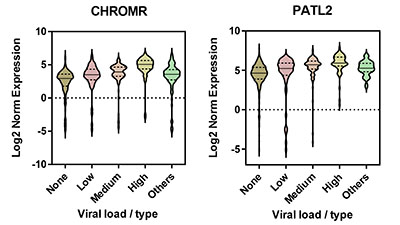
Our results showed that SARS‑CoV‑2 infection induces a transcriptional shift—a shift in the genomic output—of the host cells, mainly characterized by an up-regulation of RNA transcripts that includes a specific group of lncRNAs. We revealed a molecular lncRNA expression signature that is correlated not only with the SARS‑CoV‑2 infection but also with the viral load quantified by quantitative polymerase chain reaction (qPCR), the test commonly used to diagnose SARS‑CoV‑2. Some of the differentially expressed lncRNAs, such as NRIR, CHROMR, and PATL2, have been previously shown to be involved in the host response against specific viral infections as mediators of the cellular immune response.
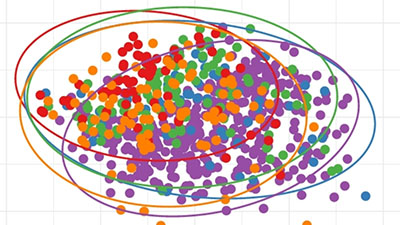
We postulate that the overexpressed lncRNAs—the lncRNAs that appear in higher amounts in patients infected with SARS‑CoV‑2 versus patients without SARS‑CoV‑2—will, in response to SARS‑CoV‑2 infection, establish interaction networks with other cellular molecules such as RNA-binding proteins (RBPs). To infer functional relationships of this lncRNA expression signature and RBPs, we took advantage of the already available proteomic data in SARS‑CoV‑2 infection. Our results clearly showed that in response to SARS‑CoV‑2 infection, the up-regulated lncRNAs interact mainly with RBPs that are also up-regulated to similar levels in samples infected with viruses other than SARS‑CoV‑2. These RBPs are functionally related to RNA splicing and the interferon response, in which infected cells release small molecules that let nearby cells know an invader is present so that cell is able to activate its defense mechanisms. Further characterization of these interactions opens a new window for the development of therapeutic strategies that could target lncRNA function in SARS‑CoV‑2 and other viral infections.
Why HPC Matters
NASA high-performance computing (HPC) resources and services played a critical in role in generating the data for this project. The researchers utilized these resources to develop and test three data processing pipelines. HPC experts at the NAS facility at Ames Research Center were instrumental in helping troubleshoot, debug, and optimize the PBS scripts within each pipeline, enabling parallel processing of samples, and thus reducing processing time. To date, a total of 845 samples (732 patient nasal swabs, 62 NYC environmental swabs, and 51 control samples) have been processed through each pipeline on the Pleiades supercomputer, generating approximately 107 terabytes of data. The project used on average four Intel Xeon Haswell nodes for about 19,300 hours, for a total of 77,200 node-hours.
Francisco J. Enguita, University of Lisbon, Portugalfenguita@medicina.ulisboa.pt Afshin Behesti, NASA Ames Research Center
afshin.beheshti@nasa.gov Guy Karlebach, The Jackson Laboratory for Genomic Medicine
guy.karlebach@jax.org Peter Robinson, The Jackson Laboratory for Genomic Medicine
peter.robinson@jax.org Amanda Saravia-Butler, NASA Ames Research Center
amanda.m.saravia-butler@nasa.gov Christopher E. Mason, Weill Cornell Medical College
chm2042@med.cornell.edu