Aeroelasticity of Electric Vertical Take-off and Landing Air Taxis
Overview
NASA, in collaboration with industry partners, is actively pursuing Advanced Air Mobility (AAM) projects. Several types of advanced air mobility vehicles are under consideration for different purposes, including for use as air taxis. For instance, in partnership with Uber, NASA recently tested a prototype for a future urban transport air taxi.

Among AAM projects, electric aircraft are common. A typical electric vertical take-off and landing vehicle (eVTOL) includes lifting propellers near the wing and a pushing propeller near the rear-end of the body, like that of the Kitty Hawk Cora prototype, which flew for the first time in November 2017. In order to reduce the vehicle weight, the wings are allowed to be flexible. However, flexible wings are susceptible to aeroelastic oscillation, which can be triggered from sudden gusts of wind and often lead to adverse instability. The presence of propellers further adds to the aerodynamic complexity.
In order to numerically simulate the wing flexibility effects on AAM vehicles, researchers in the NASA Advanced Supercomputing (NAS) Division at NASA’s Ames Research Center generated a typical eVTOL configuration with eight lifting propellers and one pushing propeller. Simulations are made using Navier-Stokes (NS)-based computational fluid dynamics (CFD) coupled with structural equations of motion. To obtain accurate simulations, the NS equations are essential for this analysis and are only feasible with the use of supercomputers.
"This is a game-changing effort to advance from the current quasi-steady loose coupling method to a time- accurate coupling method for accurate simulation of time-dependent aeroelastic responses of electric vertical take-off and landing vehicles."
Project Details
To date, all the aeroelastic simulations for eVTOL generated using NS equations are limited to quasi-steady loose coupling methods. Since the flight conditions often involve time-dependent transient cases, time-accurate simulations are needed. In this effort, a new aeroelastic module has been added to NASA’s well-known software, OVERFLOW. The module models wing structures using finite-element-based modal equations. CFD and structural equations are time accurately coupled by using the Newmark time-integration method. Also utilized is RUNDUA (dual-level parallel), a protocol based on a Portable Batch System script developed in the NAS Division that facilitates automatic running of
multiple cases.
Results and Impact
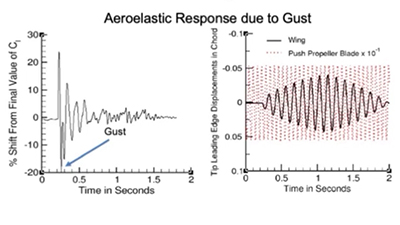
This work has demonstrated accurate prediction of aeroelastic oscillations of wing and lifting propellers due to sudden gust for a typical lift + cruise air taxi with eight lifting propellers and one pushing propeller. Due to the presence of adequate structural damping, aeroelastic oscillations are self-suppressed, in this specific case. The damping phenomenon makes any vibrating structure gradually decay in amplitude of motion by means of energy dissipation through various mechanisms, such as joints. The NAS team successfully demonstrated the usefulness of the new NS and RUNDUA computational capability for NASA AAM projects.
Why HPC Matters
Each simulation required 1,800 processor-hours on NASA’s Pleiades supercomputer, completing within 90 hours of wall-clock time using 20 processors and generating five terabytes of data for preparing visualizations. To accurately model the complete design of an eVTOL vehicle, several hundred simulations are needed. Timely generation of a design database is feasible only with the use of supercomputing resources such as those available at the NAS facility. With the use of the RUNDUA protocol, about 250 simulations can be completed in approximately 100 hours of wall-clock time, using
5,000 cores on Pleiades.
What's Next
Stability of eVTOL in trajectory mode—such as during take-off—is very important for safe flight. Adverse aeroelastic oscillations can deviate eVTOL from the planned trajectory. Therefore, the next step in this study will be to extend the prediction capability to include trajectory equations. The goal will be to automatically produce 1,000 simulations in 100 hours of wall-clock time to demonstrate the efficiency and quick turnaround time of the Navier-Stokes CFD method on NAS supercomputers.
Related Links
- NASA and Uber Test System for Future Urban Air Transport
- Takeoff Simulation of Lift + Cruise Air Taxi by Using Navier–Stokes Equations ( PDF)
- Dynamic Aeroelasticity of Wings with Tip Propeller by Using Navier–Stokes Equations (Abstract)
- Dual Level Parallel Computations for Large-Scale High-Fidelity Database to Design Aerospace (PDF)
guru.p.guruswamy@nasa.gov