Understanding How Violent Cosmic Events Create Heavy Elements
Overview
More than 150 years after the periodic table of the elements was published, the cosmic origin of the elements populating the bottom rows of the table still remains an open question. These so-called “r-process” elements—including well-known elements such as gold, silver, and platinum—are thought to be created in an astrophysical environment with an enormously high neutron density, such as those resulting from the collisions of neutron stars or supernova explosions. Simulations run on NASA’s massively parallel supercomputers provide key insights into how such elements were likely formed in the first-ever observed neutron star merger, witnessed by the Laser Interferometer Gravitational Wave Observatory (LIGO), the Virgo gravitational-wave detector, and NASA’s Hubble Space Telescope and Neil Gehrels Swift Observatory. Additionally, our simulations lead to the surprising realization that a certain class of supernova explosions could be the actual main cosmic factory of heavy elements like gold. These predictions provide exciting new prospects for current and upcoming NASA missions.
"Our simulations over the past few years were entirely performed on the Pleiades supercomputer at the NASA Advanced Supercomputing (NAS) facility at NASA’s Ames Research Center, and required more than 30 million core hours to complete."
Project Details
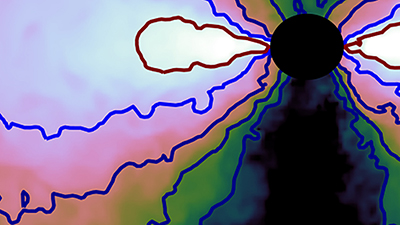
The first observed collision of two neutron stars via gravitational waves (GW170817) was accompanied by ultraviolet, optical, and infrared emissions consistent with a “kilonova”—characteristic thermal emissions generated by the radioactive decay of r-process elements. Employing general-relativistic magnetohydrodynamic simulations, including weak interactions and approximate neutrino transport, we have investigated the long-term post-merger evolution of such a collision: a neutrino-cooled accretion disk around a black hole that is formed by the collision. These simulations are conducted in order to interpret the first merger event and in anticipation of future observations that will be made by the LIGO/Virgo detectors and NASA facilities. We have applied similar techniques to accretion disks that form following the death of massive, rapidly rotating stars, which collapse under their own gravity to form a black hole surrounded by a neutrino-cooled accretion flow. These “collapsars” are thought to give rise to certain supernovae and long gamma-ray bursts frequently observed by NASA’s Swift and Fermi Gamma-ray Space Telescope missions.
Results and Impact
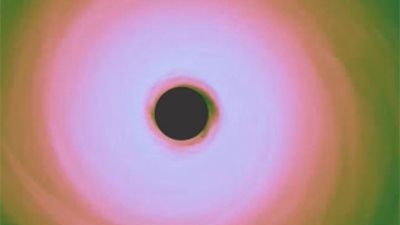
Our results suggest that most of the heavy r-process material generating the kilonova in GW170817 likely originated in powerful outflows from a post-merger accretion disk. A follow-up study covering different regimes of post-merger systems revealed that indeed most heavy r-process material created in mergers is likely produced by accretion disks over comparatively long timescales, rather than by debris from the prompt collision itself. Future observations will be able to test this hypothesis. The results from our collapsar simulations revealed an entirely new source of r-process elements and suggest that these systems could be the dominant factory of r-process elements in the universe. This finding could solve problems related to chemical evolution and provides exciting prospects for upcoming NASA missions, such as the James Webb Space Telescope (JWST), to look for infrared signatures in gamma-ray burst supernovae that would be indicative of the formation of heavy elements.
Why HPC Matters
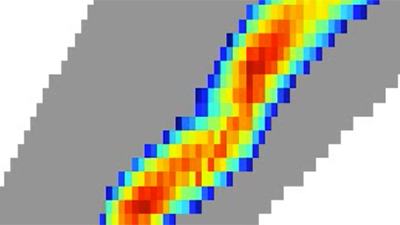
Our simulations over the past few years were entirely performed on the Pleiades supercomputer at the NASA Advanced Supercomputing (NAS) facility at NASA’s Ames Research Center, and required more than 30 million core hours to complete. The simulations typically ran on 3,000 to 7,000 processor cores for nearly three months, producing tens of terabytes of data that we store on the NAS mass storage systems. Pioneering simulations such as ours, which provide theoretical insights and an interpretation of new and complex observations, would not have been possible without these high-performance computing resources.
Related Links
- Collapsars as a Major Source of r-Process Elements
- A New Spin on Where Gold Comes From
- Three-Dimensional GRMHD Simulations of Neutrino-Cooled Accretion Disks from Neutron Star Mergers
- Three-Dimensional General-Relativistic Magnetohydrodynamic Simulations of Remnant Accretion Disks from Neutron Star Mergers: Outflows and r-Process Nucleosynthesis
dsiegel@perimeterinstitute.ca Brian Metzger, Columbia University
bdm2129@columbia.edu