New Modeling Tools Help Explore the Interior of the Sun
Overview
There are still many unanswered questions about the nature of meridional flows throughout the solar interior—the velocity fields that play a key role in distributing magnetic flux and regulating the 11-year period observed in the Sun’s magnetic cycle. To gain a deeper insight into the nature of these flows, we use a new, three-dimensional numerical solver, called 3DGLASS, to model acoustic oscillations throughout the solar interior. We implement a forward-modeling approach to test techniques in helioseismology that are used on solar and stellar surfaces to probe the interior velocity structures of the Sun and stars.
Our stellar models use new and efficient pseudo-spectral computational techniques to capture the impacts internal velocities can have on the propagation of sound waves. By simulating various models of internal flows, we are able to test techniques in local helioseismology that can offer critical insights on the data that we infer from the Sun.
Project Details
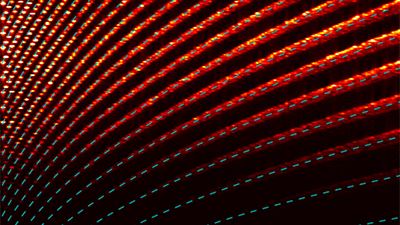
For this work, we solve the Euler equations in their conservative compressible form in order to simulate the propagation of acoustic waves throughout the Sun. Our equations simulate how 3D global structures of internal mass flows affect the travel times of acoustic waves, allowing us to take various models of meridional circulation and differential rotation and test how they will affect the results of helioseismology investigations into the Sun.
We use a forward-modeling approach of testing theoretical and simulated models of these solar flow profiles to zero in on key differences that will be present in solar observations—especially deeper into the solar interior, where information has been sparse and unreliable.
Results and Impact
Flows that sit at the base of the solar convection zone have been thought to have a dramatic effect on the action of the solar dynamo; however, it becomes very difficult to resolve structures around this depth using helioseismology techniques. There are still many competing theories about the nature of return flows in this region, where exactly they sit, and whether they are poleward in a double-cell meridional circulation model or equatorward in a single cell model. These global 3D simulations offer us a chance to explore the functional differences that these different theories create and will offer us a basis to be able to identify the subtle changes in structures that inform our understanding of solar observations.
Why HPC Matters
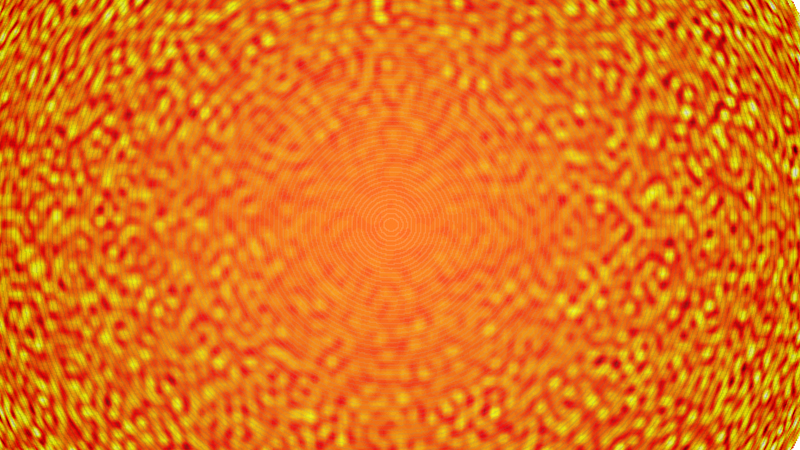
High performance computing has become an indispensable tool in understanding the Sun and its relationship to space weather near and around the Earth. We are reaching the limits of what simple theoretical models can do, and numerical simulations offer the opportunity for a much deeper understanding of the evolution of complex and chaotic systems. We use thousands of computing hours on the Pleiades supercomputer at the NASA Advanced Supercomputing (NAS) facility at Ames Research Center to run incredible simulations that would normally take years to accomplish. These simulations have become critical foundational tools in physics and will help researchers continue to answer questions integral to our understanding of the universe.
What's Next
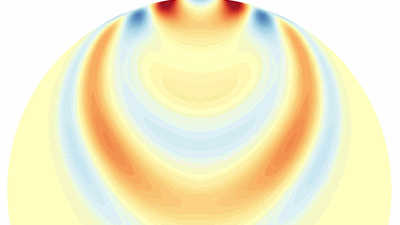
We plan to continue using this model to test increasingly complex systems of internal solar dynamics, using acoustics to probe structures of internal velocities. Our team is also working to soon add the ability to include the effects that large magnetic structures have on acoustic waves, opening up their model to aid in the understanding of, and developing functional prediction techniques for, large magnetic events on the solar surface.
Andrey Stejko, New Jersey Institute of Technologyams226@njit.edu Alexander G. Kosovichev, New Jersey Institute of Technology
alexander.g.kosovichev@njit.edu