3D Realistic Modeling of Rotating Stars
Overview
The dramatic increase of observational data from NASA's Kepler, K2, and TESS missions, and from supporting ground-based observatories, has opened new opportunities to investigate distant worlds. But because stars are many light years distant from Earth, it is challenging to extract information about their dynamics, evolution, and internal and atmospheric structures from observations alone.
"The teams at the NAS Facility provided several critical services needed for this project: 24/7 user support, visualization, and computer science expertise."
The discovery of thousands of exoplanet systems has made the effects of stars’ variable activity on their planets a hot topic of study. Our current state-of-the-art computational simulations allow us to build 3D dynamical and radiation models of stars from physical first principles. These models open up opportunities for validating existing data analysis techniques and for interpreting observational data in terms of the physical processes inside stars. For example, understanding how a star’s internal dynamics and structure depend on the star’s rotation period is critical for interpreting observational data.
Project Details
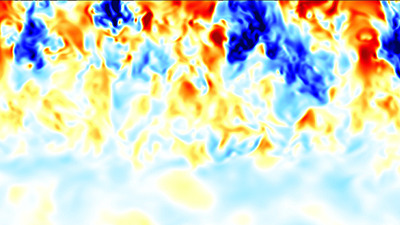
We modeled a star of 1.47 solar mass (an F-type star) with a relatively shallow convection zone of 30,000 kilometers (km), as compared with the Sun’s 200,000-km convection zone. These models allow us to investigate the star’s turbulent dynamics from the radiative zone to the outer convection zone and the surface, and at different latitudes. This study sheds light on the mechanisms of differential rotation, the excitation of stellar oscillation modes, and the dynamics and structure of the stellar tachocline—the interface between the inner radiative zone and the outer convection zone—which plays a key role in stellar variability processes.
Results and Impact
Our results revealed that the stellar surface is covered by multi-scale convective structures (granules) that are much bigger than solar granules. Below the surface, the scale of convection gradually increases with depth. Convective motions form downdrafts that penetrate through the entire convection zone, reaching speeds of 20 km/s and even faster. These high-speed downdrafts penetrate the radiative zone boundary, forming a convective overshooting layer at the top of the radiation zone and exciting internal gravity oscillations.
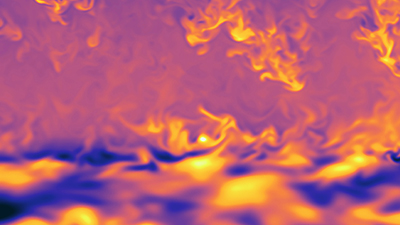
The ability to model the effects of stellar rotation at different latitudes allows us to study the fundamental properties of stellar differential rotation and meridional circulation, including their variations in depth and latitude. Our simulation results have also revealed that the equatorial regions of an F-type star, rotating within a one-day period, rotate slower than the star’s polar regions. This behavior is opposite that of the Sun, where the equatorial regions rotate faster than the polar regions in its 27-day average period.
These models provide critical theoretical insights into the structure and dynamics of rotating main-sequence stars, which are essential for understanding the evolution of stars, the effects of rotation on the stellar structure, and the role of turbulent flow. Our computational models support the interpretation of observational data from NASA space missions.
Why HPC Matters
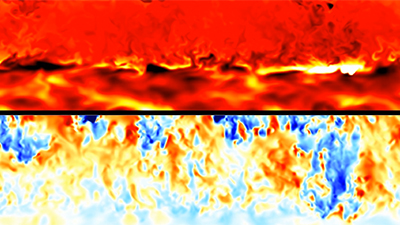
The availability of NASA supercomputing resources provided a unique opportunity to generate fully dynamical radiative models of stellar interiors with a high degree of realism. The project required around 3 million processor-hours and 180 terabytes of storage space. Support from experts at the NASA Advanced Supercomputing (NAS) facility at Ames Research Center, including code optimization, data analysis, and scientific visualization has been critical for I/O efficiency, analysis of massive multidimensional datasets, and efficient workflow—all essential to the success of this project. We primarily used the Pleiades supercomputer (Ivy Bridge nodes) and the modular Electra (Sky Lake nodes) and Aitken (Cascade Lake nodes) systems to generate the 3D stellar models and perform their analysis. Our typical run required 2,048 to 4,096 nodes. The Merope system was used for postprocessing analysis.
What's Next
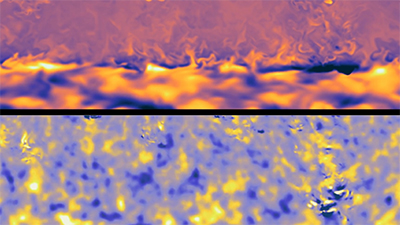
Our plans include expanding the computational domain higher into the stellar atmosphere, investigating the processes of magnetic-field generation, the formation of magnetic structures, and their effects on the stellar variability. We also plan to develop numerical models for stars of different masses and chemical compositions observed by NASA missions.
Irina Kitiashvili, NASA Ames Research Centeririna.n.kitiashvili@nasa.gov Alan Wray, NASA Ames Research Center
alan.a.wray@nasa.gov