Modeling the Impact of Martian Dust on Atmospheric Entry Vehicles
Overview
The presence of suspended dust in the Martian atmosphere is a unique aspect of Mars atmospheric entry that current and future NASA missions to the planet need to address. The dust particles not only interact with the flow field surrounding the entry vehicle as it descends, but also strike its heat shield at high velocities. These interactions can have notable adverse effects, including augmented surface heat fluxes on the vehicle body and increased erosion of the heat shield. The design of thermal protection systems is therefore highly dependent on the expected dust environment of the planet’s atmosphere. Our work focuses on the development of a computational methodology to efficiently and accurately simulate supersonic and hypersonic particle-laden flows over blunt bodies in order to better predict how entry vehicles will interact with the Martian atmosphere and to identify knowledge gaps in how to reliably model such processes.
"High-performance computing is critical to perform these large-scale simulations with reasonable cost. Specifically, the well-maintained and well-documented Pleiades supercomputer housed at the NASA Advanced Supercomputing (NAS) facility at Ames Research Center."
Project Details
In computational fluid dynamics, the discontinuous Galerkin (DG) method benefits from high-order accuracy, geometric flexibility, and good scalability to thousands of processors on high-performance computing systems. Another major advantage in hypersonic flow simulation is its significantly lower sensitivity to misalignment between the mesh and strong shocks than the conventional finite-volume method. We employed the DG method to perform simulations of hypersonic dusty flows, and conducted a parametric study to address the lack of experimental data for validation and insufficient knowledge of the important physics at play during a vehicle’s entry into a dusty atmosphere.
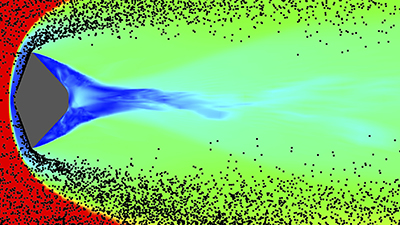
Our team also developed a Lagrangian particle method in the DG framework, with algorithms created to track particles on arbitrary elements and handle particle-fluid coupling and particle-particle interactions in an efficient and accurate manner. Particular attention was paid to evaluating the sensitivities of the solution to various physical models of the particle phase, and analyzing the trajectories of particles as they traverse the shock layer and strike the heat shield in detail.
Results and Impact

With the development of this new robust, efficient, high-order methodology for simulating hypersonic dusty flows, we found that our predictions of dust-induced surface heat flux augmentation agreed well with experimental tests, demonstrating the applicability of our computational models to accurately simulate the impact of suspended dust particles on thermal protection systems during atmospheric entry on Mars. We were also able to identify the components of the physical model that most significantly influenced the solution of the particle phase, namely the drag correlation, the Nusselt number correlation for heat transfer, and characterization of particle sizes. The effect of particle loading on dust-induced heating augmentation and erosion and the influence of the dust environment on particle-fluid coupling and particle-particle collisions was investigated. The results from this work can be used to determine the type of test data needed from future experiments and guide the development of a simple, reliable physical model appropriate for the flow conditions of interest. Several of the methods and models discussed have been adopted by NASA researchers and incorporated into the well-established US3D flow solver.
Why HPC Matters
High-performance computing is critical to perform these large-scale simulations with reasonable cost. Specifically, the well-maintained and well-documented Pleiades supercomputer housed at the NASA Advanced Supercomputing (NAS) facility at Ames Research Center was used to run nearly all such simulations, with each simulation using thousands of processors. The large storage capacity provided at NAS was also necessary to regularly save key data files for both the flow field and the particles.
Related Links
- Modeling Heat-Shield Erosion Due to Dust Particle Impacts for Martian Entries
- A Two-Way-Coupled Euler-Lagrange Method for Simulating Multiphase Flows with Discontinuous Galerkin Schemes on Arbitrary Curved Elements
- Smooth Projection Kernels for Euler-Lagrange Simulations on Arbitrary Elements Computed with Discontinuous Galerkin Schemes
- Sensitivity Study of High-Speed Dusty Flows Over Blunt Bodies Simulated Using a Discontinuous Galerkin Method
eching@stanford.edu Matthias Ihme, Stanford University
mihme@stanford.edu