Simulations of Giant Cold Fronts in Clusters of Galaxies
Overview
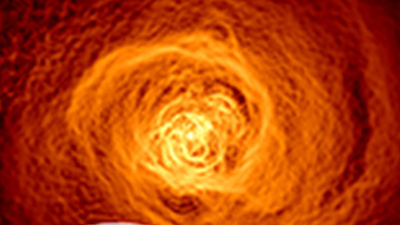
Clusters of galaxies are the largest objects to have formed in the universe to date. In visible light, we can see that clusters contain tens to hundreds of galaxies, each containing tens to hundreds of billions of stars. In fact, this is merely a fraction of the total mass of galaxy clusters. Each cluster also contains hot, magnetized gas that emits in X-rays, as well as dark matter that dominates the cluster gravitationally.
Using numerical simulations on NASA’s Pleiades supercomputer, we can simulate collisions between clusters that produce features known as “cold fronts,” which are jumps in gas density and temperature that are visible as edges in X-ray observations, especially by the Chandra X-ray Observatory, NASA’s flagship mission for X-ray astronomy. Through comparison of simulations with different physics with observations, we can learn details about the complex physics of the hot gas.
"The large dynamic range of merging clusters requires massively parallel numerical simulations which can only be carried out on resources such as the Pleiades supercomputer at the NASA Advanced Supercomputing facility at Ames Research Center."
Project Details
Merging galaxy clusters produce cold fronts by bringing gases of different temperatures and densities together. The cold fronts manifest themselves as wave-like features that expand outward from the cluster center. Across the boundary of the cold front, there is a shear flow, which can excite fluid fluctuations such as Kelvin-Helmholtz instabilities to produce these wave-like features along the front surface. Such features can be suppressed or slowed if the gas is highly magnetized or viscous, so if numerical simulations can reproduce what is observed, they will reveal the details of the gas physics. Our simulations have included the effects of dark matter, gravity, and magnetohydrodynamics. In the different simulations, we can vary the magnetic field strength or viscosity to predict what will be observed by X-ray observatories in these cases.
Results and Impact
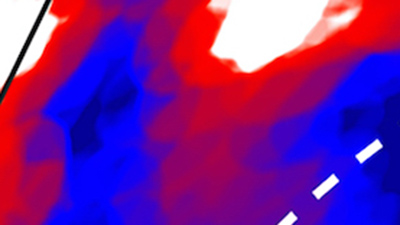
We used our simulations of cold fronts to compare to Chandra’s observations of the Perseus Cluster, one of the nearest and brightest clusters of galaxies. The first thing we were able to determine is that for a cold front relatively close to the cluster center, a Kelvin-Helmholtz wave appears along the surface, which is reproduced by simulations with a very narrow range of magnetic field strengths. If the field is too strong, the wave never grows, but if the field too weak, the wave becomes more chaotic than is seen in the observations.
Similarly, a later Chandra observation of a cold front at a very large radius revealed a “split” cold front, which produced a “hook” feature. Our simulation was also able to produce this feature, provided that the magnetic field was in the same “just-right” range. This work showed that simulations of merging clusters on high-performance computing (HPC) resources, in combination with Chandra observations, can be used to constrain properties of galaxy cluster gas.
Why HPC Matters
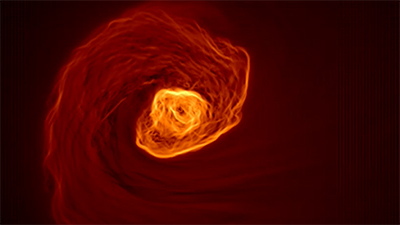
Our simulations must include the full dynamics of two merging clusters, on the scale of millions of light-years, but must also be able to resolve length scales on the thousands of light-years, where detailed physics plays an important role. Such a large dynamic range requires massively parallel numerical simulations which can only be carried out on resources such as the Pleiades supercomputer at the NASA Advanced Supercomputing (NAS) facility at Ames Research Center. Over the past several years, we have used millions of core-hours to carry out these simulations, which use approximately 1,000 cores each and have generated tens of terabytes of 3D simulation data. Only facilities such as those provided by NASA are capable of producing, storing, and facilitating analysis of such data.
What's Next
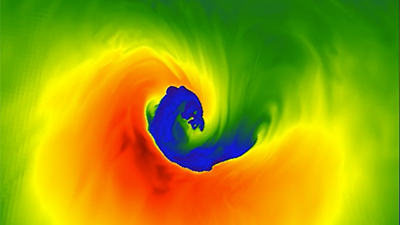
Galaxy clusters such as Perseus also have supermassive black holes in their centers, which drive jets that inflate enormous cavities that can also be seen as “holes” in X-ray observations. In the future, we will include the effects of supermassive black holes in our cluster merger simulations in order to investigate the combined interplay of these two powerful drivers of cosmic structure.
Related Links
- Scientists Find Giant Wave Rolling Through the Perseus Galaxy Cluster
- Gigantic Wave Discovered in Perseus Galaxy Cluster
- Colossal Cosmic Waves
- Perseus Cluster: Scientists Find Giant Wave Rolling through the Perseus Galaxy Cluster
- Perseus Cluster: Scientists Surprised by Relentless Cosmic Cold Front
john.zuhone@cfa.harvard.edu Stephen Walker, University of Alabama in Huntsville
saw0041@uah.edu Jeremy Sanders, Max Planck Institute for Extraterrestrial Physics
jsanders@mpe.mpg.de Andrew Fabian, Cambridge University
acf@ast.cam.ac.uk