Monitoring the Global Decline of Air Pollution During the COVID-19 Pandemic
Overview
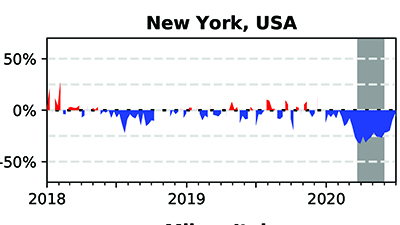
Nitrogen dioxide (NO2) is an important air pollutant formed during the combustion of fossil fuels. The reduced human activities in the wake of the COVID-19 pandemic led to sharp reductions in surface NO2 around the globe. Near-real-time NASA computer simulations, combined with surface observations, can be used to track the decline and subsequent recovery of NO2 related to COVID-19 stay-at-home orders around the globe. Since NO2 concentrations are a good proxy for industrial, transportation, and domestic activities, the changes in NO2 derived from NASA models during mandatory quarantine correlate well with officially reported changes in economic output.
Project Details
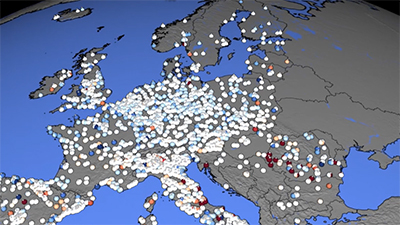
Observations from 4,778 air quality monitoring sites in 46 countries are used to monitor the change in NO2 as a result of COVID-19 containment measures. High-resolution NASA computer simulations are used to explain the confounding impact of meteorology on air pollution, as well as to provide a business-as-usual baseline of NO2 that would have been expected had COVID-19 not occurred.
Results and Impact
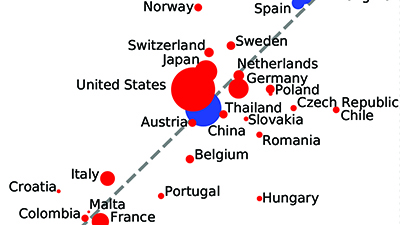
"Comparisons of surface observations against model-simulated baseline concentrations show that surface NO2 declined sharply after the outbreak of COVID-19. These NO2 declines correlate well with reported year-over-year changes in quarterly Gross Domestic Product (GDP), highlighting the close relationship between NO2 concentration and economic activity."
Comparisons of surface observations against model-simulated baseline concentrations show that surface NO2 declined sharply after the outbreak of COVID-19. Reductions in NO2 correlate with timing and intensity of COVID-19 restrictions, ranging from 60% in severely affected cities (e.g., Wuhan, Milan, and New York) to little change (e.g., Rio de Janeiro and Taipei). On average, NO2 concentrations were 18% lower than baseline between February and August 2020. Country-level changes for the second quarter of 2020 (April to June) range from +5% (in Brazil) to more than -40% (e.g., Ecuador, India, the United Kingdom, and Spain). These NO2 declines correlate well with reported year-over-year changes in quarterly Gross Domestic Product (GDP), highlighting the close relationship between NO2 concentration and economic activity.
Why HPC Matters
The model simulation of air pollution is conducted in near real-time on the NASA Center for Climate Simulation (NCCS) Discover supercomputer. Simulating the global evolution of air pollution at 25x25-kilometer horizontal resolution requires 3,416 processors. The model produces approximately 300 gigabytes of output per day, stored on the NCCS DataPortal. The model NO2 baseline is computed by combining terabytes of model output with millions of surface observations using an XGBoost machine learning algorithm. This analysis is conducted on Discover as well as the NCCS ADAPT Science Cloud.
Related Links
- Global Impact of COVID-19 Restrictions on the Surface Concentrations of Nitrogen Dioxide and Ozone
- Declines in Atmospheric Pollution During the COVID-19 Lockdown Are Consistent With Contraction in Economic Output
- Discover Supercomputer
- ADAPT Science Cloud
christoph.a.keller@nasa.gov K. Emma Knowland, NASA Goddard Space Flight Center
k.e.knowland@nasa.gov Mat J. Evans, University of York
mat.evans@york.ac.uk Trent L. Schindler, NASA Goddard Space Flight Center
trent.l.schindler@nasa.gov