
Advancing the Development of Hypersonic Transportation
Overview
Supersonic combustion ramjets (scramjets) are a class of airbreathing engines that could one day fly you from New York to Tokyo in just two hours! As fast as a rocket engine, scramjets can run much longer, as they don't need to store oxygen to burn—instead, they breathe in air from the atmosphere just like conventional plane engines. Additionally, they do not expend part of their propulsion energy to run a compressor. Instead, the compression naturally results from a complex system of multiple shock-turbulent boundary layer interactions called a "shock train," which resides in the isolator, a duct located between the engine inlet and the combustor where kinetic energy is converted into internal energy. The shock train's sensitivity to external perturbations can be detrimental to the engine's compression ratio, delaying ignition and eventually decreasing thrust. Ensuring efficient fuel/oxidizer mixing and burning at supersonic speed is challenging, given the very short residence time of the air within the combustor. Because high speed provides the compression ratio, which in turn ensures stable propulsion, a downward cycle can occur, leading to "engine unstart." Understanding both the shock train's complex response to external perturbations and the mechanics of supersonic combustion are therefore key design considerations for engine designers.
Project Details

We perform direct numerical simulations (DNS) of a model dual-mode scramjet isolator to study the impact of frequency-dependent instabilities. The shock train's dynamic response to upstream perturbation in the simulation allows us to identify the resonating frequencies that are of critical interest in designing a stable compressor. Based on our simulation results, we are also working toward developing a better understanding of the underlying physics to improve numerical modeling of such complex systems. This will eventually permit us to adjust computationally less-expensive Reynolds-Averaged Navier-Stokes (RANS) numerical simulation models to match the DNS.
Additionally, it is known that hypersonic flows cannot be accurately described by conventional (so-called equilibrium) thermodynamics. As the flow gets closer to the discontinuous regime, additional conservation equations must be resolved to quantify the internal energy distribution. This can alter the ignition process because chemical reactions are highly dependent on the gases' internal energy distribution. Numerical simulations of a model scramjet combustor are also being performed to understand the impact of such hypersonic (non-equilibrium) thermodynamics on ignition.
Results and Impact
The results of this numerical investigation allowed us to identify—for the first time—a resonance response to inlet perturbation in the shock train system that could potentially provoke a critical engine failure. The DNS also help improve the physical understanding of shock-turbulent-boundary layer interactions. In addition, a multi-temperature model based on molecular gas dynamics physics was implemented to describe non-equilibrium thermodynamics effects within the system. Reaction rates were also derived for such flow from quantum chemistry calculations. The end result is a consequent ignition delay between the simplistic equilibrium and nonequilibrium thermodynamics cases.
Why HPC Matters
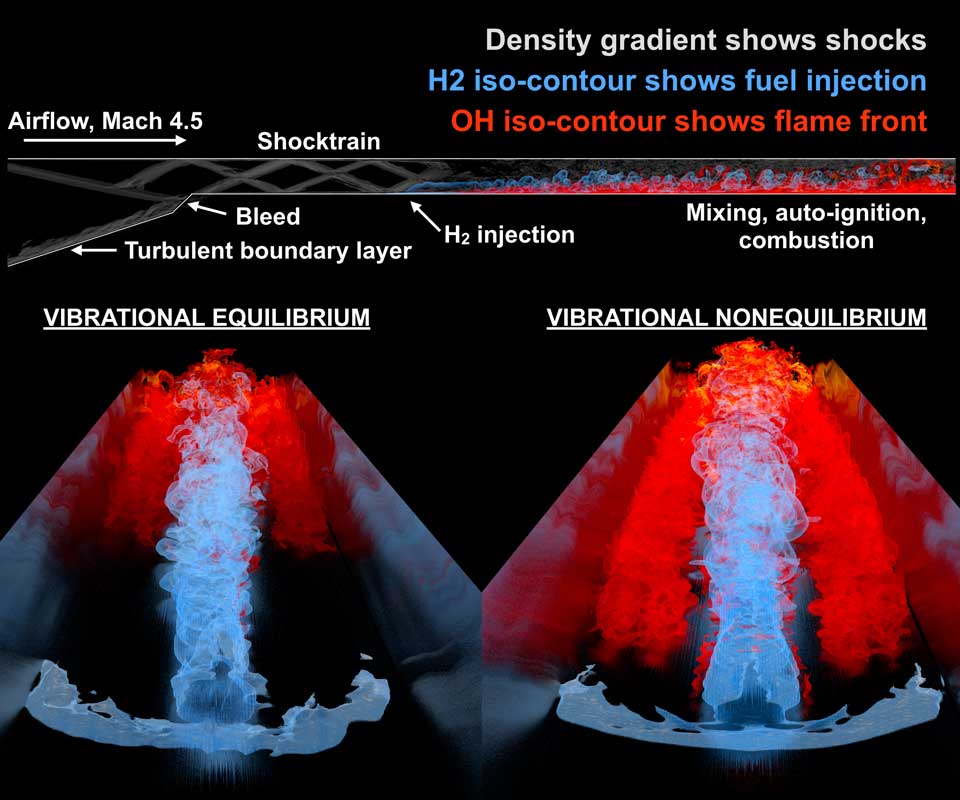
Our direct numerical simulations of the shock train are based on a 600-million cell grid, and required several runs on intermediate grids of 50 and 200 million cells in order to let the structure develop. A typical simulation takes approximately 500,000 processor-hours on the Pleiades supercomputer at the NASA Advanced Supercomputing (NAS) facility. As we investigate low-resonance frequencies, the simulation runtime increases as well. The simulations of the scramjet combustor are based on a 125-million cell grid but require the transport of many species mass fractions and internal energy modes, which increases the computational cost. The NAS facility's Lou mass storage system holds about 3 terabytes of data generated by these simulations.
More Media
See additional images/videos related to this demo in our media gallery.
rfievet@umich.edu Venkat Raman, University of Michigan
ramanvr@umich.edu Aaron Auslender, NASA Langley Research Center
aaron.h.auslender@nasa.gov