
From Tomography to Material Properties of Thermal Protection Systems
Overview
Protecting a spacecraft during atmospheric entry is one of highest risk factors that must be mitigated during the mission design phase. NASA is developing new material architectures to protect its spacecraft and probes as they enter planetary atmospheres at hypersonic speeds. At entry speeds from space, air turns into high-temperature plasma, and thermal protection systems (TPS) are needed to protect the vehicle payload and manage the heat from the freestream plasma. For extreme speeds, such as those achieved when returning to Earth from the moon, "sacrificial" materials such as ablators—which erode during entry—are the only options that can be used as TPS materials.
Modern TPS material architectures use porous substrate impregnated with a phenolic. The substrate is designed to be highly porous to minimize weight and heat conduction, but these properties make it susceptible to penetration of hot gases. Therefore, to mitigate the rush of gases into the protective substrate, its pores are filled with a phenolic that decomposes when heated. The decomposition process generates gases that block the incoming plasma.
Project Details
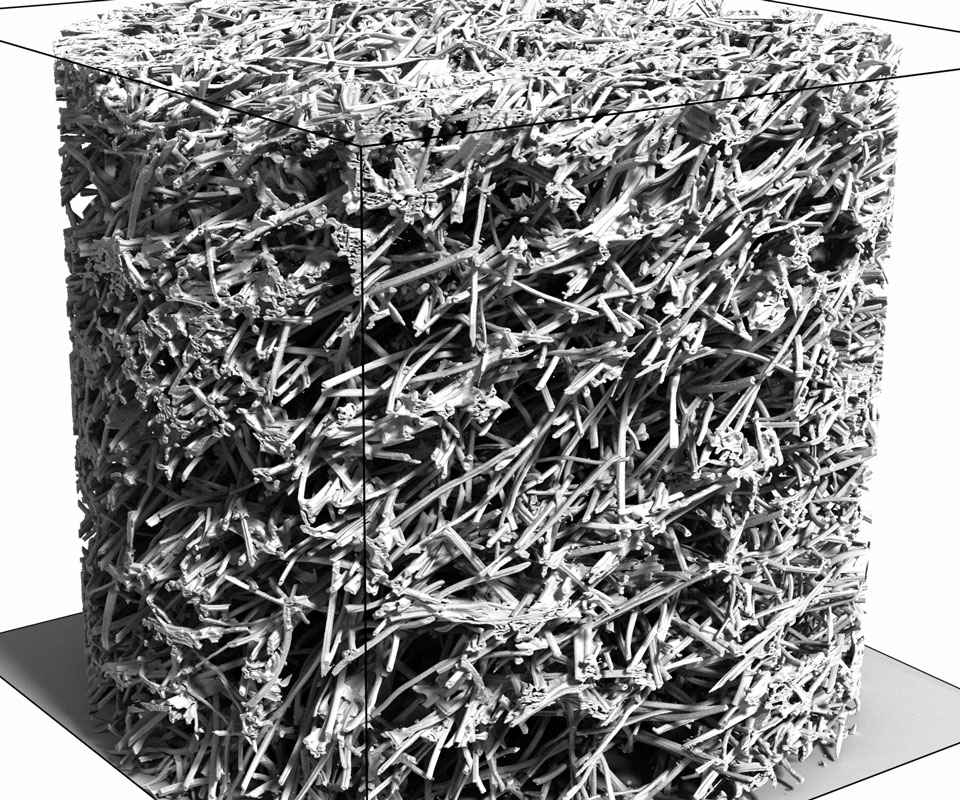
Developing new material architectures involves an extensive design and test cycle. Material properties that are key to a successful design of a spacecraft heat shield include conductivity, permeability, and material recession rate. To accelerate the design cycle process and reduce the need for extensive testing, NASA is developing modeling and simulation tools that enable the characterization of material properties and the materials' response to hot plasma.
Realistic digital representation of a substrate can be generated either synthetically or from high-resolution tomography of a built substrate. The digitized representation is then used to compute fundamental properties of the material and its response to high-temperature plasma.
Results and Impact
We used Direct Simulation Monte Carlo (DSMC), a particle-based method that computes the response of low-density carbon fiber materials based on their digitized volumes acquired using X-ray microtomography. This provided a better understanding of the material recession process in details previously unavailable experimentally. The effort will lead to better substrate design. In addition:
- We compared numerical computations of permeability with experimental results for FiberForm, a TPS material used on several NASA missions; results show excellent agreement.
- The validated method enabled us to compute the permeability of other substrates—including those used on the SpaceX Dragon vehicle—and carbon felt, a new substrate in development at NASA. Using DSMC eliminates the need for extensive experiments on these new substrates.
Why HPC Matters
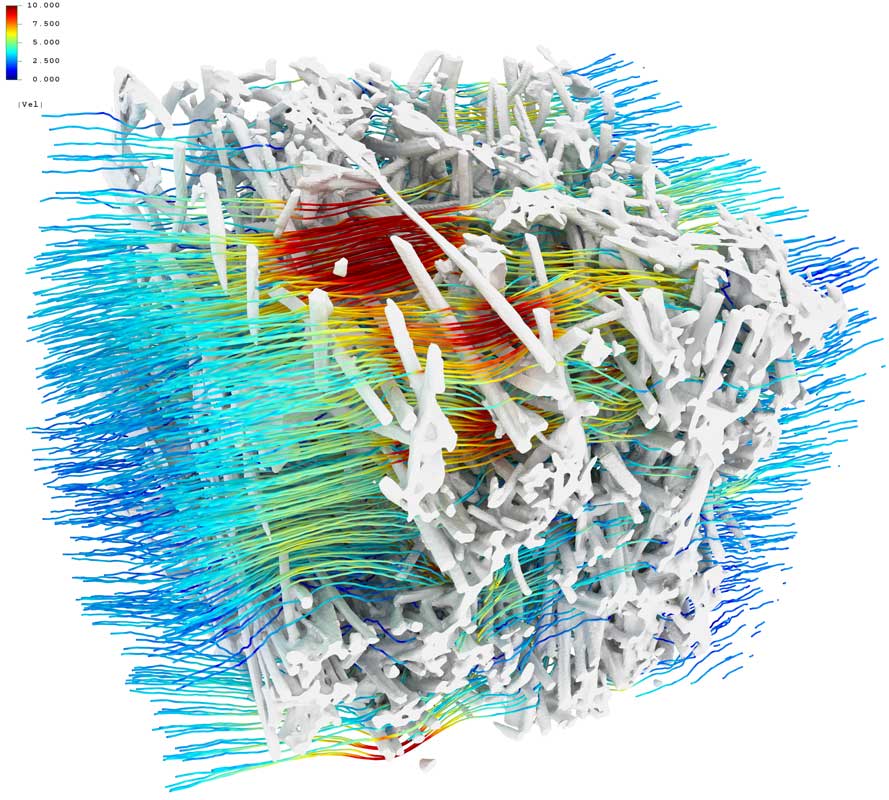
We used the Stochastic PArallel Rarefied-gas Time-accurate Analyzer (SPARTA) code developed at Sandia National Laboratories to run our simulations on the Pleiades supercomputer at the NASA Advanced Supercomputing facility. A grid was used to group particles by grid cell for purposes of performing collisions and chemistry, as well as to efficiently find particle/surface collisions. The datasets used 200 x 200 x 200-voxel samples digitized from microtomography, and more than 10 million total cells were used for the simulations. Around 200 millions particles were used in the domain, leading to an average number of 20 particles per cell, which was needed to reduce statistical scatter.
What's Next
As NASA contemplates large payloads to Mars, as well as missions to Venus and the giant planets Jupiter and Saturn, our project goal for the next four years is to develop a material design framework that will enable rapid development of mission-tailored TPS materials.
More Media
See additional images/videos related to this demo in our media gallery.
nagi.n.mansour@nasa.gov Arnaud Borner, NASA Ames Research Center
arnaud.p.borner@nasa.gov