
The Rewards of HPC: Experiments in Turbulence
Overview
Because the flow of air over a flight vehicle is normally turbulent, it must be approximated using engineering models, which in many important cases are too inaccurate for industrial purposes. In order to address this deficiency, we used high-performance computing (HPC) to generate turbulent flow simulations that serve as benchmark data against which engineering turbulence models can be tested and eventually improved. This effort is part of NASA's Transformational Tools & Technologies Project, sponsored by the Transformative Aeronautics Concepts Program, which aims to develop the computational tools necessary to design and certify future commercial, military, and space vehicles.
We are particularly interested in model predictions of whether the turbulent flow of air immediately adjacent to the vehicle—known as the "boundary layer" flow—remains attached to or separates from the vehicle surface. There are two primary reasons for this focus: 1) model predictions of separation are unreliable, and 2) while separation leads to extremely inefficient flight, the state at which separation first appears defines optimal flight conditions. In other words, one of a model's most important tasks is also one of its most difficult.
Project Details

HPC is used to perform a series of virtual experiments in a numerical wind tunnel, in order to produce high-fidelity solutions to the equations governing the behavior of turbulent fluid flow involving boundary-layer separation. Although we are not yet able to duplicate exact flight conditions, in terms of the size and speed of the aircraft, we can produce cases physically very similar to full-scale behavior. A family of such cases has been considered and compared to predictions of the models. The discrepancies between the models and the HPC data are currently being assessed, and the first finding is that all models predict separation too early.
Results and Impact
The advantage of this HPC-based approach is that unlike traditional laboratory experiments, it produces accurate non-intrusive measurements of any quantity of interest, anywhere in the flow. These measurements can be used to probe the internal mechanisms of the turbulent separation and the model's attempts to replicate them, as well as to generate the statistics the models are called upon to predict. Examples of generated statistics include the distribution of skin friction over the vehicle surface and the location of the line of mean separation; both have been compared to a range of current state-of-the-art turbulence models, revealing the models' shortcomings and quantifying the necessary improvements. These improvements could lead to superior vehicle design, in terms of flight characteristics and fuel efficiency, as well as lower the risk and cost of future aircraft.
Why HPC Matters
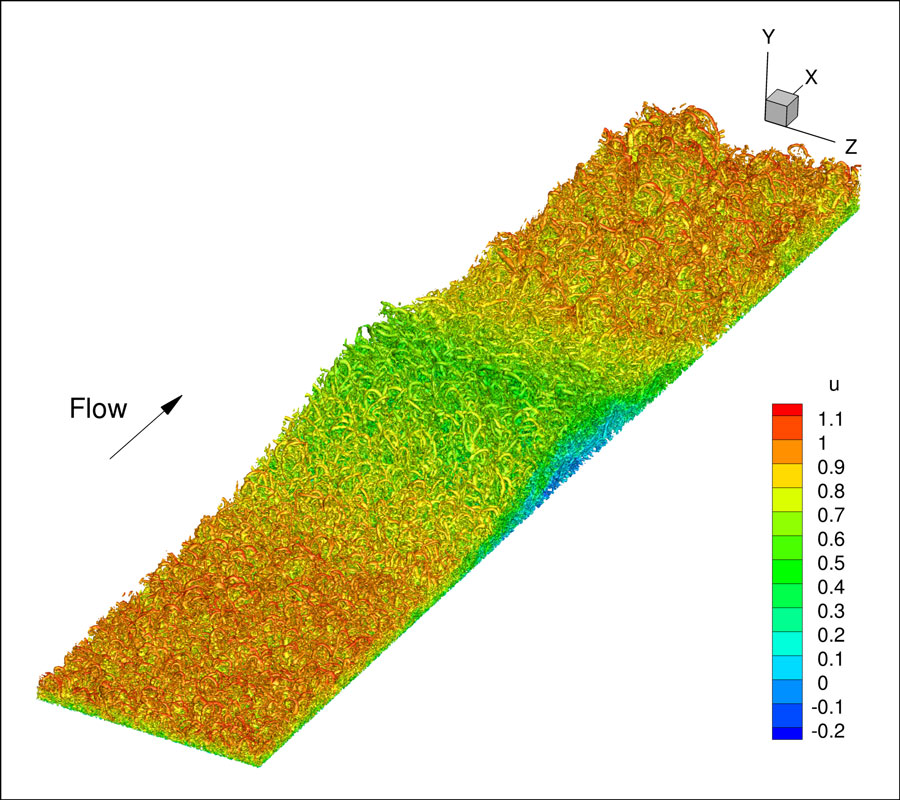
Because turbulent flows are unsteady and contain three-dimensional eddies that range from very large to very small (and from very slow to very fast), this exercise requires the vast amounts of memory and high processor speeds only available via HPC. Without access to HPC—specifically, the Pleiades system at the NASA Advanced Supercomputing facility—the quality and usefulness of this study, measured both in terms of the number of cases and the values of some of their defining parameters (such as Reynolds number and sweep angle), would have been severely compromised. Compared with a similar study we conducted in 1997, the scientific progress made possible by today's HPC capability is considerable.
More Media
See additional images/videos related to this demo in our media gallery.
gary.n.coleman@nasa.gov Christopher L. Rumsey, NASA Langley Research Center
c.l.rumsey@nasa.gov Philippe R. Spalart, Boeing Commercial Airplanes
philippe.r.spalart@boeing.com