
Exploring the Sun through High-Resolution Modeling
Overview
At NASA, we use cutting-edge computer modeling techniques to gain new insights into the dynamics of the sun. With recent advances in computing power, we are able to create more accurate models that can help us predict physical phenomena and give us a better understanding of the interior workings of the sun and the stars.
Our goal is to create global 3D models that bring together many different physical stellar processes so that we can see how they interact on a global scale. We aim to use these models to create accurate solar magnetic cycles in order to better understand the effects they produce and to track their evolution over the stars' lifetime.
Project Details
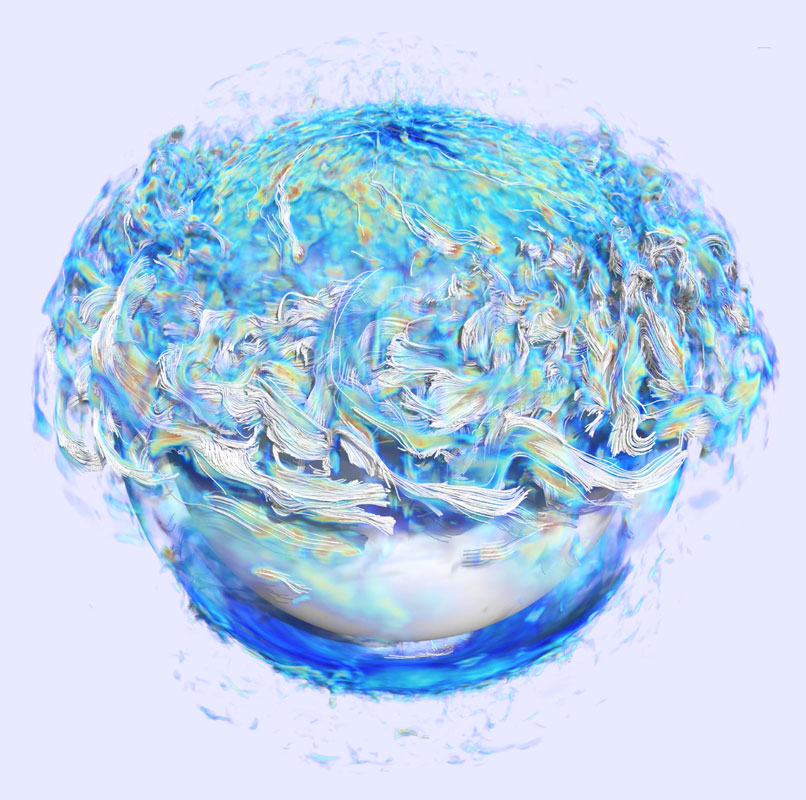
We use techniques in computational fluid dynamics to create global 3D models of the sun. We solve for the mass flows of plasma in and around the convective zone, which is where most of the turbulent motion and flow occurs. In addition, we simulate how these flows generate and sustain a global magnetic field and how this field produces the solar cycle.
With the help of the visualization team at the NASA Advanced Supercomputing (NAS) facility, we use this data to create striking, high-resolution videos of the models. These visualizations give us a chance to gain a deeper understanding of the underlying physics and help us to improve our understanding of elusive solar phenomena.
Results and Impact
Our models generate a magnetic solar cycle that corresponds with our understanding of the sun. We work with data from NASA's Solar Dynamics Observatory (SDO) that records detailed observations on the structure of plasma motion and differential rotation, which we compare to our computational results. We are gaining new insights into how the sun's magnetic field is stored and how it propagates throughout the system. Our high-resolution simulations offer us a greater understanding of how turbulent effects inside of the sun can create magnetic structures at the bottom of the convection zone. These models can also offer great learning opportunities for researchers and students, and can help us to visualize complicated phenomena that are difficult to understand.
Why HPC Matters

High-end computing is an indispensable part of exploring the universe today. At NASA, we use some of the most advanced computing architectures in the world to help solve problems in heliophysics and astrophysics. The NAS facility's Pleiades supercomputer allowed us run incredibly detailed simulations with complicated advection algorithms, which would take years on regular computers. The data that we generate can also be visualized on the NAS hyperwall —giving us an unprecedented look at the structure of these models.
What's Next
We will use this data to further improve our models of the sun until we are able to generate complex and realistic models that can give us a predictive power of solar weather—similar to that of meteorological models that we use on Earth today.
We also plan to extend this work to stellar data collected from NASA's K2 mission—which continues the Kepler mission's search for Earth-size habitable planets—to better understand the star systems of extra-solar planets.
More Media
See additional images/videos related to this demo in our media gallery.
astejko1@ithaca.edu Alexander Kosovichev, NASA Ames Research Center
alexander.g.kosovichev@nasa.gov