
Toward Quieter Skies: New Tools to Predict and Mitigate Airframe Noise
Overview
The Federal Aviation Administration projects significant growth in air travel during the next decade. The resulting expansion in civil aircraft operations will require aggressive mitigation of the environmental impact of associated byproducts, such as aircraft noise, which adversely affect communities surrounding major airports. A prominent component of aircraft noise during landing is noise produced by the airframe. Under the Flight Demonstrations and Capabilities (FDC) Project of the NASA Aeronautics Mission Research Directorate, researchers are working to advance the state of the art in simulation-based airframe noise prediction methodologies. This effort, which is being performed in collaboration with the Boeing Company, focuses on extending high-fidelity simulations to large civil transports. The complexities of the flow field and the size of these aircraft make achieving such simulations the "holy grail" of airframe noise prediction.
During approach to landing, noise generated by the airframe is comparable to, and in some instances even louder than, propulsion noise. For large civil transports, the aircraft undercarriage—in particular the main landing gear—is the most dominant noise source. The extreme geometrical complexities associated with the main landing gear, which is composed of a multitude of subsystems, make this component one of the most challenging configurations for aeroacoustic behavior simulation.
Project Details
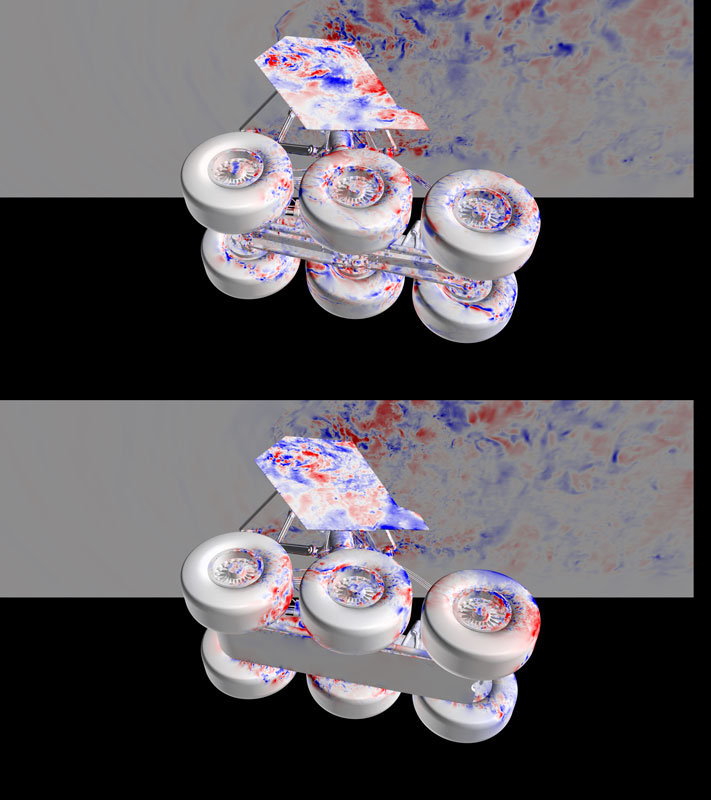
As part of the FDC-Boeing collaboration on airframe noise research, we simulated the airflow over a high-fidelity, 26%-scale model of the Boeing 777 aircraft's main landing gear, both in isolation and as installed on a semi-span model of the aircraft in landing configuration. Our goal was to accurately capture the noise sources associated with the various components of the main gear. Then, we evaluated the effectiveness of a toboggan-shaped noise-reduction device installed on the gear model. The time-dependent simulations were obtained using Exa Corporation’s PowerFLOW Lattice-Boltzmann flow solver. Approximately three billion volumetric cells were used to discretize the space surrounding the main landing gear.
Results and Impact
Our simulations accurately predicted, for the first time, the noise generated by the main landing gear of a large civil aircraft with all of its extreme geometrical complexities included. Simulating the unsteady flow field for the main landing gear of a large aircraft, which is a complex system of systems, was a daunting task. For the isolated gear, the computed farfield noise for flyover and sideline directions is in excellent agreement with wind tunnel measurements of the same model. Adding the toboggan device to the main gear resulted in a 3- to 4-decibel reduction in farfield sound pressure levels over most of the frequency range. Preliminary simulations of the main landing gear installed on the semi-span model indicate that significant interaction occurs between the flows associated with the main gear and high-lift devices.
Why HPC Matters

The large-scale calculations needed to conduct each of our simulations require use of the largest supercomputers. All of the simulations were performed on NASA's Pleiades supercomputer using approximately 4,000 processors. Depending on the nature of the information required, the computational runs could last from two to three weeks, resulting in hundreds of terabytes of data. Rendering and effective visualization of such massive datasets were made possible by members of the NASA Advanced Supercomputing (NAS) visualization team at NASA's Ames Research Center.
What's Next
Our plan is to continue the high-resolution simulations of the 26%-scale semi-span model of a large civil aircraft in landing configuration, with and without the main gear toboggan device installed. Those simulations will pave the way for our future attempt at simulating a full-scale, complete aircraft similar to the Boeing 777 in landing configuration.
Mehdi R. Khorrami, NASA Langley Research Centermehdi.r.khorrami@nasa.gov