
Highly Parallel Radiative Transfer in Stellar Simulations
Overview
The structure and dynamics of stars are key elements to understanding the universe. Since experiments on stars are impossible and observations are restricted to the stars' exteriors, numerical simulations are a primary means of studying them.
Stars function the way they do largely because heat is transferred from point to point within them via light waves. In order to simulate stars, this heat transfer must be properly modeled in combination with other stellar processes—namely fluid flow, gravitational forces, and magnetic field effects. Together, this set of processes is called radiative magnetohydrodynamics (MHD). In our work, we do not directly simulate the nuclear reactions that power stars, but the effect of these reactions is included as a boundary condition specifying the heat flowing upward from the reactions in the stellar cores.
This work supports NASA programs that seek to understand stars in terms of their dynamics, evolution, interaction with planetary systems, and role in the large-scale structure of the universe. The results from and implications of stellar simulations interact closely with observations made using NASA satellites and other space- and Earth-based facilities.
Project Details

Our group has developed two codes for stellar simulation: StellarBox and StellarSegment. StellarBox, our current workhorse code, simulates a small rectangular block of stellar matter that extends a few tens of megameters (Mm) down into the interior and a few Mm up into the stellar atmosphere. StellarSegment, which is a new code still under development, simulates an orange-segment-shaped piece of a star—and potentially the entire star—down to some radius below the surface. Both codes utilize a form of highly accurate radiative transfer calculation that uses "long characteristics," or light rays, that extend in many directions from each point. The computational cost of this type of method can be very high, even dominating the overall runtime; however, by using carefully designed parallel programming algorithms, this cost can be controlled and made commensurate with that of the rest of the simulation.
Results and Impact
By accurately simulating the radiative heat transfer within a star, combined with advanced turbulence modeling and numerical algorithms, we have achieved simulations of solar and stellar dynamics that exceed the detail that can be obtained observationally, even for the sun. Such high resolution has given us many new insights into the processes that make stars behave as they do and has provided new data on how the sun generates its atmospheric dynamics and solar wind. The solar wind interacts strongly with the interplanetary space environment and therefore with spacecraft, human explorers, and Earth's atmosphere and electrical infrastructure—especially during solar storms. For this reason, understanding its origin at the solar surface is particularly relevant to us all.
Why HPC Matters
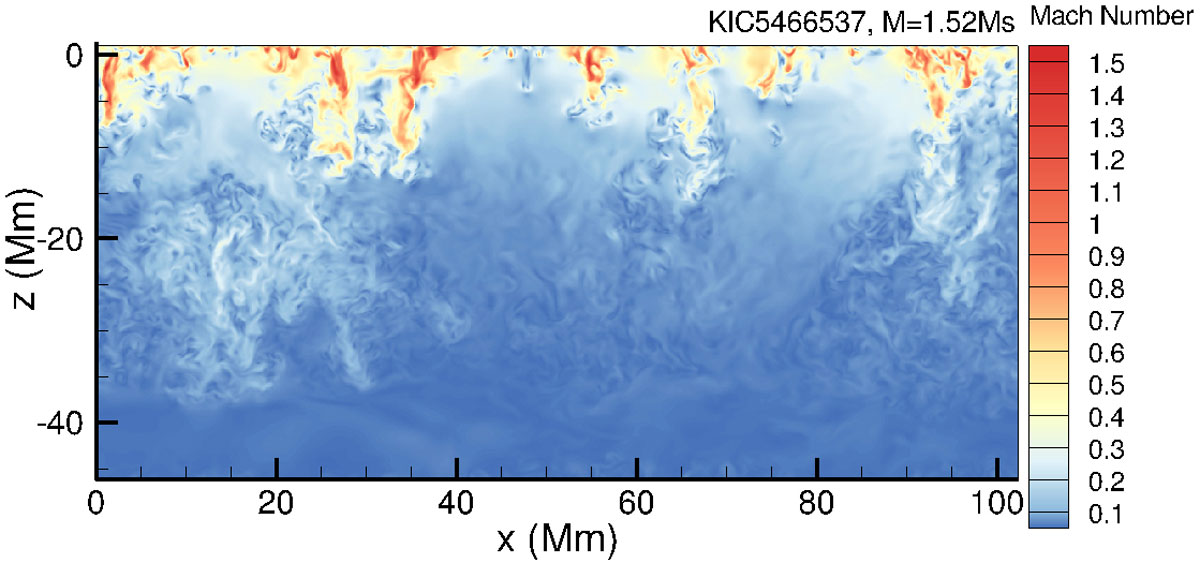
None of this work would be possible without high-performance computing (HPC). However, high performance comes with constraints, sometimes severe, on programming techniques and numerical methods. Through decades of experience with such systems, starting with the Illiac IV in the early 1970s, users have learned to deal with HPC's limitations and exploit its strengths. It is now possible to use tens of thousands of cores to simulate stars at levels of physical detail that make the results highly credible and therefore of great value to the astrophysical community, and ultimately to society in general.
Alan Wray, NASA Ames Research Centeralan.a.wray@nasa.gov