
DeMISTifying Climate Informatics:
Visualizing Tomorrow's Forecasts Today with Web World Wind
Overview
Developing a rapid and more intuitive means of displaying large-scale simulated atmospheric data will help NASA researchers quickly view model output and improve their understanding of our planet's ever-changing weather and climate.
Project Details

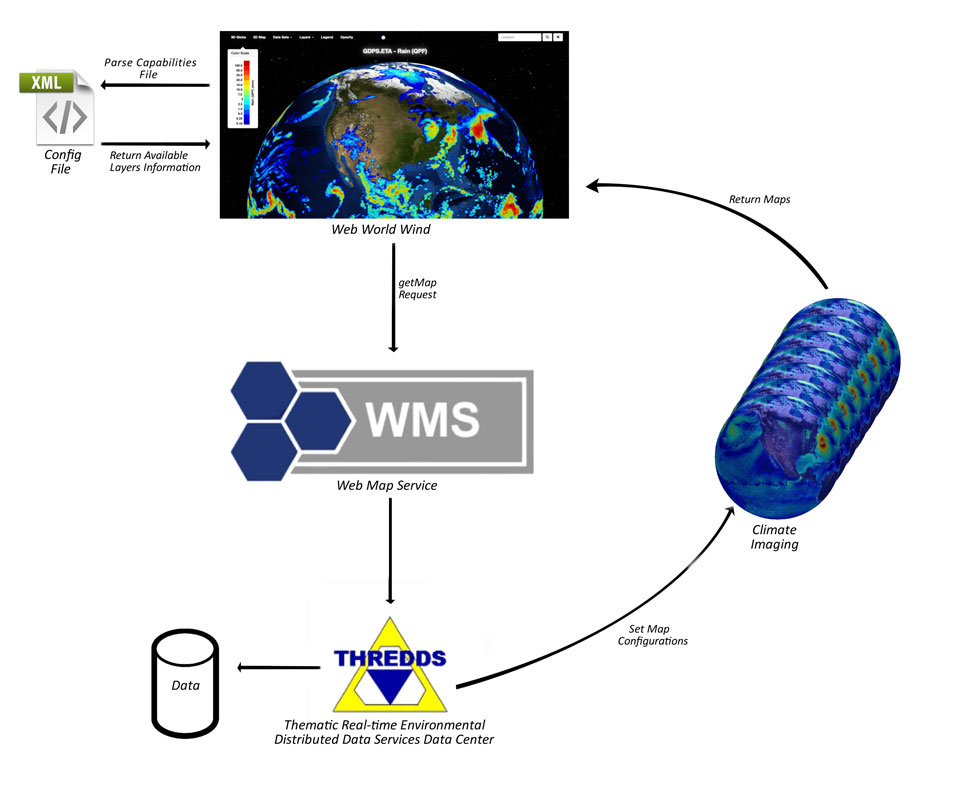
Traditionally, the major hurdle to displaying weather data over a web service has been the shear amount of data, which inhibits interactive visualization through web browsers. To overcome this barrier, the NASA Center for Climate Simulation (NCCS) has developed an instance of Web World Wind (WWW) working in conjunction with the Web Map Service (WMS) and the Thematic Real-time Environmental Distributed Data Services (THREDDS) Data Server to provide a more logical display of climate informatics.
Results and Impact
- Developed by NASA, WWW enables rapid visualization of high-resolution atmospheric data on an interactive 3D virtual globe or a 2D map. Users can easily access the tool through any web browser.
- WWW makes WMS queries to the THREDDS Data Server (TDS), which can store simulation data in various file types and applications, creating a centralized data library that can be easily accessed and interpreted by WMS protocols.
- Currently the WWW displays specific variables from high-resolution forecasts and research runs from NASA's Global Modeling and Assimilation Office (GMAO).
Why HPC Matters
The NCCS has enabled several GMAO datasets to be visualized through the WWW, including the current Forward Processing model that provides a 25-kilometer (km) resolution global forecast over a 7-day period. In addition, the NCCS has worked closely with the GMAO to display both a 12-km downscaled forecast (~300 million grid points) and an experimental 6-km downscaled forecast (~1.2 billion grid points) using updated two-moment microphysics.
What's Next
Future development to the WWW front end will incorporate a vast collection of reanalysis data (MERRA/MERRA-2) that will allow users to display imagery from the past few decades. Together, these tools enable a more readily accessible and intuitive vehicle for understanding Earth's weather and climate.
Ben Bledsoe, NASA Goddard Space Flight Centerbenjamin.c.bledsoe@nasa.gov Dan Duffy, NASA Goddard Space Flight Center
daniel.q.duffy@nasa.gov