Simulating Hypersonic Turbulent Combustion for Future Aircraft
Overview
In the future, the aerospace industry will continue its efforts to make aircraft that fly higher, faster, and more efficiently. This may eventually lead to flight at speeds five times faster than the speed of sound (Mach 5) — or hypersonic flight. A scramjet (supersonic combusting ramjet) engine can fly at these speeds while operating much more efficiently than a conventional rocket. However, these engines are still in the developmental stage, largely because hypersonic flight has a brutal effect on aircraft and reproducing these conditions in wind tunnels is difficult and expensive.

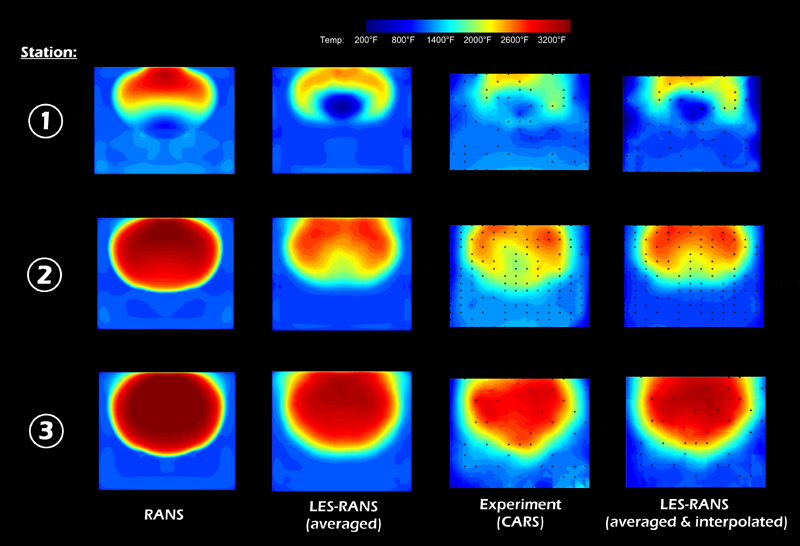
The analysis, design, and optimization of scramjets therefore rely heavily on computational fluid dynamics (CFD). A more accurate way of computing the combusting flow within scramjet engines using CFD is through large-eddy simulation (LES), which directly calculates the larger turbulent eddies (swirls) responsible for mixing fuel and air. In this work, we conducted LES simulations of the reacting flow within a model scramjet tested at the University of Virginia and compared the results with experimental data.
Project Details
For this project we used a LES strategy and REACTMB, a parallelized reactive flow solver developed at North Carolina State University that solves the compressible Navier-Stokes equations governing a chemically reactive mixture of gases. Finite-rate hydrogen-air combustion was modeled through a nine-species/nineteen-reaction mechanism, and the equations were solved and advanced in time using an implicit method. Low-dissipation discretization schemes were used to allow resolution of small turbulent eddies. Results were then compared with experimental data from the University of Virginia's scramjet facility.
Results and Impact
Our research shows that flame stabilization in the model scramjet combustor is a complex process, dependent on the interplay between the relatively fast hydrogen combustion, high mixing rates induced by the injector geometry, and the stretching and distortion of the flame caused by swirling turbulence. The LES methodology is able to capture the latter two effects more directly than the Reynolds-averaged Navier-Stokes methods that are in popular use. We have obtained excellent agreement with experimental temperature, mole fraction, velocity, and pressure measurements, paving the way for the use of LES as a predictive tool for analyzing more complex scramjet combustor designs.
Role of High-End Computing Resources
A single iteration of our code involved simultaneous solution of 13 equations per mesh cell for a grid containing up to 80 million cells. Even for a high-end desktop computer this would be impossible, but with high-performance computing and parallelization, each iteration usually takes under 10 seconds. Our solution required several tens of thousands of iterations to achieve a steady-state solution, completing in just a few days. These computations were carried out simultaneously on hundreds of processors using NASA's Pleiades supercomputer. Each simulation generated 4 to 8 terabytes of data.
Jack Edwards, North Carolina State Universityjredward@ncsu.edu Jesse Fulton, North Carolina State University
jafulton@ncsu.edu