Modeling Weather on the Sun
Overview
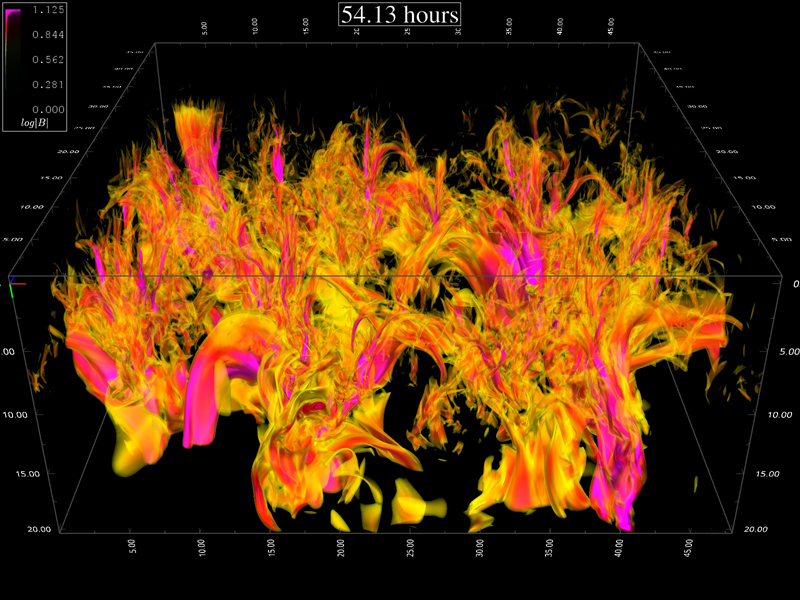
In an approach similar to that used for Earth weather modeling, the Sun's weather is modeled by numerically solving the conservation equations for mass, momentum, and energy plus the induction equation for the magnetic field. This allows us to study the magnetodynamics of the solar surface, especially the emergence of magnetic fields in both the quiet Sun and active regions. It is these magnetic fields, emerging through the solar surface, that control the heating of the solar chromosphere and corona and the eruption of flares and coronal mass ejections.
Project Details
Recently, we have simulated magnetoconvection near the solar surface using the 3D, compressible, magnetohydrodynamic STAGGER code in a Cartesian grid, with the vertical coordinate stretched for finer resolution near the visible surface. A tabular real gas equation of state is used, which includes ionization and excitation of hydrogen, helium, and other abundant elements. Radiative heating and cooling is calculated by solving the non-grey radiation transfer equation with four opacity and emissivity groups using long characteristics.
A uniform, untwisted, horizontal, 1-kilogauss magnetic field is advected into the domain through the bottom boundary at 20 megameters depth—which represents just 10% of the geometric depth of the solar convection zone but two-thirds of its density scale heights—in order to represent the effects of dynamo action in the deeper layers.
Results and Impact
Our simulations show that magnetoconvection acts on large-scale fields produced by dynamos from the lower convection zone and creates a hierarchy of magnetic loops, with smaller ones appearing as serpentine features on the larger loops.
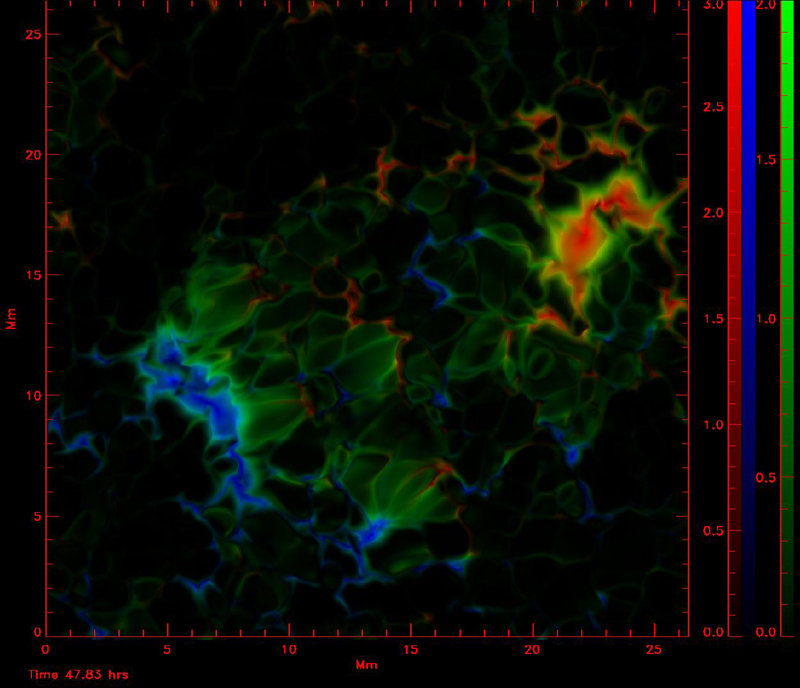
The large loop complexes emerge through the solar surface as active regions. First, mixed polarity fields emerge as small, granule-sized loops over enlarged, elongated granules. Then, opposite polarity fields collect into separate, unipolar concentrations driven by the underlying large-scale field structure to form the active region.
We are evaluating the ability of Inversions of Stokes profiles to obtain accurate 3D magnetic fields by comparing inversions of simulated Stokes spectra that have actual magnetic fields in the calculations. Inversions of weak fields (less than 100—200 gauss) are found to be unreliable due to the complex vertical structure of the magnetic and velocity fields, and exacerbated by the limited resolution of the telescopes.
These simulation results are enabling us to understand and evaluate the data from NASA missions such as the Solar Dynamics Observatory and Hinode.
Role of High-End Computing Resources
These high-fidelity simulations require several million processor hours on NASA's Pleiades supercomputer, which takes months of wall-time even when running on thousands of cores. Without these resources, our simulations would be impossible to produce.
Robert Stein, Michigan State Universitystein@msu.edu