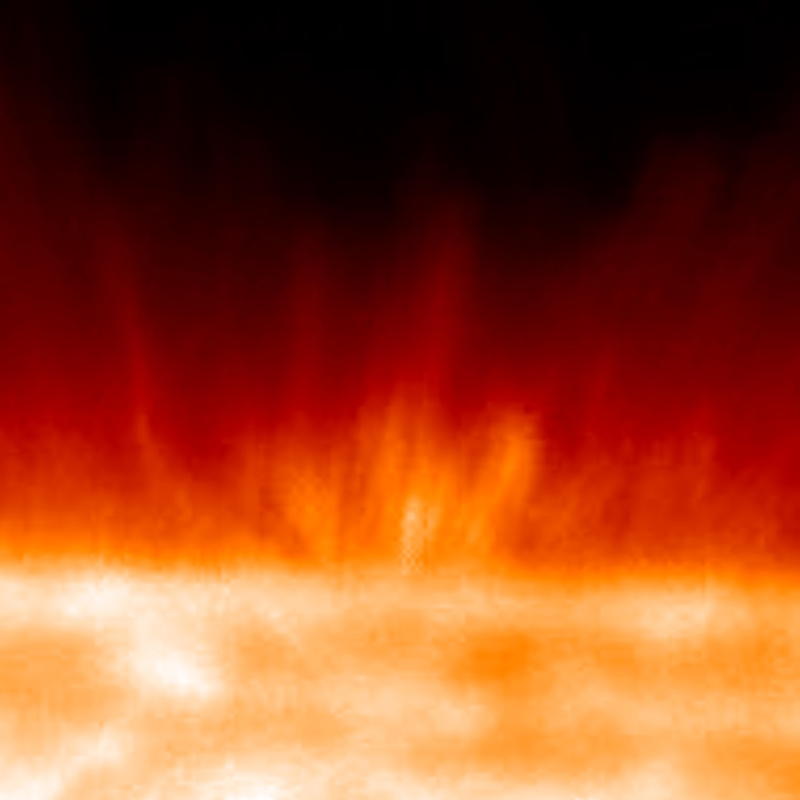
Hot-Plasma Geysers on the Sun
Overview
The Sun is covered by geyser-like plasma eruptions, or "spicules," which provide mass and energy to the million-degree corona and to the solar wind affecting Earth's space environment. Due to their small-scale structure and fast dynamics, these eruptions were not well resolved in observations, and their origin was unknown. By performing realistic, 3D, radiative magnetohydrodynamics (MHD) simulations we were able to reproduce the eruptions, investigate their structure, and uncover the driving mechanism hidden in the turbulent convection zone below the visible surface of the Sun.

Project Details
The simulation domain includes the upper convective boundary layer, photosphere, and chromosphere of the Sun. The mathematical model is based on first principles. It employs Large-Eddy Simulations (LES) of MHD turbulence, as well as a multi-group approximation for radiation transfer. The simulations utilize a parallel "SolarBox" code developed at NASA Ames Research Center. The code runs very efficiently on large numbers (1,000-4,000) of processors.
Driven by the energy flux generated in the Sun's core, the turbulent convection forms granulation cells with high-speed downflow plumes in the intergranular lanes. These overturning and shearing flows below the solar surface form compact, self-organized, turbulent vortex tubes with high-speed swirling flow. The vortex tubes are concentrated in the intergranular lanes and interact with the twisting magnetic field lines that surround them. Finally, in response to the excess pressure that accumulates in the Sun's low atmospheric layers, the magnetized vortex tubes erupt in a manner similar to geyser eruptions.
Results and Impact
Our realistic simulations revealed that the ubiquitous flow eruptions on the Sun are produced by self-organized, magnetized vortex tubes generated by turbulent convection below the visible solar surface. These results help us better understand the mass and energy flowing from the Sun into the heliosphere and Earth's space environment. We also use this knowledge to interpret data from NASA's Solar Dynamics Observatory, from the Hinode and Interface Region Imaging Spectrograph (IRIS) solar missions, and for developing physics-based models of solar dynamics and activity.
Role of High-End Computing Resources
The realistic, radiative MHD numerical simulations require massive computational resources. These simulations were accomplished using the Pleiades supercomputer at the NASA Advanced Supercomputing (NAS) facility, which demonstrated a highly efficient performance for massive parallel computations. The 3D visualization, supported by NAS experts, greatly contributed to the success of this project.
Alan Wray, NASA Ames Research Centeralan.a.wray@nasa.gov Irina Kitiashvili, Stanford University
irina@sun.stanford.edu