Designing Curiosity's Perfect Landing on Mars
Overview
On August 5th, 2012, millions of people around the world watched as the Curiosity rover gently touched down on the floor of Gale Crater. Five hundred thousand lines of sophisticated, interplanetary, autonomous code brought the spacecraft down from a speed of 13,000 kilometers per hour (km/h) at the top of the Martian atmosphere to a complete stop on the planet's surface in just seven minutes. Engineers at NASA's Jet Propulsion Laboratory (JPL) combined their unique entry, descent and landing (EDL) knowledge with thousands of processor hours on several Beowulf clusters to orchestrate the sequence of events that successfully placed this 2,000-pound rover onto the surface of Mars.
Project Details
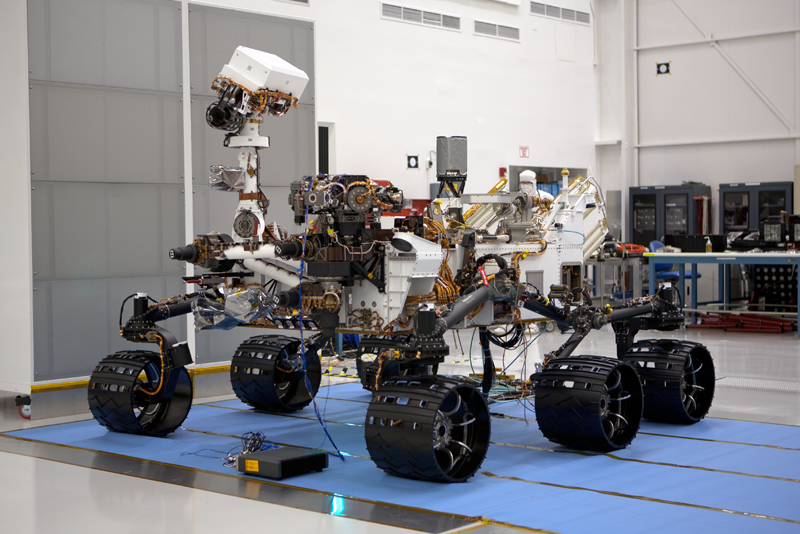
The biggest robotic exploration rover yet, Curiosity carries 10 times more payload in scientific instruments than the Mars Exploration Rovers, making it the most comprehensive Martian geologist ever to rove the red planet. It powers its 17 different cameras, 4 spectrometers, 2 radiation detectors, environment sensor, and atmospheric sensor with a radioisotope thermoelectric generator that produces 110 watts.
After a nine-month journey across 350 million miles, the spacecraft was designed to steer itself using a series of S-curves for a guided entry through the atmosphere. Three minutes from touchdown, the spacecraft parachute decelerated to about 200 mph in an atmosphere that is 100 times thinner than that of Earth. Finally, retrorockets and a sky crane were used to complete the precision landing sequence, touching down inside the smallest Martian landing ellipse ever attempted.
Results and Impact
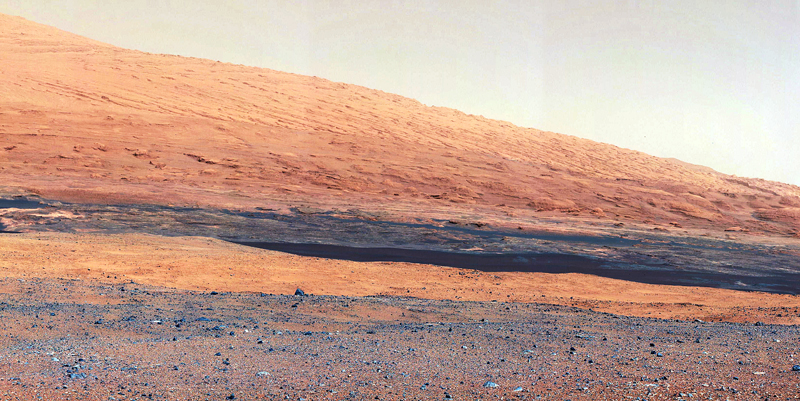
Curiosity's primary science objective is to evaluate whether Mars has ever had, or still has, the necessary environmental conditions to support life. Scientists believe that the alluvial fan on the floor of Gale Crater may have been created by water-carried sediments and may hold the key to answering this question. Mount Sharp's layered formation, rising nearly 6 km above the center of the crater, may contain minerals formed in water that are the building blocks of life. Curiosity has a long journey of discovery ahead, but it has already captivated millions of hearts through its revolutionary achievements in science and technology.
Role of High-End Computing Resources
Sixteen months ago, JPL's EDL team began working with the center's supercomputing team to create the fully customized supercomputing environment necessary to run the complex guided-entry simulations. Innovative version-control and automated-build techniques allowed the teams to re-create any version of the customized environment.
A Monte Carlo simulation ran a series of high-fidelity trajectory integrations that used a unique set of inputs for each embarrassingly parallel simulation. Precision landing with guided entry required that each simulation have 8,001 separate trajectory integrations and 90 minutes of runtime. JPL's supercomputing capabilities allowed the EDL team to dramatically reduce the risk in landing at Gale Crater.
John Grotzinger, Jet Propulsion Laboratory/California Institute of Technologygrotz@gps.caltech.edu Timofey Ovcharenko, Jet Propulsion Laboratory/California Institute of Technology
tima@jpl.nasa.gov