The Mysterious Origin of Stellar Masses
Overview
Most stars have a mass similar to or a few times smaller than that of our Sun. Extreme cases—100 times more or less massive than the Sun—are rare. The classical theory of gravitational instability cannot explain either this characteristic stellar mass or the wide spread of values between the extreme cases.
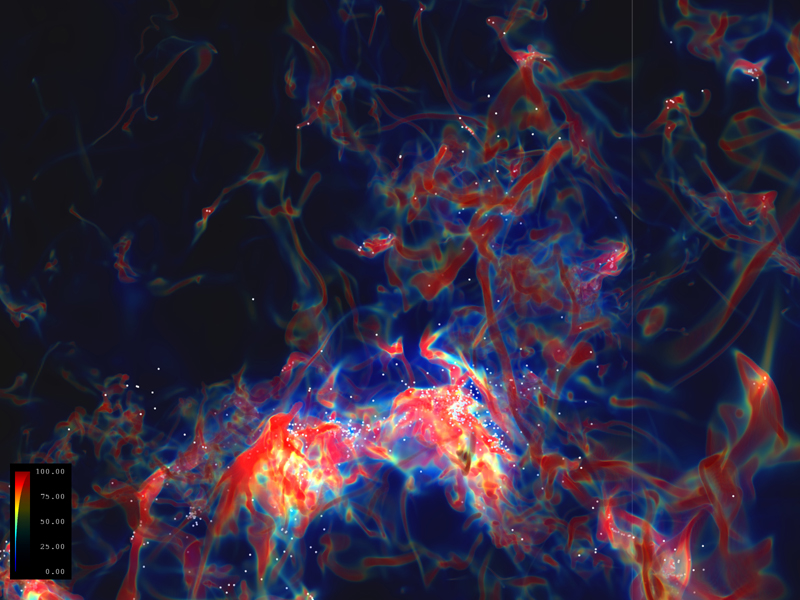
The key to this problem is the turbulent nature of stellar "nurseries"—cold clouds consisting primarily of molecular hydrogen, characterized by violent internal motions many times the speed of sound. Through the effect of strong shocks, this supersonic turbulence results in a complex network of dense filaments, where the observed stars are formed.

Using NASA's fastest supercomputer, we have carried out the largest simulations to date of star-forming clouds, capable of capturing the full range of stellar masses.
Project Details
We use a heavily modified version of the publicly available adaptive-mesh-refinement code Ramses, which allows us to run simulations effectively on a large portion of the Pleiades supercomputer at NASA Ames Research Center. By focusing the computational resources on the densest regions of the clouds, with the adaptive mesh refinement method we achieve a maximum resolution covering five orders of magnitude in linear size; for example, from 10 parsecs to 10 astronomical units (AUs) (one AU is equal to the average distance between the Sun and Earth).
Our simulations yield the full range of stellar masses, from a small percentage of a solar mass to almost one hundred solar masses. They also reproduce the observed probability distribution of stellar masses.
Results and Impact
Our simulations allow us to test theoretical models of star formation that are necessary to understand the formation of galaxies. They explain the process that assembles the mass of stars and shed new light onto the early phases of star and planet formation.
Each simulation results in the formation of thousands of stars, providing very large statistical samples of the initial conditions for both protoplanetary disks around normal stars and gas accretion around massive stars. Such simulated initial conditions can be used to make predictions and interpretations for the observations of space- and ground-based observatories.
Role of High-End Computing Resources
Thanks to the Pleiades supercomputer, we have achieved the largest star-formation simulations to date, using thousands of processors. NASA's large shared-memory machines and massive online disk storage systems have provided us with a powerful environment for data analysis that is crucial to extracting scientific results from these simulations.
In addition, scientific visualizations carried out by experts at the NASA Advanced Supercomputing (NAS) facility have provided deeper insight into the structure and evolution of the modeled star-forming regions.
Paolo Padoan, Catalan Institution for Research and Advanced Studies, Institute of Cosmos Sciences, University of Barcelonappadoan@icc.ub.edu