Modeling and Simulation Support for NASA's Next-Generation Space Launch System
Overview
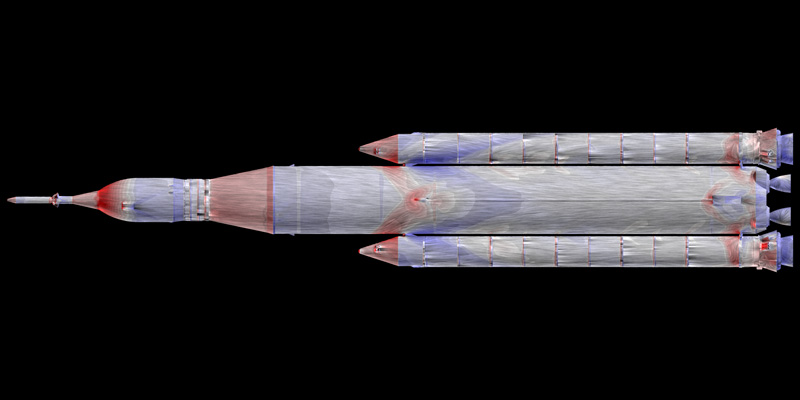
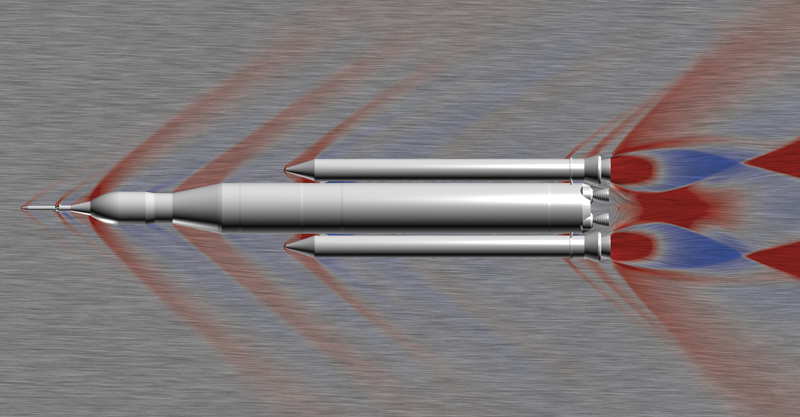
Researchers in the NASA Advanced Supercomputing (NAS) Division at Ames Research Center are performing computational fluid dynamics (CFD) simulations to support the design of NASA's next-generation launch vehicle, the Space Launch System (SLS). Support includes characterizing the aerodynamic performance of the vehicle for a suitable ascent trajectory, determining the distributed aerodynamic line loads along the vehicle for structural analysis, and providing surface pressure signatures to assist in the design of venting methods for vehicle components.
Project Details
During the early design period, focus is placed on the stability and control of the SLS during ascent and on maintaining structural integrity throughout the mission. Characterization of the aerodynamic environments plays a key role in providing the necessary inputs for the Guidance, Navigation, and Control and Structural Loads teams. In order to determine these environments before the vehicle is built, CFD simulations of candidate SLS designs are performed at select points over the ascent trajectory and at multiple angles of attack. The integrated and distributed aerodynamic loads on the vehicle are then extracted from the CFD solutions and provided as input data for trajectory and structural analyses that are used to improve the vehicle's design.
In addition to helping designers modify the exterior shape and the interior structural components of the SLS, information about surface pressure occurring over specific vehicle components helps engineers on the Venting team determine proper placement of vents along the vehicle.
Results and Impact
CFD simulations were used to aid in critical design decisions for SLS very early in the design cycle when wind tunnel data was not yet available. The ongoing modeling and support effort is making a large impact on important design decisions including:
- Downselection from several vehicle shapes
- Outer mold line of the vehicle
- Structural analysis of the core stage and protuberances
- Hinge moment analysis of core stage main engines
CFD support for the SLS will continue to advance as the vehicle matures, and will influence booster separation analysis as well as core-stage fairing and main engine layout.
Role of High-End Computing Resources
The use of NAS facility resources enables fast and efficient turnaround time for CFD simulation support of the SLS. The Pleiades supercomputer allows us to generate viscous databases including several hundred simulations in under a week, using 300 cores and 40 hours of wall-clock time per simulation.
Cetin Kiris, NASA Ames Research Centercetin.c.kiris@nasa.gov