Turbulent Life of Kepler Stars
Overview
NASA's Kepler mission has discovered a whole new world of extraterrestrial planets and variable stars. A recent, surprising finding is that in shallow envelopes of massive stars, the heat flowing from the stars' energy-generating cores to their outer layers drives vigorous turbulent convection, or "boiling," which causes significant fluctuations in brightness as well as stellar pulsations.

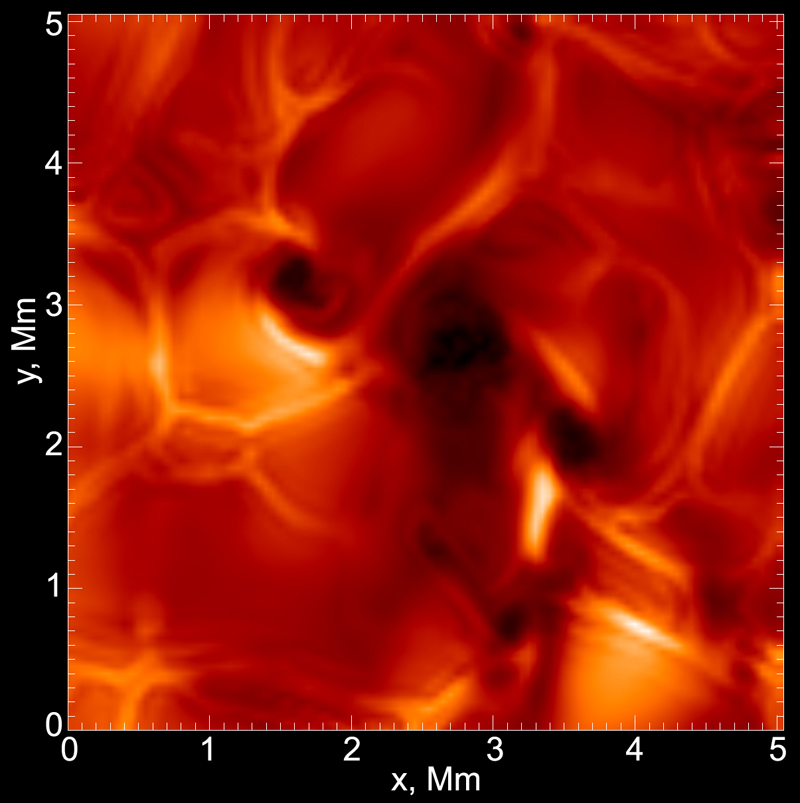
Because of the great distances between the Earth and these stars, their surfaces cannot be resolved in observations, and the only way to learn about their surface structure and dynamics is by using numerical simulation methods. Our simulations have provided the first detailed view of the turbulent surface of the planet-hosting stars that are more massive than the Sun, and have allowed us to discover the mechanisms of sound waves emitted by the stars.
Project Details
Stellar turbulence simulations were performed using the 3D hydrodynamics code "StellarBox," developed at NASA Ames by Alan Wray and Nagi Mansour. The code employs the high-order Padé finite-difference scheme and large eddy simulation subgrid-scale models to obtain an accurate description of the stellar turbulence and acoustics. The simulations were performed for several Kepler target stars in the mass range from 1.05 to 1.7 solar masses, using standard hydrostatic stellar evolutionary models for the initial conditions.
Results and Impact
The simulations revealed that the surface convective layers on the target stars are much more dynamic and turbulent than those on the Sun. Because of their higher luminosity, the turbulent energy transport drives supersonic turbulence and strong acoustic emission. The stellar granulation cells are bigger than the solar granulation, and are often accompanied by high-speed downward plumes rarely seen on the Sun.
The most interesting phenomenon is formation of large-scale turbulent vortices on the stars' surface, which generate sound waves. These waves form global resonant acoustic modes discovered for this type of stars by the Kepler mission. The strong turbulence and acoustic emission found in these simulations are likely to energize the stellar winds and may lead to profound effects on planets around these stars.
Role of High-End Computing Resources
The radiative hydrodynamics numerical simulations of the stellar turbulence were performed using 2,000–4,000 processors on the Pleiades supercomputer at the NASA Advanced Supercomputing (NAS) facility. This high-end computing system demonstrated the highly efficient performance needed for our massive parallel computations. 3D visualization support was provided by NAS visualization team experts.
Nagi Mansour, NASA/Amesnagi.n.mansour@nasa.gov Alexander Kosovichev, Stanford University
sasha@sun.stanford.edu