
Parametric Studies of Asteroid Impact Scenarios
Overview
As they decelerate through the atmosphere, meteors transfer mass, momentum and energy into the surrounding air at literally astronomical rates. The violent entry of such bodies produces strong blast waves that can propagate hundreds of kilometers and cause substantial damage on Earth even when no ground impact occurs. NASA’s Asteroid Threat Assessment Project (ATAP) seeks to quantify the risk from such phenomena through a combination of observational data, high-fidelity simulations, and probabilistic risk modeling. Uncertainties in entry conditions and asteroid composition are accounted for using fast-running Monte Carlo tools, anchored with large, computationally intensive parametric studies of hypothetical cases that are run using high-fidelity computational fluid dynamics (CFD) simulation tools like Cart3D, DPLR, and ALE3D.
ATAP’s goal is to provide a comprehensive risk modeling and hazard simulation framework for potentially hazardous asteroids. This framework, which includes modeling entry, airbursts, and surface impacts along with blast, tsunami, and seismic propagation, supports the formulation and validation of engineering methods needed for accurate and efficient probabilistic risk assessment. This simulation-based risk analysis enables ATAP to appraise the NASA Planetary Defense Coordination Office of potential hazards posed by near-Earth objects.
Project Details

To develop engineering models appropriate for use with the fast-running probabilistic risk assessment tools, the ATAP team conducts parametric studies with the high-fidelity CFD tools to understand how meteoroid size, composition, and entry conditions affect the ground footprint. The team recently extended the Cart3D high-fidelity simulation package to enable numerical modeling of entry, airburst, and water or ground impacts. Since ocean impacts are statistically more probable, this tool has also been coupled with the GeoClaw tsunami propagation model to investigate the threat of asteroid-generated tsunamis. Ground damage estimates and tsunami simulations are driven by long-distance blast simulations that track the shock waves from the entry corridor across hundreds of kilometers, through the atmosphere and over the landscape.
Results and Impact
Airburst, impact and long-range blast simulations conducted by the ATAP team have resulted in a much better understanding and characterization of the ground footprint that governs the damage potential of asteroid entry. For example, a recent parametric study examined the effects of the angle of entry and the composition of asteroids on the shape and eccentricity of the ground footprint. Similarly, simulations of entries over terrain were used to quantify how local topography can amplify the high wind and overpressure, which drive damage estimates. One important result revealed by the modeling is a better understanding of asteroid-generated tsunami, which is now understood to pose less risk than was previously believed.
Why HPC Matters
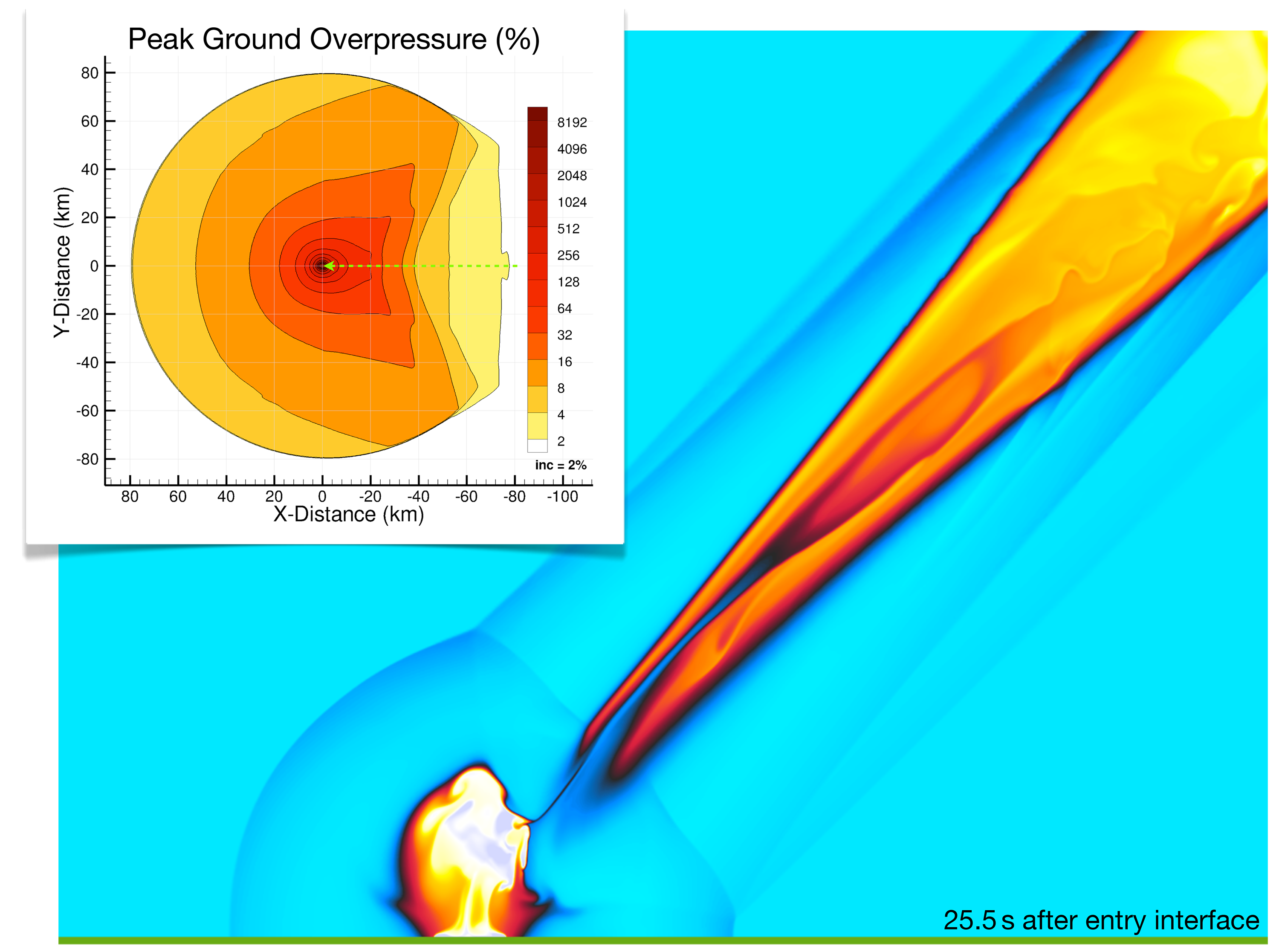
The simulations are run on the Electra supercomputer at the NASA Advanced Supercomputing (NAS) facility. Individual cases use up to 8,000 cores of Intel Xeon Skylake processors, and simulations with over a billion degrees of freedom are completed in less than a day. The large capacity of Electra is critical for enabling the parametric ensembles of CFD simulations that feed ATAP’s probabilistic risk analysis—which is also critically dependent on high-performance computing (HPC). While the risk tool uses pre-computed data and models provided by the CFD to quickly evaluate a particular damage scenario, tens of millions of such evaluations are required for statistically meaningful characterization of risk on a global scale. Such modeling is only possible with large-scale HPC.
More Information
- Cart3D Simulation Software
- NASA Planetary Defense Coordination Office
- SDT 2017: Update to Determine the Feasibility of Enhancing the Search and Characterization of NEOs (PDF)
- Scientists Use Supercomputers to Predict Asteroid Damage on Earth
- Simulation-based height of burst map for asteroid airburst damage prediction
- See the poster for this demonstration (PDF, 2.2MB). As shown in the NASA booth at SC18.
michael.aftosmis@nasa.gov Marian Nemec, NASA Ames Research Center
marian.nemec@nasa.gov