
Aircraft Noise Reduction Technologies Come In for a Landing
Overview
The noise produced by civil aircraft during takeoff and landing is a source of public annoyance for communities near major airports. To address this, a long-term goal of the NASA Aeronautics Research Mission Directorate is to ultimately confine aircraft noise to within airport boundaries. When a modern airplane is landing, most of the noise heard on the ground is produced by airframe components such as landing gear, and wing flaps and slats. With today’s supercomputers, we can create virtual models of landing aircraft and use them to develop and evaluate viable airframe noise reduction technologies. This approach may significantly reduce the cost of experimental tests by identifying the best performers prior to hardware fabrication.
In support of NASA’s Integrated Aviation Systems Program Flight Demonstrations and Capabilities (FDC) project, we are working to make simulation-based, system-level airframe noise prediction tools integral and complementary elements of any airframe noise flight test—a paradigm shift in the development of airframe concepts from the current time-consuming, costly, cut-and-try approach to a physics-based virtual design environment.
Project Details

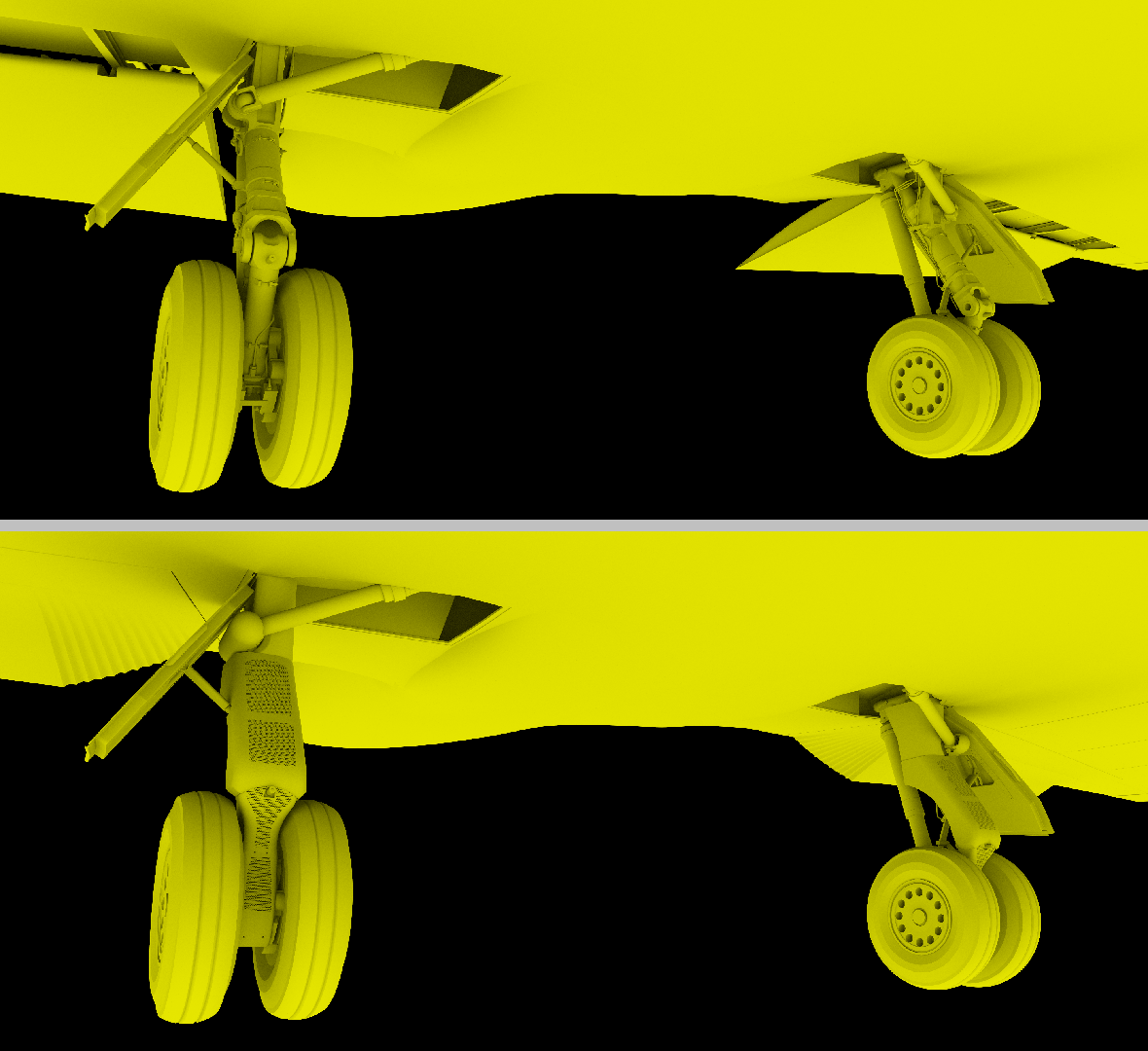
Our simulations were performed in support of an extensive flight test campaign conducted under the FDC project. The tests evaluated the aeroacoustic performance of wing flap and main landing gear (MLG) noise reduction technologies as installed on a Gulfstream III (G-III) aircraft. The technologies tested were an Adaptive Compliant Trailing Edge (ACTE) flap that replaces the existing flap system on the test aircraft, and a set of porous fairings and other smaller fairings fitted around the flow-facing components of the MLG.
We used Exa Corporation’s PowerFLOW Lattice-Boltzmann flow solver to perform these high-fidelity, full-scale, time-accurate simulations. The geometric complexities that characterize the complete aircraft in landing configuration required a very large computational mesh—17 billion volumetric cells—for discretization of the space surrounding the aircraft surfaces and simulation of the flow interactions caused by these surfaces.
Results and Impact
The high-fidelity simulations were indispensable to the flight test campaign in two ways. First, they were used to tailor and retrofit the gear fairings into the main landing gear of the NASA test aircraft. The fairings, originally developed for the larger Gulfstream V aircraft, had to undergo significant design alterations to fit into the smaller G-III. Each major design change was followed by a virtual assessment of the full-scale, redesigned fairings to ensure that their noise reduction effectiveness was not compromised.
The simulations also contributed to the success of the flight test campaign by providing the capability to conduct system-level, full-scale evaluations of the noise reduction hardware prior to the test. The insights gained from the simulated results helped reduce the risk of test non-completion, since only the conditions and configurations that yielded better acoustic performance were considered. Moreover, this integrated and synergistic execution of the flight test and simulations enabled us to directly compare measured and simulated aeroacoustic results to validate the predictions and determine the strengths and shortcomings of our computational methodology.
Why HPC Matters
Simulating the extreme geometric complexity of a full-scale, complete aircraft in landing configuration requires the use of very large computer clusters. For this study, all computations were performed on NASA’s Pleiades supercomputer. Our finest resolution simulations required 8,000 to 10,000 processors and 7 million processor-hours, and generated 50 – 60 terabytes of data per case. Rendering and visualization of these large datasets were made possible by NASA Advanced Supercomputing Division’s visualization team.
More Information
- See the poster for this demonstration (PDF, 1.9MB). As shown in the NASA booth at SC18.
mehdi.r.khorrami@nasa.gov