
Simulating Swirling Disks of Matter Around White Dwarf Stars
Overview
Rotating disks of matter around gravitating objects are a fundamental component of many astronomical sources observed by NASA space telescopes. Such disks around young stars are the sites of active formation of new planets. Disks around stellar-mass black holes and neutron stars are powerful sources of high-energy particles and radiation, and radiation from disks around supermassive black holes even affects the formation and evolution of galaxies over cosmic time. Disks are also observed around white dwarf stars, which often undergo outbursts every few months or so, and exhibit all sorts of periodic and aperiodic variability on shorter time scales. This variability is shared by the other systems as well, but often on time scales that are too long for human beings to observe. Moreover, white dwarf disks are sufficiently compact that now, for the first time, modern supercomputers are powerful enough to simulate their entire global structure, including the physics of magnetized turbulence and the radiation we observe—making them ideal model systems to explore in order to help understand how all other classes of disks work.
Project Details
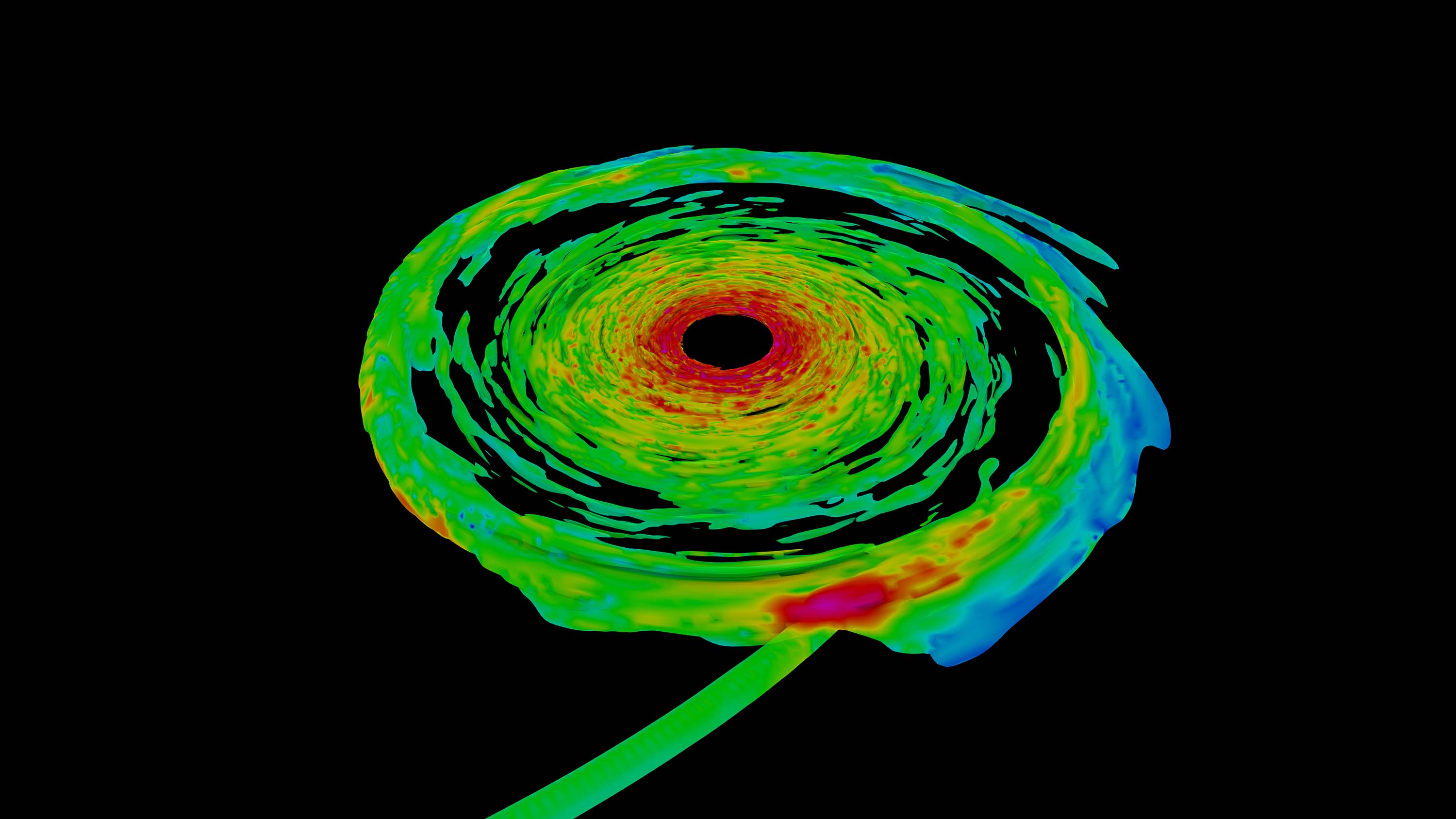
We have begun by directly simulating a particular white dwarf binary system (KIC 004547333) that has been observed for several years by the NASA Kepler spacecraft, and which shows very interesting variability. We created a magnetized stream that leaves the surface of the companion star (which is actually outside the simulation domain). This stream goes into orbit around the white dwarf star and forms a ring that slowly spreads out into a disk. As more and more mass is fed into the disk from the stream, the disk spreads out, releasing energy that is converted into radiation. In the future, we intend to change the mass feeding rate and magnetic field topology to see how the disk structure changes.
Results and Impact
Our first simulation shows some very interesting dynamics. The orbits in the interior of the disk are slightly non-circular, and the orbits in the exterior of the disk tilt out of the orbital plane of the binary system. These two components precess, or wobble, like a top, but in opposite directions, providing a nice explanation for so-called positive and negative “superhump” periods that are commonly observed in many binary systems—including in the NASA Kepler observations of this particular binary system. We need to understand why these structures are forming in the simulation, and whether they produce enough light variations to explain the Kepler observations. This will enable us to finally understand the true physical origin of this class of variability in binary systems.
Why HPC Matters

NASA HPC resources are ideally suited to our radiation magnetohydrodynamics code, Athena++. We run our production simulations on the Pleiades supercomputer’s Intel Xeon Broadwell nodes with 5,000 to 10,000 cores. Each run requires approximately 10 million processor-hours to complete, and generates some 40 terabytes of data. The biggest challenge is then to analyze and visualize this data to understand the fundamental physical processes driving the complex, dynamical disk behavior in the simulation, and then correlate that to actual NASA observations. Visualization experts at the NASA Advanced Supercomputing facility have been enormously helpful in creating high-resolution movies of the data that accentuate the physics.
What's Next
Once we understand the basic dynamics of our simulations, we will post-process the data to generate light curves and spectra, and compare them directly to observations by NASA space satellites and ground-based observatories. In several years, it should even be possible to go to low enough mass feeding rates that we trigger a transition from ionized helium to neutral helium atoms in the disk. This is thought to drive massive outbursts in these disks, and simulations of such outbursts would be a crucial step forward in fully understanding their origin.
More Information
- See the poster for this demonstration (PDF, 1.8MB). As shown in the NASA booth at SC18.
blaes@physics.ucsb.edu Yan-Fei Jiang, University of California at Santa Barbara
yanfei@kitp.ucsb.edu