
Predicting Aircraft and Spacecraft Acoustics
Overview
Steady-state Reynolds-averaged Navier-Stokes aerodynamic analysis has been the workhorse for the design of aerospace vehicles over the last 20 years. But this approach can provide only limited information for unsteady flows and acoustic vibrations. Scale-resolving methods fill this gap, but are very computationally expensive. Experts in the NASA Advanced Supercomputing (NAS) Division at NASA’s Ames Research Center developed the Launch Ascent and Vehicle Aerodynamics (LAVA) simulation suite to increase the computational efficiency of scale-resolving simulations enough to improve the design phase of NASA’s next-generation concept aircraft and space vehicles. To reach this level of computational efficiency, the LAVA team has added another level of parallelism (tiling) to the suite, and is working on enabling the use of new hardware architectures like GPUs. We also developed a new Lattice-Boltzmann solver that can be an order of magnitude faster per time step compared to traditional approaches. LAVA results have already impacted the design of the launch pad flame trench at NASA’s Kennedy Space Center (KSC), the Orion launch abort vehicle, and future urban air mobility (UAM) vehicles.
Project Details
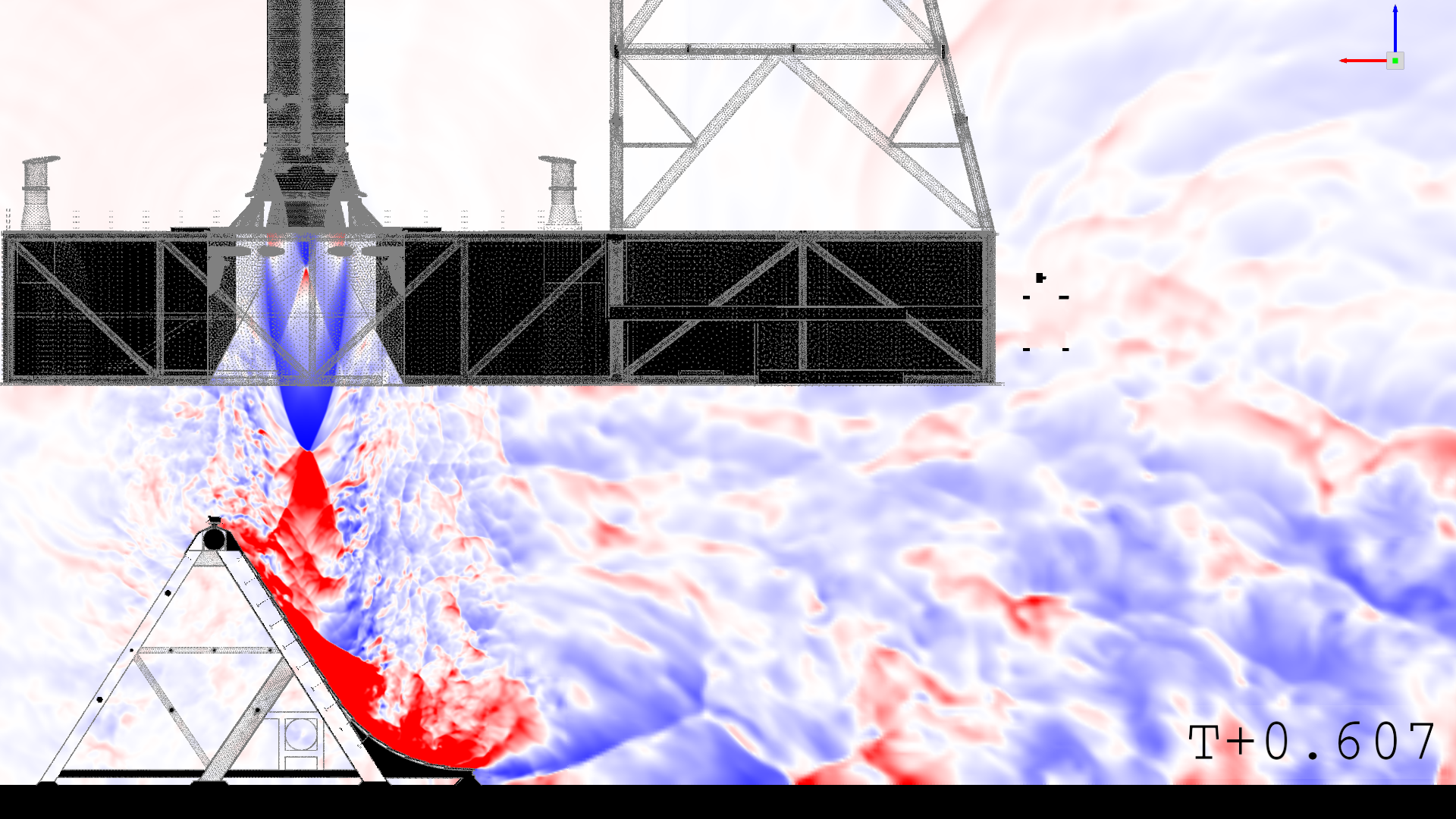
We used the Cartesian Navier-Stokes (CNS) paradigm within LAVA to predict the pressure environment during launch of NASA’s next-generation Space Launch System (SLS) at the newly redesigned launch pad at KSC. LAVA’s CNS solver was also used to predict transient and acoustic loads on the Orion spacecraft for a number of launch abort scenarios. Acoustic predictions showed good agreement with abort motor ground safety test measurements and wind tunnel tests.
In addition, using a revolutionary Lattice-Boltzmann approach, LAVA predicted aerodynamic noise from a first principles approach for a single-rotor, drone-sized propeller. Reducing time-to-solution without compromising accuracy within the context of propeller noise prediction is a key enabling technology for several emerging applications, such as UAM vehicles that currently rely on semi-empirical approaches. This project also represents another step towards advancing NASA Ames’ expertise in the Lattice Boltzmann approach and improving the NAS Division’s in-house Lattice Boltzmann solver.
Results and Impact
Recent success in predicting noise levels for aircraft and acoustic loads for spacecraft demonstrate the LAVA framework’s powerful capabilities. LAVA paves the way for the inclusion of more computational aeroacoustics (CAA) analysis in the design of future aircraft and spacecraft. The LAVA team’s work has already impacted the requirements for the final design of both the KSC launch pad and the Orion launch abort vehicle. The computational efficiency of the Lattice-Boltzmann approach will also enable larger-scale, more accurate airframe and fan noise computations than were previously possible.
Why HPC Matters
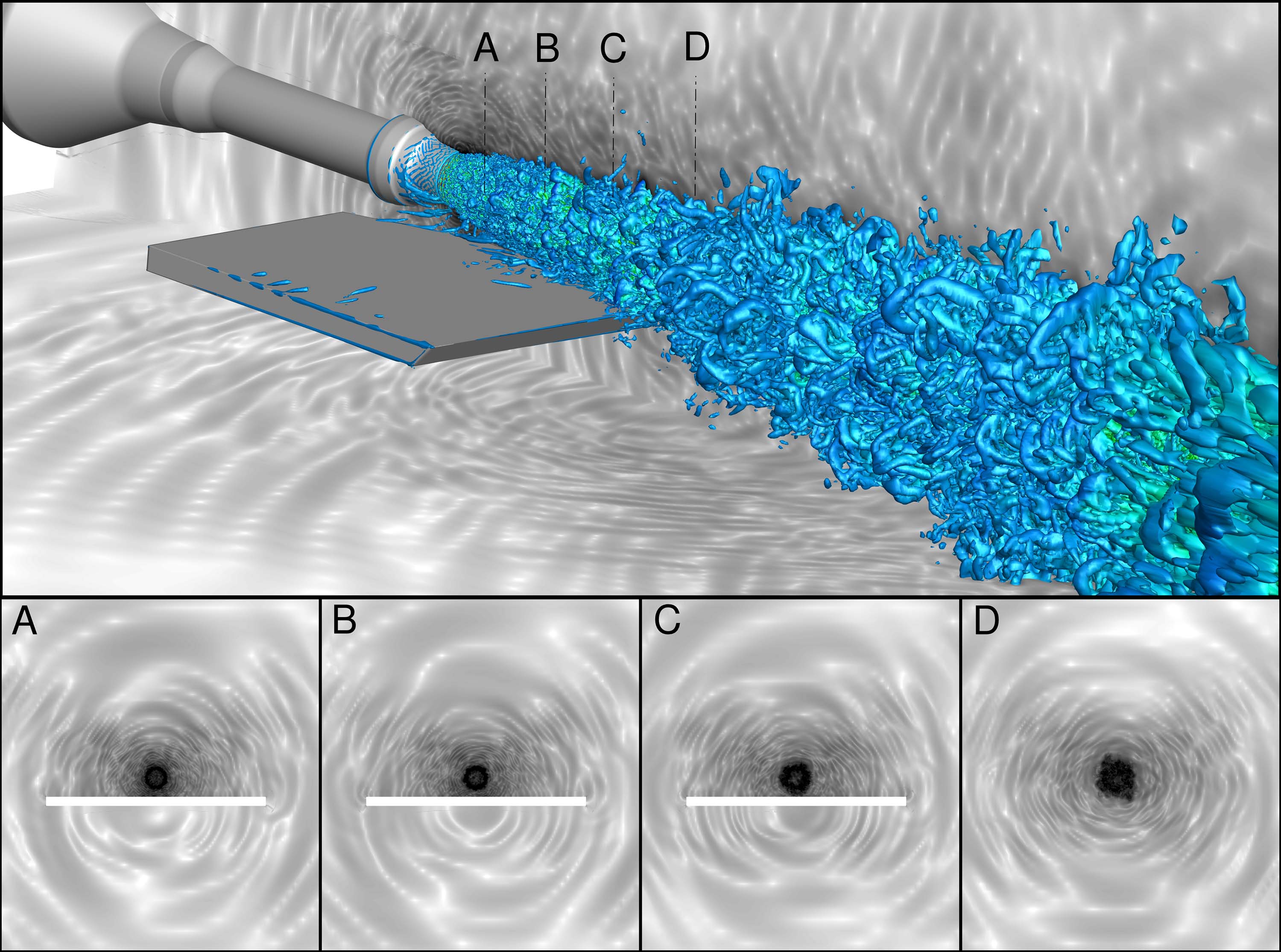
NASA’s Pleiades and Electra supercomputers are instrumental in enabling these next-level, large-scale CAA simulations over hundreds of nodes and thousands of cores. Each simulation generates very large datasets (hundreds of terabytes). The data is then analyzed in the frequency domain, which requires parallelized post-processing tools that hide the cost of accessing data on disk. Raw computational power is not enough—large and efficient distributed filesystems are also critical. In addition, NASA’s visualization services help us go beyond what traditional data analysis tools offer.
More Information
- Orion Launch Abort System Fact Sheet (PDF)
- Jet Noise Prediction using Hybrid RANS/LES with Structured Overset Grids
- Launch Abort Motor Qualification Motor 1 (QM-1) Static Test video (Orbital ATK)
- Helping Keep Astronauts Safe with Advanced Simulations, Visualizations
- Lattice Boltzmann and Navier-Stokes Cartesian CFD Approaches for Airframe Noise Predictions
- See the poster for this demonstration (PDF, 1.8MB). As shown in the NASA booth at SC18.
cetin.c.kiris@nasa.gov