
Hypervelocity Sampling of Venus’ Noble Gases
Overview
Cupid’s Arrow is a small satellite probe mission concept that would determine the amount of noble gases and associated isotope ratios in Venus’ atmosphere. Noble gases act as tracers of the evolutionary process of planets, since their concentration ratios can be correlated to various planet-formation processes, such as indicating the original supply of volatiles from the solar nebula, delivery of volatiles by asteroids and comets, escape rates of planetary atmospheres, as well as the degassing of a planet’s interior and its timing in a planet’s history. Performing high-fidelity noble gas measurements in the Venus atmosphere would provide the required information to understand why Earth and Venus have diverged in their geological evolution¬—a critical piece of information scientists need to better assess whether a terrestrial exoplanet is Earth-like or Venus-like.
Project Details

Cupid’s Arrow is a small spacecraft skimmer that would sample Venus’ atmosphere below the homopause, where the different atmospheric compounds are well mixed. Four samples of the atmosphere would be acquired at periapsis (the point in orbit where the satellite will orbit closest to the planet), then noble gas concentrations for each sample would be determined using a miniaturized Quadrupole Ion Trap Mass Spectrometer (QITMS) aboard the spacecraft. Velocity at periapsis is expected to be 10.5 kilometers per second, and the altitude is expected to be 110 km. One potential issue with this mission architecture is whether or not a sample collected by the spacecraft would be representative (compositionally) of Venus’ atmosphere. Due to the high velocity of the spacecraft and associated high enthalpy of the flow, complicated thermodynamic and fluid mechanical processes will occur around the spacecraft and associated sampling system. Therefore, it should be demonstrated that elemental and/or isotopic fractionation processes do not significantly alter the relative concentrations of the gas to be measured by the QITMS. In order to address this, both experimental and modeling work is being performed.
Results and Impact
We used the Direct Simulation Monte Carlo (DSMC) code SPARTA, an open-source software package developed by Sandia National Laboratories, for this work. Since SPARTA, a molecular-level gas-kinetic technique, is able to model hypervelocity reacting flows in strong chemical and thermal non-equilibrium, this software package is well suited to determine relevant flow properties for Cupid’s Arrow, and to numerically investigate the possibility of elemental and/or isotopic fractionation in the sampled gases. Preliminary simulations have been run for simplified spacecraft and sampling system geometries in both 2D axisymmetric and full 3D configurations. Our preliminary results show that while there is no significant isotopic fraction for xenon or argon isotopes, the total ratio of argon to xenon does change throughout the domain. Additional simulations are being performed in order to investigate the sensitivity of the numerical results to a wide range of parameters. Our results will also help inform the overall spacecraft and sampling system design.
Why HPC Matters
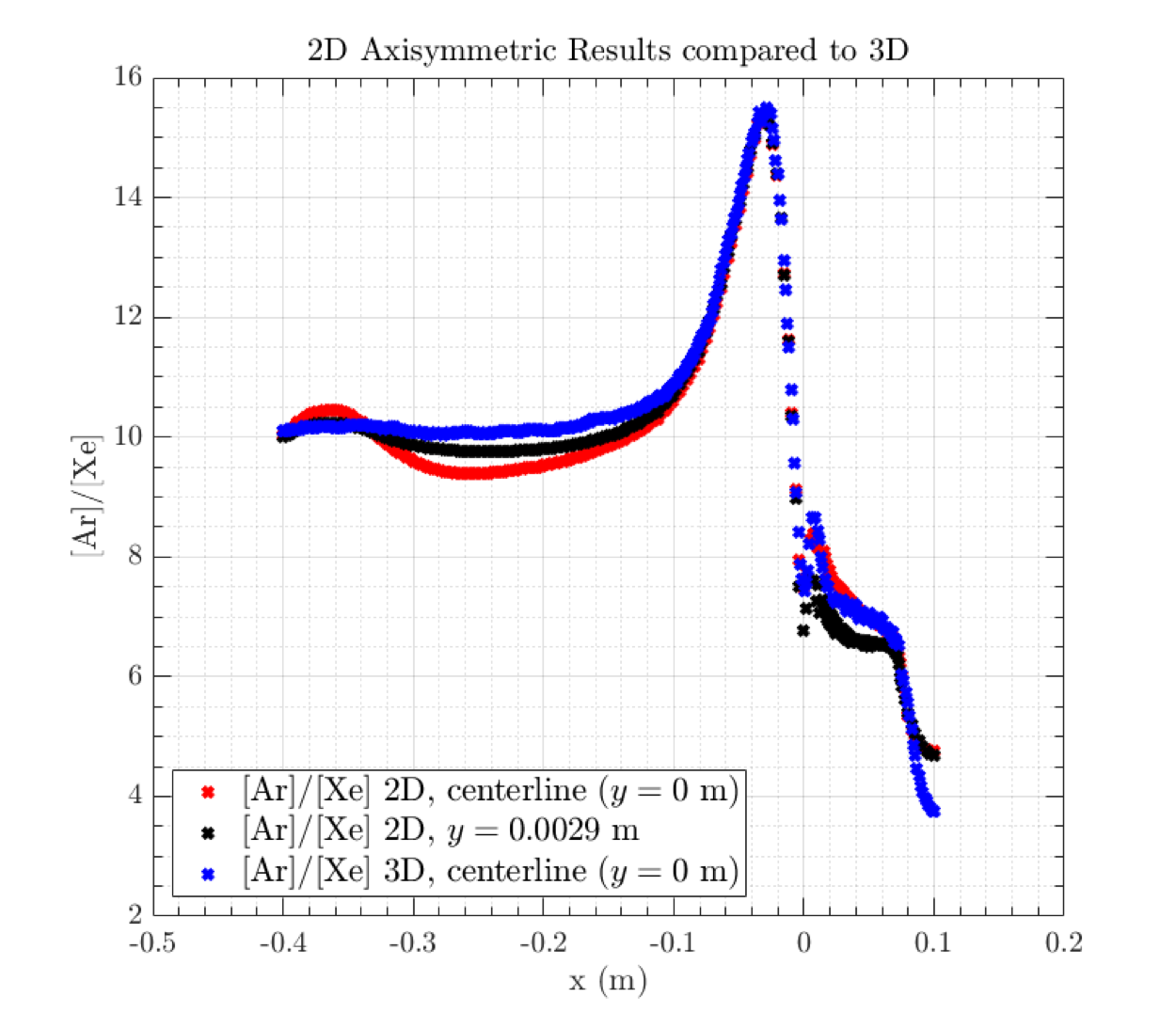
Using the Pleiades supercomputer at the NASA Advanced Supercomputing (NAS) facility, we were able to perform 2D axisymmetric and full 3D DSMC simulations of the Cupid’s Arrow probe in Venus’ atmosphere. We used the SPARTA DSMC code to run our simulations in parallel, with one simulation using up to 2,048 processors during 72 hours for the 3D simulations.
More Information
- SPARTA Direct Simulation Monte Carlo (DSMC) Simulator
- See the poster for this demonstration (PDF, 1.8MB). As shown in the NASA booth at SC18.
arnaud.p.borner@nasa.gov Jason Rabinovitch, NASA Jet Propulsion Laboratory
jason.rabinovitch@jpl.nasa.gov