|
|
Cart3D
v1.6
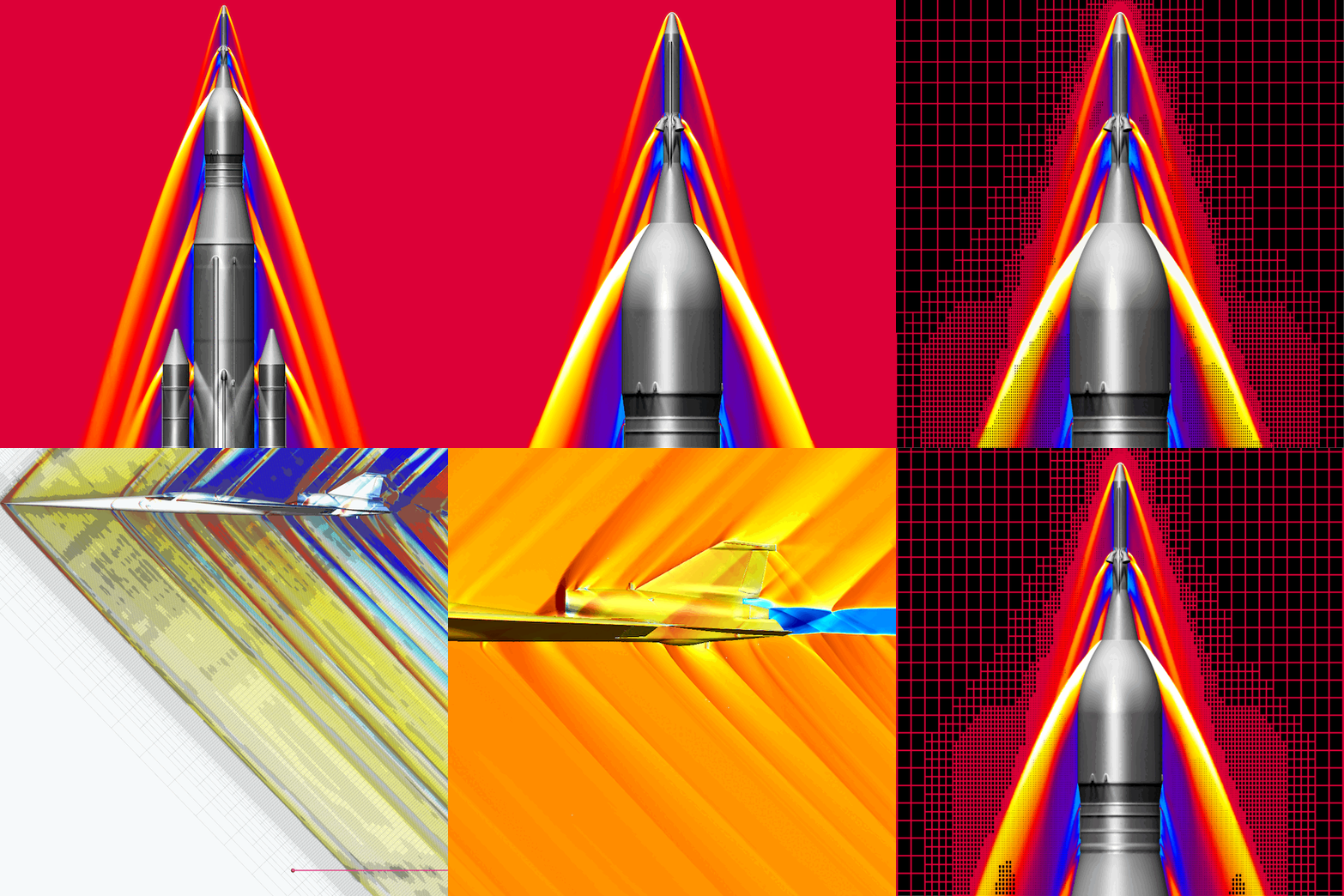 Cart3D is a high-fidelity inviscid
analysis package for conceptual and preliminary
aerodynamic design. It allows users to perform
automated CFD analysis on complex geometry and
supports steady and time-dependent simulations. The
package features robust and fully-integrated
adjoint-driven mesh adaptation and includes
utilities for geometry import, surface modeling and
intersection, mesh generation, and post-processing
of results. The main flow solvers run in parallel
using either shared memory (OpenMP) or distributed
memory (MPI) with excellent
scalability. The package is highly automated
so that geometry acquisition and mesh generation
can usually be performed within a few minutes on
most current desktop computers.
Geometry enters into Cart3D in the
form of surface triangulations. These may be
generated from within a CAD packages, from legacy
surface triangulations or from structured surface
grids. Cart3D uses adaptively refined
Cartesian grids to discretize the space around
a geometry and cuts the geometry out of the
set of "cut-cells" which actually intersect the
surface triangulation. With adjoint-based adaptation,
meshes automatically refine
as simulations evolve to reduce error in aerodynamic
outputs. Flow solvers run in parallel and to take
full advantage of multi-core and multi-cpu hardware.
The current release of
Cart3D is v1.6.0. This release can
be downloaded from the NASA
Software Catalog and includes significant
improvements and new tools. There are upgrades
to the propulsion boundary conditions
and mass-flow objective functions for adaptation
and design. The solvers are faster, more robust
and have lower dissipation. Cart3D's
integrated
adjoint-driven error-estimation and mesh refinement module
has also been enhanced with full integration of
the propulsion boundary conditions and support
for farfield objective functions when coupling
with NASA's
sBOOM
propagation code. Also included are new
tools for simplifying deflection of
control surfaces and other geometric
manipulations. "Extras" include tools for
automating setup of sonic-boom simulations a
driver for 6-DOF simulations and scripts and examples
for integrating with NASA's QUEST Uncertainty Quantification
package..
What Platforms are Supported?
Currently
supported platforms include Linux (X86_64, Linux 8)
and MacOS (arm64, Apple Silicon). For information on
other platforms, contact us.
quick
reference guide, Images,
publications, adjoint-based
mesh adaptation,
Power BCs,
geometry
intersection,
mesh generation,
flowCart, file formats,
geometry
import, triangle formats,
input/output files,
HowTo's,
boolean polytope
intersection,
adaptive precision floating
point arithmetic, algorithmic
tie-breaking
|
|