Simulating Air Taxi Safety: NASA’s Quadcopter in Ground Effect
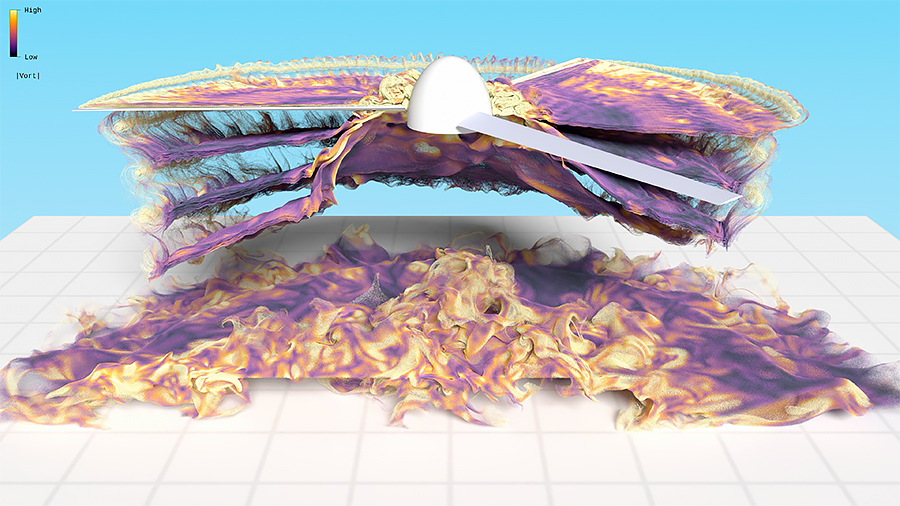
With the development of urban air mobility (UAM) vehicles, in the near future people might be offered rides in air taxis across large cities. NASA supports the development of this revolutionary market in aviation by studying multiple new designs of vertical take-off and landing (VTOL) vehicles for a variety of missions, ensuring they will operate safely and efficiently. Many VTOL aircraft concepts developed at NASA have rotors, just like helicopters. The aerodynamic interactions between the rotors and other components, like the fuselage or wings, must be quantified to accurately predict flight performance. Studying these complex interactions while vehicles are still being developed requires high-fidelity computational fluid dynamics (CFD). Aerospace engineers at NASA’s Ames Research Center are performing CFD simulations of rotors and air taxis in “ground effect,” where the addition of a ground surface makes simulations more challenging, substantially increasing the size of the computational grids compared to those simulating the vehicle alone.
Quick Facts
NASA’s expertise in high-fidelity CFD is a key enabler to better understand and predict the aerodynamics of future urban air mobility vehicles that are still under development.
- The vehicles, ground, and surrounding air are modeled using hundreds of millions of grid points. NASA’s OVERFLOW CFD solver was run on NASA’s Pleiades, Electra, and Aitken supercomputers, located at the NASA Advanced Supercomputing (NAS) facility at Ames. It took about 40 days on 2,000 CPUs to complete the single-rotor case.
- These simulations enable researchers to better characterize the vehicle aerodynamics in proximity to the ground. The simulation-induced flow alongside the ground (called outwash) was also investigated. The engineers found that interactions between the rotors lead to the emergence of dangerous areas where a person could not stand due to high winds and large gusts.
- The simulation data will be used to help tune lower fidelity methods, which are less computationally intensive and make parametric study more manageable. The combination of low- and high-fidelity results can be used to build maps of dangerous areas in the vehicle surroundings, which will inform safe routes for passengers and operators to embark or disembark from the vehicle.
- The Ames team will compare their simulation results for different vehicle designs to highlight how ground effect impacts performance and safety.
Researchers
- Patricia Ventura Diaz, NASA Ames Research Center Please enable Javascript to see email address.
- Denis-Gabriel Caprace, NASA Ames Research Center Please enable Javascript to see email address.
