How to Find a Signal from Earth-Like Planets in Stellar Noise
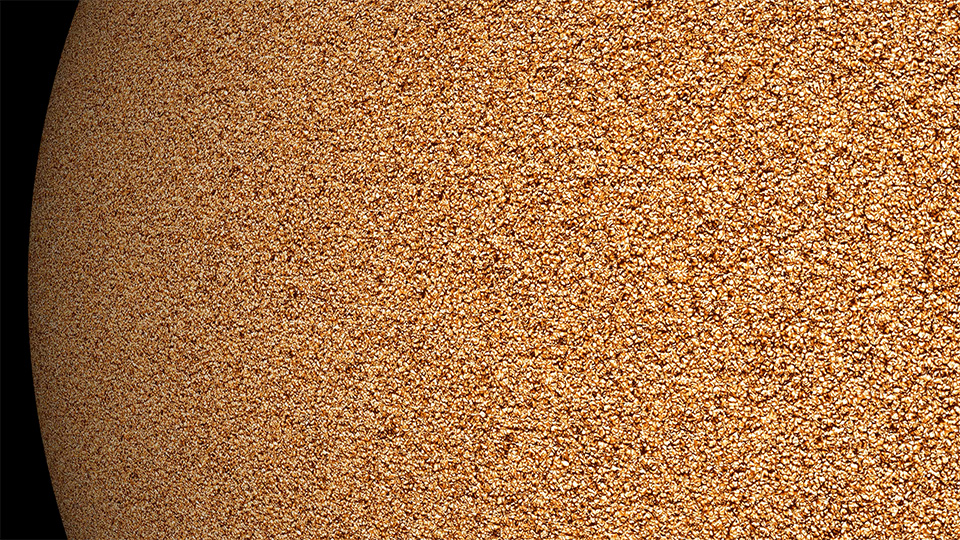
Searching for life outside of the solar system is a challenging task, requiring both advanced instrumentation and a theoretical understanding of how to process and interpret observations. For NASA, the primary goal is to find extraterrestrial planets similar to the Earth, which are orbiting their parent stars in the habitable zone where conditions are favorable for living organisms to develop and survive, even the simplest of life forms. One of the most promising methods for detecting such planets is to measure variations of a star's radial velocity, caused by orbiting planets. However, the radial velocity variations are much weaker than disturbances produced by the parent stars. These disturbances, the so-called "stellar jitter," are driven by turbulent surface dynamics and magnetic activity on the stellar surfaces. Using high-end computing at the NASA Advanced Supercomputing (NAS) facility at NASA’s Ames Research Center, research scientists developed 3D radiative hydrodynamic models of several solar-type stars to investigate the origin and properties of stellar jitter. This work, supported by the Extreme Precision Radial Velocity Foundation Science program, enables the development of noise reduction procedures to retrieve planetary signals and explore how different areas on the stellar surface contribute to the observed radial velocity variations.
Quick Facts
For the first time ever, the available computational capabilities allow us to reconstruct the surface dynamics over the whole stellar disk using the realistic modeling approach, and spectroscopic observations obtained from these models allow researchers to investigate the disturbances induced by photospheric motions and enable extraction of the radial velocity signal caused by the orbiting planets.
- The research team performed high-fidelity 3D numerical models of several target stars using the StellarBox code developed at Ames, and calculated synthetic observational data from the models with the SPINOR code.
- For the first time, this project enables researchers to reconstruct the dynamics of the whole stellar surface with a high degree of realism. This demonstrates that regions on the periphery of the stellar disk can contribute significantly to disk-integrated radial velocity disturbances.
- Realistic modeling of the stellar convection, accompanied by a detailed synthesis of spectroscopic observations with ultra-high resolution, enables the development of new techniques to filter out the stellar jitter disturbances.
- The project's next step is to substantially expand the models of the solar-type stars to perform a detailed study of the influence of different levels of stellar activity and magnetic field distribution over the stellar surface on the observed variations of the radial velocity.
Researchers
- Irina N. Kitiashvili, NASA Ames Research Center Please enable Javascript to see email address.
- Alan A. Wray, NASA Ames Research Center Please enable Javascript to see email address.
