Fiery Winds and Plasma Tornados: Exploring Dynamics of the Deep Solar Interior
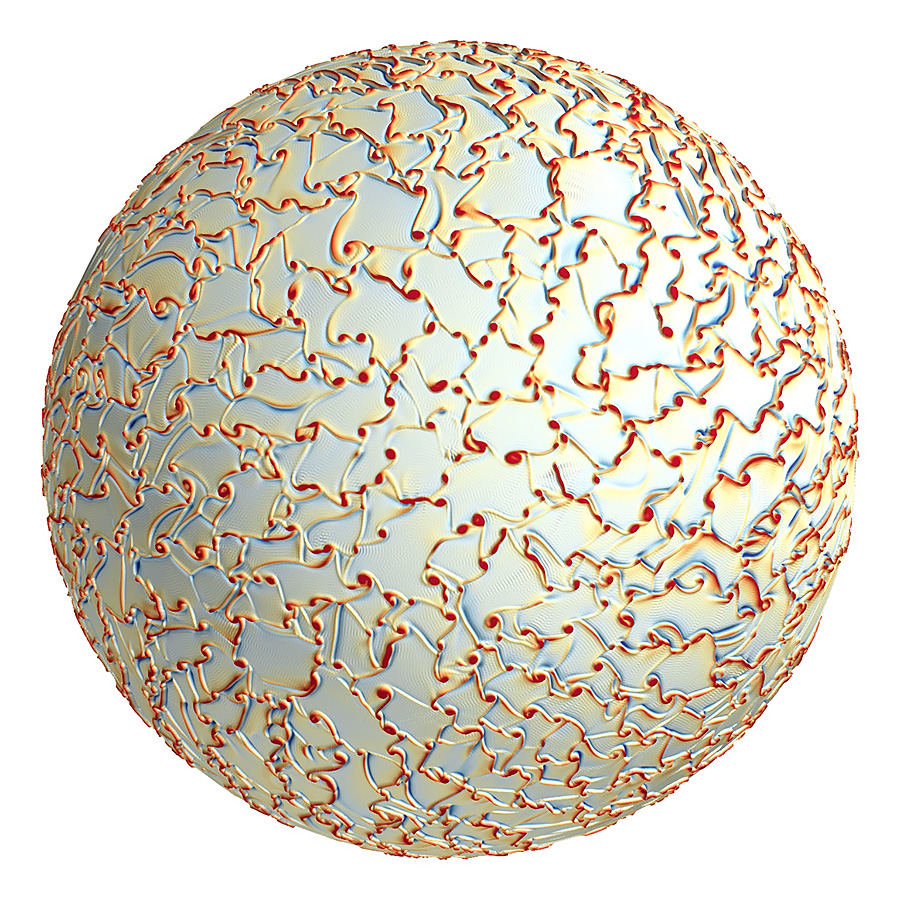
The Sun’s exquisitely complex magnetic field is rooted deep below the solar surface, where winds of ionized plasma continually regenerate and reorganize the field throughout the Sun's 22-year sunspot cycle. The largest wind patterns are observable with modern telescopes and are similar in many respects to the jet streams and large-scale circulations observed in Earth's atmosphere. Beneath these large-scale features are thought to lie much smaller-scale wind patterns that are similar to tornadoes in structure, in addition to being magnetic and considerably hotter at 1,000,000 Kelvin (nearly 1.8 million degrees Fahrenheit)! It is these smaller features that are ultimately responsible for sustaining both the Sun's magnetic field and the large-scale winds that imbue it with such remarkable organization in space and time. However, very little is understood about the detailed structure and wind speed of these small-scale winds buried deep beneath the solar surface. Scientists at the Southwest Research Institute (SWRI) are examining the link between these large- and small-scale plasma winds, exploring how new observations might be leveraged to provide indirect insight into their structure and behavior. Their findings contribute to NASA’s goal to better understand how the universe works and help protect our technology and astronauts in space.
Quick Facts
Our survey of simulations represents the largest of its kind yet developed, both in the number of simulations and in their spatial resolution. NASA’s Pleiades supercomputer was used to carry out all simulations in this work, which required over 100 million core hours. Simply put, this work would have been impossible without the support of NASA supercomputing.
- The SWRI science team found that the size and distribution of the small-scale plasma tornadoes is tightly linked to their wind speed and the structure of the large-scale winds that develop.
- Their results are being used to examine the indirect observational consequences of these small-scale motions, such as their spatial scale and lifetime, which are otherwise impossible to observe directly.
- The 3D simulations of convecting solar plasma were typically produced using 4,000 cores on NASA’s Pleiades supercomputer for 3–4 weeks at a time. All simulations were carried out using SWRI’s Rayleigh convection code.
- The next step is to examine how these different possible types of plasma motions might contribute to our understanding of the Sun’s observed magnetic field.
Researchers
- Nicholas Featherstone, Southwest Research Institute Please enable Javascript to see email address.
- Bradley Hindman, University of Colorado Boulder Please enable Javascript to see email address.
