Advancing NASA Software for Sonic Boom Prediction
Overview

NASA’s Quesst (Quiet SuperSonic Technology) mission teams are designing and building the X-59 supersonic aircraft—an advanced low-boom flight demonstrator that will be used to test the noise created by future supersonic transport designs. Community response testing across a wide variety of environments and locations will take place to build a database of noise levels and acceptibility metrics that will be used by the Federal Aviation Administration and International Civil Aviation Organization to set noise level requirements for supersonic overland flight. The most critical feature of the X-59 design is its ability to fly at supersonic speeds without creating an objectionable sonic boom on the ground, as well as its ability to fly at a target loudness level across a wide range of conditions for the flight test campaign. To ensure that the aircraft performs as required, NASA’s Commercial Supersonic Technologies (CST) project is developing new flight planning software that will inform pilots how to fly the aircraft to achieve a desired loudness level for testing.
Teams of researchers at NASA’s Ames Research Center are using the agency’s Cart3D and Launch Ascent and Vehicle Aerodynamics (LAVA) flow solvers to assist in the creation of the flight planning tool, creating a database requiring thousands of high-fidelity computational fluid dynamics (CFD) simulations. To minimize the cost of developing the flight software, the Cart3D and LAVA teams are making various improvements to their analysis tools, increasing the speed of individual calculations and furthering our understanding of low-boom aircraft physics.
Project Details
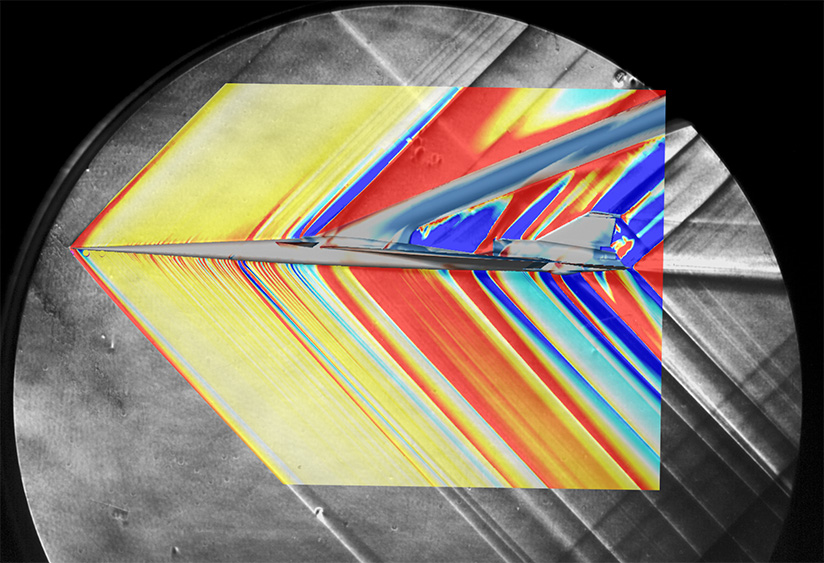
The creation of the flight planning database requires running thousands of complex CFD simulations, each requiring hundreds of millions of degrees of freedom and requiring thousands of processor hours on NASA high performance computing (HPC) systems. To optimize case efficiency, the LAVA team developed and improved a space-marching technique within the LAVA framework that can be coupled to the CFD, significantly reducing the computational domain and therefore decreasing run times without any loss in accuracy. This method has been utilized by many NASA CFD teams, including LAVA, FUN3D, and USM3D, reducing simulation times by approximately 50%. Additionally, the LAVA team developed an automatic adjoint-based mesh redistribution capability optimized for sonic boom cases and space-marching, achieving the same level of sonic boom prediction accuracy with a quarter of the turnaround time on simpler cases.
Prediction of sonic-boom noise involves a multidisciplinary simulation. The CFD tools are coupled with atmospheric propagation solvers, such as NASA’s sBOOM tool, to determine the sonic boom carpet ground effects generated by the aircraft. These simulations are highly susceptible to numerical errors, which may excessively attenuate the pressure waveforms. To address this issue, teams at NASA’s Ames and Langley Research Centers developed a reliable error estimate for loudness predictions, which is also used to guide adaptive mesh refinement, controlling the level of discretization error to within a user-specified tolerance. This is an important step in simulation verification of the X-59 sonic boom database and future certification-by-analysis of low-boom aircraft, ensuring that the new designs satisfy noise standards.
Results and Impact

The space-marching and mesh redistribution methods developed by the LAVA team were able to reduce the computational resources required to get a high-fidelity CFD solution by a factor of at least 2. The capability of the space-marching method to be coupled with all of the NASA CFD codes used for the X-59 flight database is leading to significant cost savings over the large number of cases required.
The loudness error estimate for coupled Cart3D-sBOOM simulations developed at NASA Ames by the Cart3D team allows automatic, error-controlled analysis of the X-59. This new tool has provided significant insight into meshing requirements near the aircraft to control numerical errors in the sonic boom predictions on the ground, over 20 kilometers away from the vehicle. In addition, this tool significantly reduces the amount of human intervention the simulation needs, and virtually eliminates the need to handcraft vehicle meshes to minimize signal loss, thereby allowing unprecedented automation on NASA supercomputers.
Why HPC Matters
HPC is critical for simulation-based analysis, design, and uncertainty quantification for the X-59, since these areas require many high-cost simulations to generate high-fidelity databases. The Pleiades, Electra, Aitken, and Endeavour supercomputers at the NASA Advanced Supercomputing facility at Ames have been critical for providing a fast turnaround for this work. For example, a sonic boom carpet database for various X-59 operating conditions and configurations requires several hundred Cart3D-sBOOM simulations, with each simulation requiring 48 cores and approximately three hours of wall clock time. A typical LAVA simulation for the X-59 database requires 1,500 cores and eight hours of wall clock time, with hundreds of cases needing to be generated.
What's Next
With construction of the X-59 well underway at Lockheed Martin’s Skunkworks in Palmdale, California, the improvements made to NASA’s LAVA and Cart3D frameworks are helping to generate the sonic boom prediction databases needed by Quesst mission engineers to develop advanced flight planning software. Additionally, the CFD database is providing key insights in the relationship between changes in the flight parameters and their effect on ground level noise, improving our understanding of the complex physics of aircraft-formed sonic booms.
More Information
Researchers
- Jared Duensing, NASA Ames Research Center Please enable Javascript to see email address.
- Marian Nemec, NASA Ames Research Center Please enable Javascript to see email address.
- Michael Aftosmis, NASA Ames Research Center Please enable Javascript to see email address.
- Cetin Kiris, NASA Ames Research Center Please enable Javascript to see email address.