Wall-Modelled Large Eddy Simulations for Aircraft Certification-by-Analysis
Overview

Accurate computational prediction of aerodynamics for aircraft with swept wings in high-lift configurations (take-off and landing) is notoriously challenging. The flow field for these configurations is dominated by the strong interplay between turbulent boundary layer separation, a variety of off-body vortex tubes, complex wake-boundary layer mergers, and large pressure gradients. This problem has been the focus of the aviation industry’s high-lift prediction efforts, and the large variation in predictions made by independent computations underscores the need for a systematic evaluation of current state-of-the-art computational fluid dynamics (CFD) tools, especially those involving scale-resolving turbulence closure strategies, like large-eddy simulation (LES). This is particularly important to enable analysis-based compliance for aircraft certification, one of NASA’s future computational aeronautics goals.
Project Details
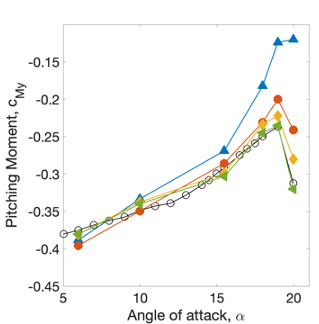
In this work, funded by the NASA Aeronautics Research Mission Directorate’s Transformational Tools and Technology Project, the Launch, Ascent, and Vehicle Aerodynamics (LAVA) group at Ames Research Center is attempting to address the CFD challenge posed by high-lift aircraft configurations. The team developed and demonstrated that wall-modeled large-eddy simulations (WMLES) can capture both qualitative and quantitative aspects of high-lift aerodynamics via systematic comparisons against experimental wind tunnel measurements.
The LAVA team utilized two distinct technologies for high-lift WMLES. The first method utilized structured overset curvilinear grids—a type of grid that can be carefully tailored for quality, desired resolution requirements, and are body aligned to represent geometry perfectly. However, due to the intensive manual grid generation effort for this method, the high-quality curvilinear grids required over two months of pre-processing time to complete for the geometry of NASA’s High-Lift Common Research model. The second method utilized fully automated structured octree-grids, which reduced the preprocessing time down to roughly two hours of human effort. However, since the resulting grids did not conform with the geometry, the team developed a new technique relying on immersed boundary closure with appropriate near-wall LES closures (such as wall-modeling).
Results and Impact

These simulations were the first to systematically show the qualitative nature of the convergence seen in pressure loading on high-lift geometries with grid refinement. The team demonstrated that grid refinement studies are necessary due to complexities associated with different resolution requirements needed to capture inviscid streamline curvature effects, and also the viscous boundary layer effects responsible for smooth body and corner flow separation that results in aircraft stall. Their study demonstrated that coarser grids can produce accurate results due to “error cancellation,” so additional care is needed when evaluating the predictability of CFD results. The team also identified the differences between the aerodynamics occurring in “free-air” versus within a wind tunnel, especially due to the utilization of “semi-span” models mounted on the tunnel wall. They were able to delineate both the inviscid effects from changes to the model geometry, as well as the viscous effects associated with the floor boundary layer, and concluded that proper comparisons between tunnel experiments and CFD requires representation of the tunnel environment in CFD simulations, especially at angles of attack near the aircraft’s maximum lift.
The LAVA team also observed that the new, automated method increased computational affordability and drastically reduced the human-intensive preprocessing time—from months to just hours—which provided computational predictions at a comparable accuracy-per-unit-cost metric to similar simulations utilizing more complex methods. This successful demonstration of NASA’s CFD capability has had a phenomenal impact on a variety of agency projects, including the design of the Transonic Truss-Braced Wing aircraft concept; the study of ice-accretion and resulting loss of aerodynamic performance; and aero-acoustic and vibroacoustic predictions involving high-speed jets, airframe noise, and buffet seen in the forward booster attachment for the NASA’s Space Launch System.
Why HPC Matters
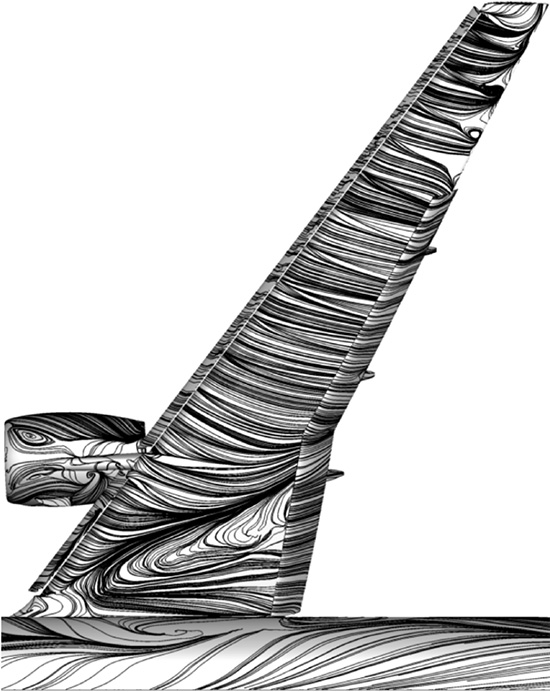
The rapid growth seen in scale-resolving technologies in aerospace applications is in large part due to the rapid growth in high-performance computing (HPC) resources. The increase in NASA’s HPC capacity, along with the development of new algorithms that leverage the new hardware efficiently, has led to use of LES in predicting aircraft-aerodynamics several decades earlier than scholars in the industry predicted in the early 2010s. The work performed by the LAVA team represents some of the largest LES performed on non-academic geometries, with the largest simulation utilizing over seven billion spatial degrees of freedom. These simulations could represent dynamically relevant turbulent motions as small as two millimeters in length on an aircraft with a 60-meter wing half-span and a seven meter mean aerodynamic chord. The largest simulations the team performed leveraged roughly 120 AMD Rome nodes of NASA’s Aitken supercomputer and took about six days to complete for a single angle of attack.
What's Next
The most exciting aspect of the technologies developed and demonstrated for this work is the massive untapped potential for further substantial reduction in simulation wall-time via strong scaling on the latest generation accelerators such as graphics processing units (GPUs). The team anticipates another order of magnitude reduction in wall-times by utilizing more computing resources, and they are looking forward to evaluating these new technologies for other NASA projects and further promoting the inclusion of scale-resolving technologies in everyday CFD applications.
Researchers
- Cetin C. Kiris, NASA Ames Research Center Please enable Javascript to see email address.
- Gaetan K. Kenway, NASA Ames Research Center Please enable Javascript to see email address.
- Aditya S. Ghate, NASA Ames Research Center Please enable Javascript to see email address.