Rocket Plume-Surface Interaction Simulations for Moon and Mars Landings
Overview

Plume-surface interaction (PSI) between a lander’s engine plumes and regolith—the fine soil found on solid planetary bodies—creates many hazards during landing: obscuration, contamination by dust particle clouds, high-energy ejecta streams, and landing area cratering. The Fluid Dynamics Branch at NASA’s Marshall Space Flight Center (MSFC) has developed simulation tools to provide predictive PSI environments to teams across the agency, including those working on the Human Lander System, Commercial Lunar Payload Services, and future crewed Mars landers. Development required the extension of proven computational fluid dynamics (CFD) tools for plume flow applications in low pressure atmosphere as found on Mars and vacuum surroundings found on the Moon. The team at Marshall performed gas-particle multi-phase interaction modeling of surface scouring and cratering with the Gas-Granular Flow Solver (Loci/GGFS), which features a Eulerian-Eulerian modeling approach—treating both the gas and granular material efficiently as continuum phases—to directly predict erosion, crater formation, and particle streams. Alternative modeling approaches that represent the soil as discrete Lagrangian particles and track hundreds of billions of particles would result in prohibitive computational cost for realistic landing site scales.
Project Details

The team validated the Loci/CHEM CFD application for low-pressure and near-vacuum plume impingement against NASA experiments at MSFC and Langley Research Center. For lunar mixed continuum-rarefied flow simulations, the team used the Loci/CHEM-Boltzmann extension, which switches cell-by-cell to a rarefied solver only where needed. The experiments indicate that rarefaction—the lessening of density to levels where gas cannot be represented as a continuum fluid anymore—has a significant amplification effect on surface shear stresses where the rocket plume and regolith meet, the dominant influence in PSI viscous erosion and scouring.
To better understand the importance of jagged lunar regolith particle mixture effects, the team at the Fluid Dynamics Branch created novel multi-phase model implementation within GGFS, which enabled them to model the roughness and interlocking of irregular particle shapes and dense packing from a wide particle size distribution—features that resist penetration of gas flow into the particle bed and reduce erosion and fluidization. To generate closure model databases for drag, shear, kinetic energy dissipation, and other properties needed in the Eulerian particle phase algorithms, they preprocessed particle-particle and gas-particle interaction simulations using the Discrete Element Method (DEM). The CFD-based predictive tools were then validated against the results from NASA experiments of plume impingement on surrogate regolith material surfaces in low pressure and near-vacuum test chambers.
Results and Impact
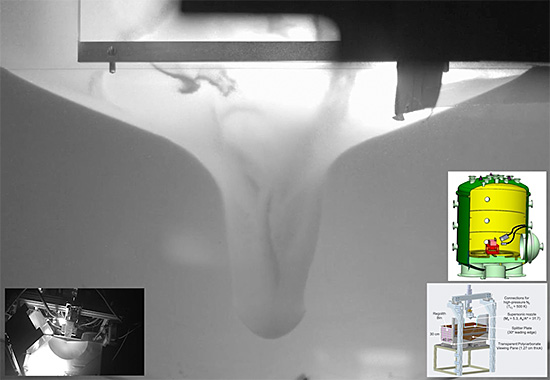
These simulations provided insight into the plume structure dynamics and the significance of rarefied flow effects in the surface erosion mechanisms. The ability to perform full-scale lander PSI simulations with GGFS in lunar conditions was demonstrated for a model of the Apollo Lunar Module—the only crewed vehicle to land anywhere outside of Earth to date—at an altitude of five meters above the regolith surface. The Lunar Module simulations were also used to progressively test and improve modeling of important effects of irregular particle shape and multi-size mixture compositions on erosion levels. Application testing and validation of GGFS is now underway using sub-scale PSI experiments recently performed in vacuum chambers at MSFC using a variety of materials to simulate regolith from spheres, mono-disperse sand, sieved mono-disperse lunar simulant jagged particles, to full size range BP-1 lunar simulant. The experiments were designed to validate and guide how the particle phase modeling approach would need to be refined.
Why HPC Matters
Simulation of gas-particle surface erosion is an inherently time-dependent process requiring time-accurate simulations with long run times and large datasets. The simulations performed by the team used over a hundred million cells, and required 4,000 to 8,000 processors on the agency’s Aitken, Pleiades, and Electra systems across two to four weeks of runtime. The NASA Advanced Supercomputing (NAS) Division at Ames Research Center provided efficient and reliable high-performance computing (HPC) resources, including storing and archiving terabytes of data for analysis and visualization postprocessing.
What's Next

GGFS maturation towards production readiness continues with improvements in two-phase flow algorithm implementation, validation of the particle physics models, and simulation optimization on agency HPC assets. Model validation will be performed against the vacuum chamber PSI experimental data generated with a variety of particle mixture compositions up to full range lunar simulants. The team’s current goal is to improve turnaround time of simulations to rapidly support customer projects, since current PSI 3D simulation run times are four weeks or more. They have identified the presence of numerous particle physics submodels and computational cost disparity between rarefied and continuum algorithms that cause simulation latency and processor load imbalances, contributing to long run times. Besides algorithm and simulation process optimization, porting submodels to graphics processing units (GPUs) is an attractive option that would allow the CPUs to perform the mainline solver work more efficiently without wait for sub-models. NAS’s CPU/GPU offerings will be a key enabler for the PSI development team in pursuing this approach.
More Information
- Overview of the Predictive Simulation Capability Element of the Plume Surface Interaction Project
- Design of a Subscale, Inert Gas Test for Plume-Surface Interactions in a Reduced Pressure Environment
Researchers
- Peter Liever, NASA Marshall Space Flight Center Please enable Javascript to see email address.
- Jeff West, NASA Marshall Space Flight Center Please enable Javascript to see email address.