
Modeling the Solar Corona to Study Sources of Space Weather Disturbances
Overview
Our everyday lives are closely linked to solar radiation and dynamics. The Sun is an active star with quasi-periodic, 11-year cycles of magnetic activity. During periods of high solar activity, strong plasma eruptions such as flares and coronal mass ejections, accompanied by high-energy radiation and energetic particles, disturb the near-Earth space environment and cause magnetic storms. Such activity can affect communication, power grids, and navigation and space technologies—and can also affect human health.
Detailed modeling of the complex dynamics of the magnetized turbulent solar plasma allows us to understand the origins of solar activity and the triggering mechanisms of plasma eruptions. Such studies provide critical support for interpreting observational data from NASA’s space missions such as the Solar Dynamics Observatory, IRIS, Hinode, and the Parker Solar Probe, and contribute to preparations for the Artemis Program and human space exploration in general. We performed 3D radiative magnetohydrodynamics (MHD) simulations to study the processes of plasma dynamics and the formation of magnetic and thermodynamic structures, which lead to energy accumulation in the solar corona and its subsequent release. These studies help us understand the complex evolution of the solar atmosphere and corona, and provide insight into the physical processes that are important for improving space weather forecasts.
Project Details

Our goal is to perform 3D radiative MHD simulations of solar dynamics, in which the computational domain includes subsurface layers of the Sun as well as the solar atmosphere and corona, to study processes of plasma heating and plasma eruptions. Such studies are critical for building reliable dynamical forecasts of coronal activity. The simulations have been performed for different solar conditions using the StellarBox code developed at NASA’s Ames Research Center. The code takes into account the effects of turbulence, ionized plasma, magnetic fields, chemical composition, and radiation in the highly stratified realistic conditions on the Sun. This work is funded by NASA’s Heliophysics Supporting Research Program.
Results and Impact
Our simulation results reveal that initially uniform weak magnetic fields are greatly amplified due to small-scale dynamo action below the visible surface of the Sun, and cause the spontaneous formation of tornado-like plasma structures and eruptions. The strongest helical flows originate in strong, 1-kiloGauss magnetic field patches formed on the solar surface. The helical magnetized structures extend into the corona and produce Alfven waves that drive plasma eruptions. The simulations also reveal many important details that are unresolved in observational data, such as the Kelvin-Helmholtz instability of the magnetic structures and plasma downflows in the corona. The current study is primarily focused on high-resolution simulations that model conditions in local areas of the Sun in order to understand the origin of various types of wave and magnetic self-organization phenomena and the triggering mechanisms of small-scale eruptions observed by NASA satellites.
Why HPC Matters
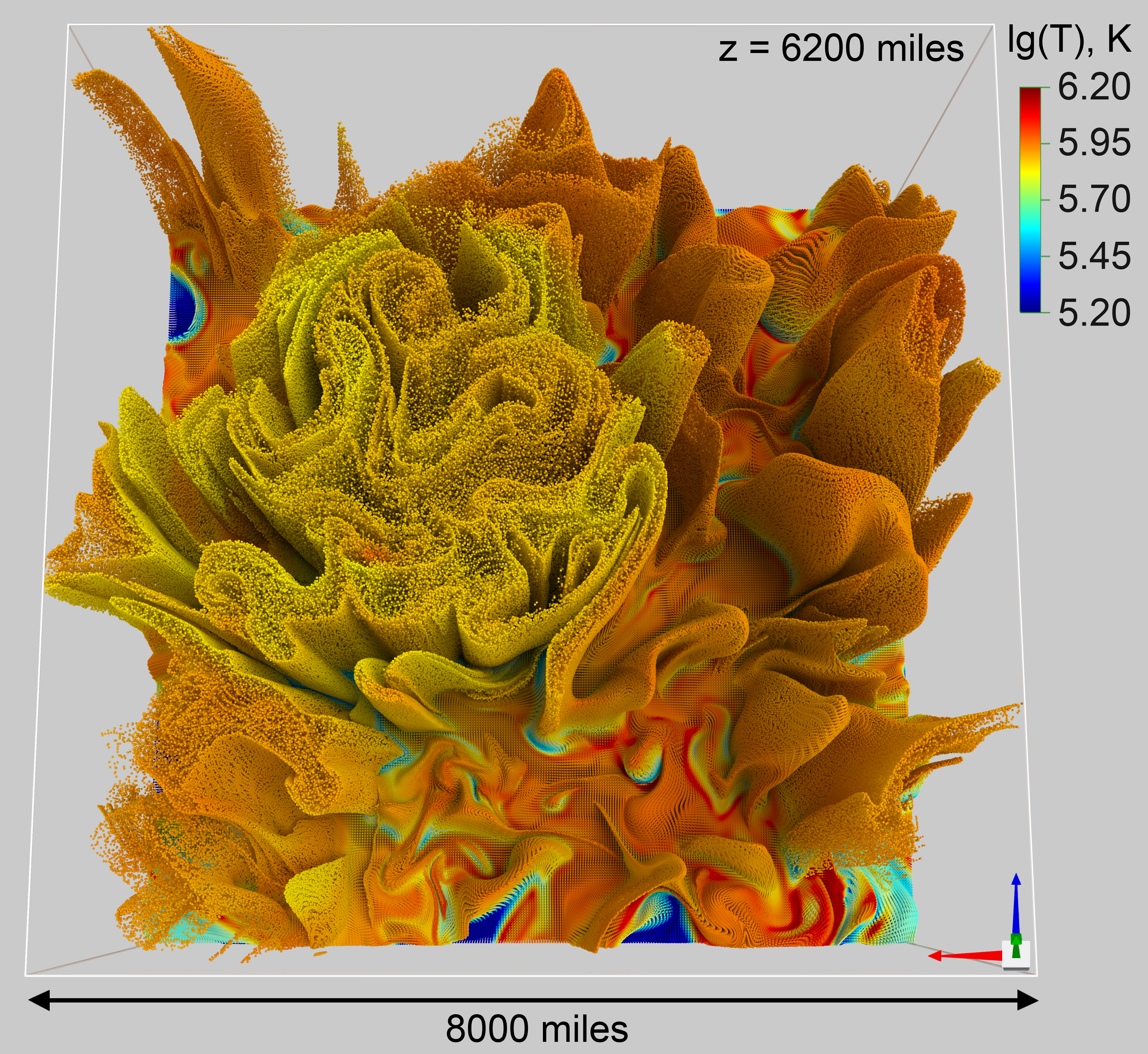
3D modeling of turbulent ionized plasma under realistic solar conditions requires large-scale computational resources. We use the Pleiades and Electra supercomputers at the NASA Advanced Supercomputing (NAS) facility to perform our high-fidelity simulations. Multidimensional massive data flows in such simulations require a very high-speed network for interprocessor communication and for postprocessing and visualization. In this work we primarily used Intel Ivy Bridge and Skylake nodes. The NAS teams provide several critical services needs for this project: 24/7 user support, visualization, and computer science expertise.
More Information
- Heliophysics Supporting Research Program
- See the poster for this demonstration (PDF, 541KB). As shown in the NASA booth at SC19.
- Download the demonstration slide deck (PPSX, 164.8MB) as presented in the NASA booth at SC19. Click "Read Only" after launching presentation.
irina.n.kitiashvili@nasa.gov Alan Wray, NASA Ames Research Center
alan.a.wray@nasa.gov