
Jumping the Queue: From NASA to the Commercial Cloud
Overview
NASA’s High-End Computing Capability (HECC) Project provides high-performance computing (HPC) resources and services to more than 1,500 scientists and engineers across the agency. Recently, we made it possible for users to run their jobs seamlessly on commercial cloud resources.
Last year, HECC conducted a trade study to determine how commercial cloud resources could be used in a cost-effective way. The study found that while replacing all in-house resources with those in the cloud would be cost prohibitive, some portions of users’ HPC workloads might be cost effective to run on commercial clouds. The study also recommended starting an effort to provide a commercial cloud capability.
Project Details
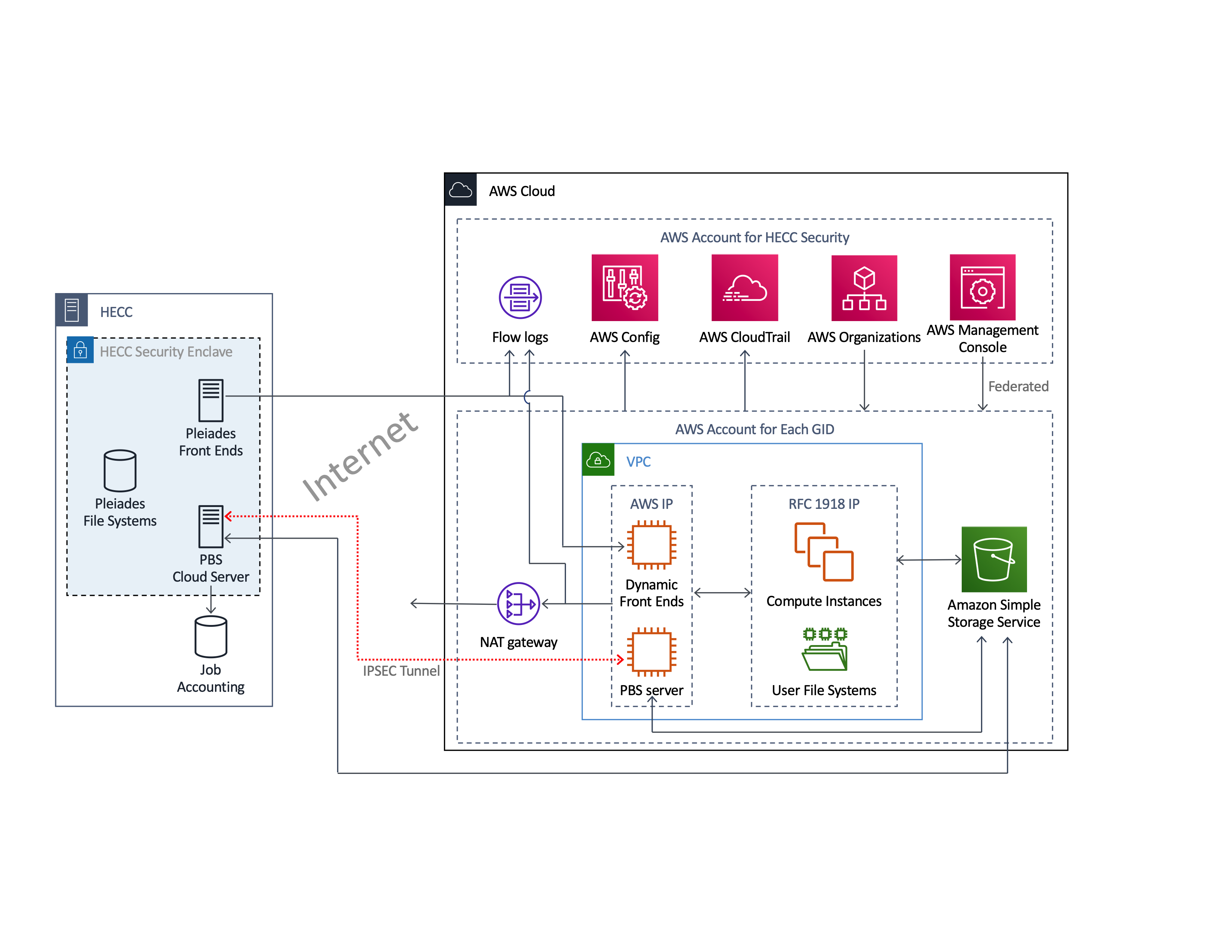
In response to these recommendations, we have undertaken a three-phased approach to making commercial cloud resources available to NASA’s science and engineering projects.
In the first phase, we implemented a pilot project that allowed a few select users to burst jobs from HECC front-end nodes to Amazon Web Services (AWS) resources. From the users’ perspective, they only needed to annotate their batch job scripts—we developed a cloudbursting mechanism that took care of allocating the AWS resources and staging files between HECC systems, located at the NASA Advanced Supercomputing (NAS) facility, and AWS systems. By using GPU-accelerated nodes at AWS, which were not available on HECC systems at the time, the users were able to make significant advances in their research.
The second phase is built on the pilot project and makes AWS access available to all HECC users. In contrast to the first phase, where HECC paid the cloud charges, users are now responsible for them. This pay-per-use system makes cloud access sustainable for HECC’s budget, and lets the user decide whether the opportunity cost of waiting in a batch queue for HECC resources exceeds the cost of “jumping the queue” by running the job at AWS. We are also enabling export-controlled work through the use of AWS GovCloud.
In the third phase, we are adding mechanisms for non-HECC users to access cloud resources to meet their science and engineering needs. We are currently analyzing user workflows to gather requirements, and will provide a user environment either by using web-based software available from cloud vendors or by building a suitable in-house environment.
Results and Impact
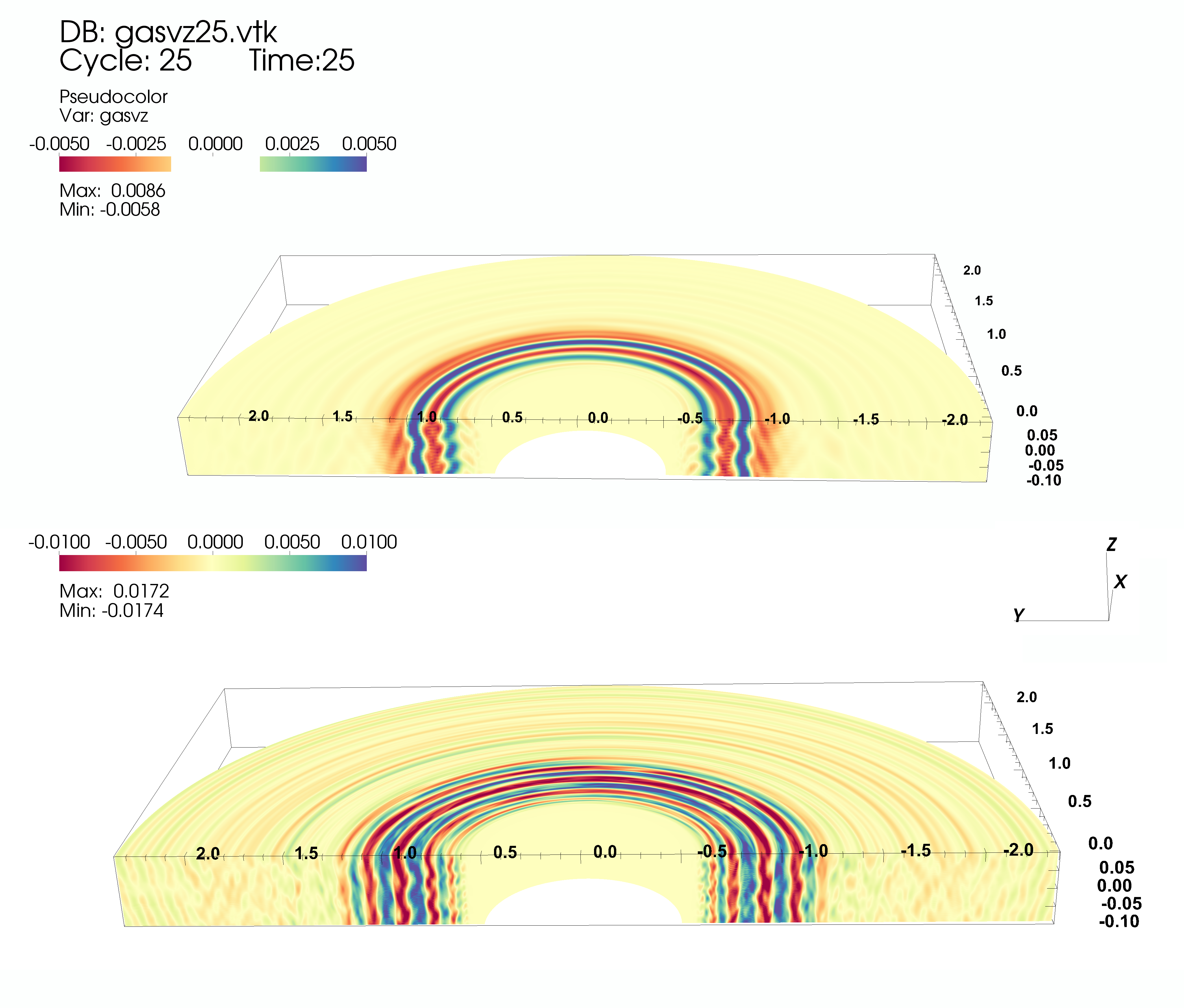
In the pilot project, two users were able to make significant advances in their research through the use of GPU-accelerated nodes at AWS. One researcher who studies spiral waves in protoplanetary disks increased the resolution of his modeling fourfold—from 512-by-128-by-128, to 2,048-by-512-by-512. The second improved the accuracy of atomistically informed predictions for 3D manufacturing, narrowing the gap between the simulation-derived predictions and experimental data by more than two orders of magnitude.
Overall, by providing researchers with a seamless way to use AWS systems to run their jobs instead of waiting to access HECC resources, the users can determine for themselves whether the benefits of jumping the queue are worth the cost of running on commercial cloud resources. This is an important factor in helping NASA stay cost effective while meeting its current and future computing needs for its science and engineering projects, missions, and programs.
More Information
- See the poster for this demonstration (PDF, 760KB). As shown in the NASA booth at SC19.
- Download the demonstration slide deck (PPSX, 10.9MB) as presented in the NASA booth at SC19. Click "Read Only" after launching presentation.
robert.hood@nasa.gov Steve Heistand, NASA Ames Research Center
steve.heistand@nasa.gov