
Lattice Boltzmann for Airframe Noise Predictions
Overview
Airframe noise—the noise generated by the nonpropulsive parts of an aircraft—is a nuisance near airports worldwide, and is a major focus of the design, retrofitting, and operation of current and future aircraft. There is increasing evidence that airframe and engine noise are comparable during an aircraft’s approach to landing. Computational prediction of airframe noise is traditionally based on lower-fidelity empirical approaches or computational fluid dynamics (CFD), which are often coupled with an acoustic analogy. This work focuses on the use of an ultra-high-performance Lattice Boltzmann (LB) method, incorporated into NASA’s Launch Ascent and Vehicle Aerodynamics (LAVA) software. Compared to traditional approaches, LB methods have better memory access, significantly lower floating-point operations, and minimal numerical dissipation—critical for computational aeroacoustics (CAA) and ideal for large eddy simulations. Our main goal is to increase the predictive use of high-fidelity CAA capabilities for NASA’s next-generation aviation concepts.
Project Details

While Navier-Stokes (NS)-based simulation has always been a primary method used by CFD experts, LB approaches have gained traction recently due to the benefits noted above and their ability to simulate arbitrarily complex geometry in a relatively straightforward manner. High performance is gained due to significantly lower floating-point operations relative to high-order NS algorithms, excellent data locality, ability to vectorize and multithread operations (despite the memory-bound nature of the algorithms), and excellent parallel scalability that is mostly platform-agnostic.
Using the Pleiades supercomputer at the NASA Advanced Supercomputing (NAS) facility, we applied both LB and Cartesian NS approaches within the LAVA software framework to simulate a massively separated aircraft landing gear. The simulated surface pressure fluctuations were compared with test measurements from transducers at strategic locations on the gear components where the primary noise sources are believed to be located.
Results and Impact
We found the pressure fluctuations predicted by both the LB and NS approaches to be largely consistent, but the LB approach achieves a ~15-times speed-up over the higher-order NS discretization, without any reduction in accuracy. The LB approach is vectorizable, with significantly fewer floating point operations than typical high-order NS methods and greatly improved memory usage. Turbulence is more sensitive to dissipative errors than dispersion errors, and the LB approach minimizes numerical dissipation while retaining the robustness needed for under-resolved engineering simulations at full-scale Reynolds numbers.
Why HPC Matters
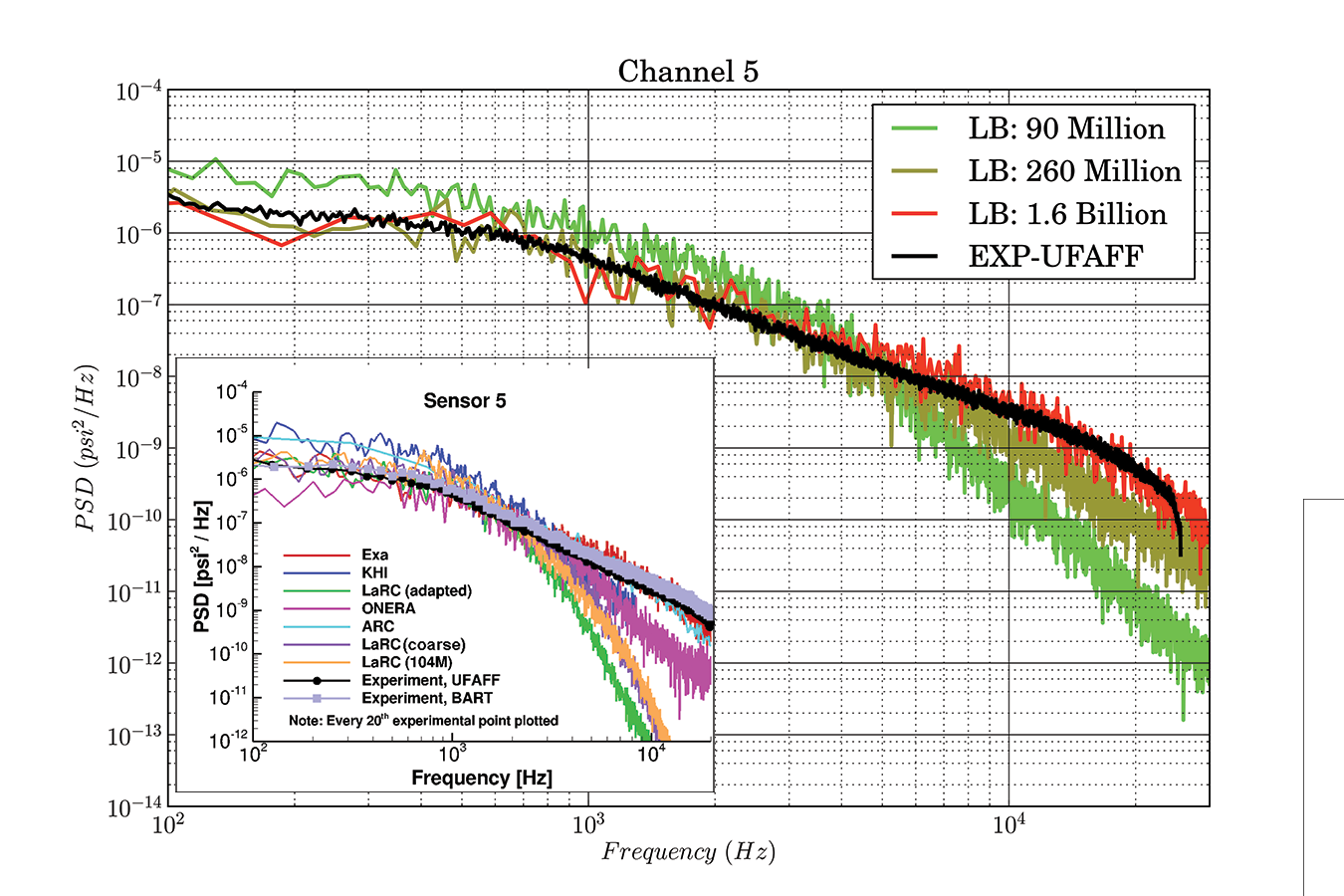
These simulations are possible only with the use of a large cluster like Pleiades. One calculation required 1.6 billion cells and ran for about a week of wall-clock time on 2,800 Intel Broadwell cores. In addition, the NAS Visualization and Data Analysis team helped generate extremely high-quality renderings of the landing gear flow physics.
What’s Next
We are now focusing on improved wall modeling for arbitrarily complex geometry at high Reynolds numbers. Initial progress toward a moving geometry capability within the LB solver in LAVA is also underway, and takes advantage of the progress made within the LAVA Cartesian-NS code base. We are also extending the LB solver for high-speed flows. A major effort to optimize the performance of the LAVA-LB code base is planned in the near future. Reducing time-to-solution for a target level of accuracy, within the context of airframe noise prediction problems, is needed for several mission-critical applications that currently rely on semi-empirical approaches.
More Information
- Lattice Boltzmann and Navier-Stokes Cartesian CFD Approaches for Airframe Noise Predictions
- See additional images/videos related to this demo in our media gallery.
- See the poster for this demonstration (PDF, 4.4MB), as shown in the NASA booth at SC17.
michael.f.barad@nasa.gov Cetin Kiris, NASA Ames Research Center
cetin.c.kiris@nasa.gov