
Studying Convection in Stars like Our Sun
Overview
Stars like our Sun have magnetic fields that are generated in their interior by global-scale plasma motions. These magnetic fields, which appear at the surface as dark spots, are the source of solar and stellar activity, and affect the long evolution of the star by connecting the stellar wind to the stellar magnetosphere. The plasma motions that generate the magnetic fields come from convection, which transports heat and energy outward and drives the “dynamo” processes that form the magnetic fields.
To understand the source of stellar magnetism, we must understand stellar convection and how it connects different regions of the interior of the star. These rotating, stratified, magnetized dynamo systems are at the forefront of astrophysical theory, and simulations help us understand the basic physics at work in stellar interiors.Project Details
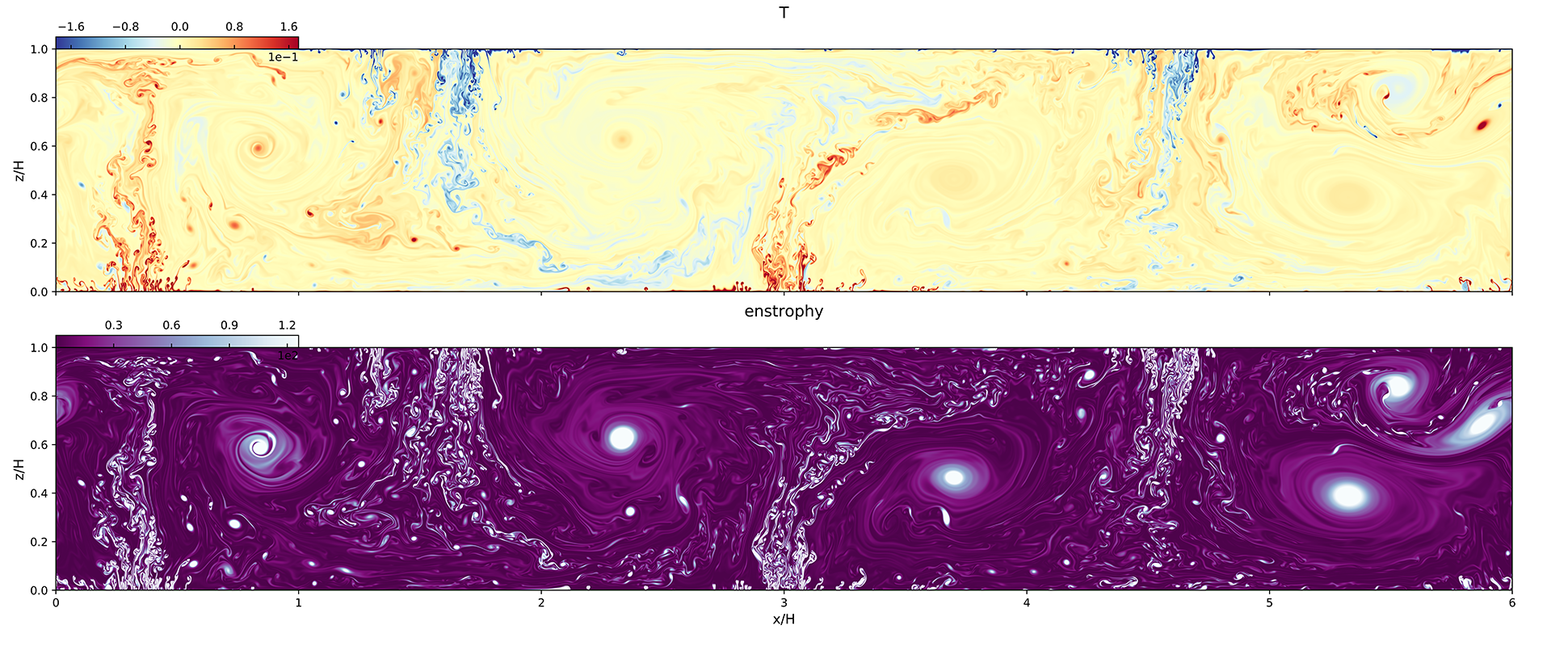
A team of astrophysicists at the University of Colorado are studying fundamental properties of stellar convection, exploring in particular how the region of convection connects to the stably-stratified region of waves below the solar convection zone.
The transition boundary between the convective and wave regions, called the tachocline, is thought to be an important part of the solar magnetic dynamo. In many solar dynamo theories, this region is where magnetic fields are stored and organized over an 11-year solar cycle. For this project, the team conducted novel simulations of turbulent, stratified convection using the open-source Dedalus pseudospectral framework.
Results and Impact
In these studies of fundamental transport, the researchers found that stratified convection behaves in a fashion similar to well-studied laboratory flows. They also found that the boundary region is very different from what they had suspected; in particular, that internal gravity waves act to efficiently stop the turbulent convection—likely limiting the connections between the dynamo generated magnetic fields in the convection zone and the stable interior. They also found evidence that this boundary region may play a surprisingly small role in the operation of the solar dynamo. If true, this suggests that solar and stellar dynamos operate very differently than our current conceptual models.
Why HPC Matters
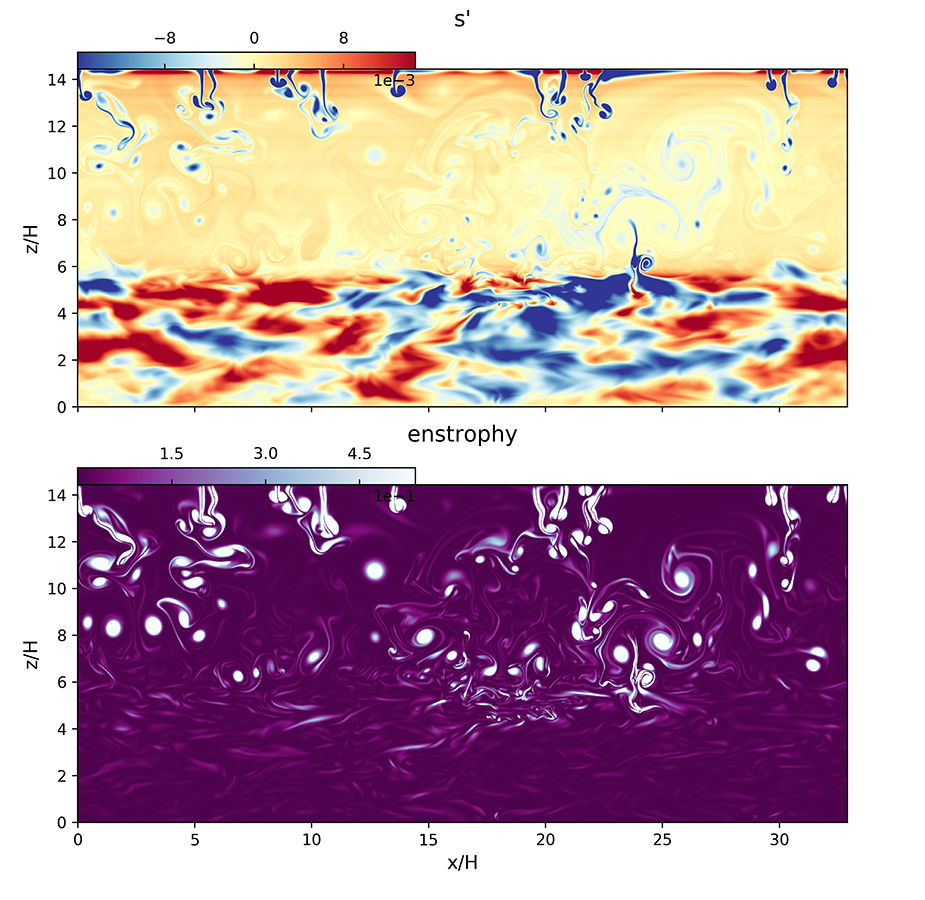
The Colorado researchers use the Pleiades supercomputer at the NASA Advanced Supercomputing (NAS) facility to conduct their simulations of stellar convection. Simulations are conducted in 2D and 3D, typically running on between 512 and 16,380 cores and requiring 24 to 120 hours of evolution per simulation. Individual studies typically require several million processor hours. In these complex numerical problems, the physics of low-Mach number flows and magnetism leads to global-scale communications, and a fast network is crucial to the simulation performance. The data volumes generated—typically several terabytes per simulation—is prohibitively large to transfer. Because of this, in situ data analysis using interactive nodes with the data remaining at the NAS facility has been critical for developing an understanding of the complex dynamics at play in stellar convection.
More Information
- Dedalus Project
- Convective Heat Transport in Stratified Atmospheres at Low and High Mach Number
- See additional images/videos related to this demo in our media gallery.
- See the poster for this demonstration (PDF, 4.9MB), as shown in the NASA booth at SC17.
bpbrown@colorado.edu