
XCO2 Measured from OCO-2
Overview
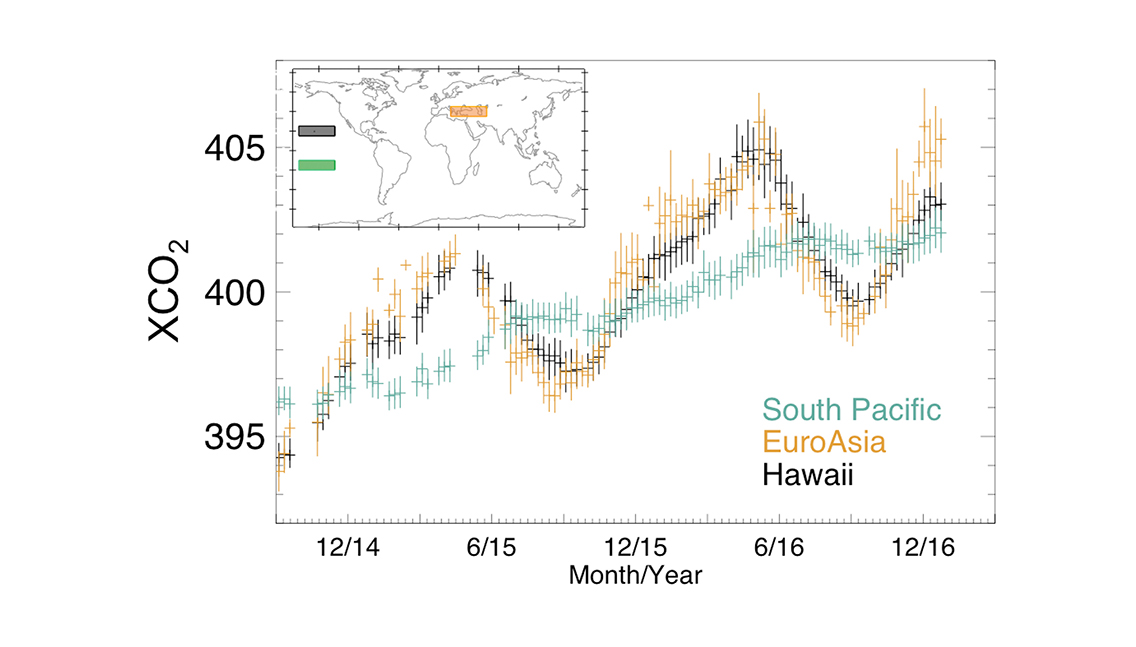
The Orbiting Carbon Observatory-2 (OCO-2) mission focuses on quantifying the exchange of carbon dioxide between Earth’s atmosphere, oceans, and the plants on land. Since September 2014, its three-channel imaging grating spectrometer has been collecting about 1 million soundings per day. Processing the cloud-free soundings yields full-column estimates of the column-averaged CO2 dry air mole fraction—XCO2—with single sounding random errors near 0.5 ppm (0.125%) over most of the globe. Another product derived is the solar-induced chlorophyll fluorescence, which yields additional insight into CO2 uptake by the land biosphere.
The Science Data Operations (SDOS) team at NASA’s Jet Propulsion Laboratory (JPL) generates data products from Level 1A (collocated instrument data) to Level 2 (geolocated XCO2). SDOS also manages a 224-node computer cluster to support routine operations and special processing.
Project Details

The SDOS team makes all Level 1A and pre-processor products locally at JPL. The data system can launch the Level 2 Full Physics (L2FP) jobs to run remotely at NASA’s Ames Research Center or locally. The L2FP algorithm carefully screens out cloudy measurements from the dataset. While OCO-2 collects nearly 1 million soundings daily, only about 20% are selected for further processing. To achieve this precision, a detailed retrieval process is required, which takes nearly 5 minutes per sounding. After each sounding is run through L2FP, all the results are aggregated to a final product.
The precision and accuracy of the first global OCO-2 XCO2 data product, Version 7 (V7), were validated through comparisons with XCO2 estimates from ground-based spectrometers in the Total Carbon Column Observing Network (TCCON) and other standards. After correcting for known biases, the median difference between co-located OCO-2 and TCCON XCO2 estimates is less than 0.4 ppm, and root-mean-square differences are typically less than 1.5 ppm. However, larger biases (~ 3 ppm) are sometimes seen, particularly at high southern latitudes over the ocean during the southern winter. These issues are addressed in the Version 8 (V8) algorithm, which will be used to reprocess the entire mission dataset (34 months) over a 10-week period.
Results and Impact
Using existing OCO-2 data and advanced modeling tools, we showed that the 2015-2016 El Niño had a significant impact on the global carbon cycle—the tropics (Amazon, Africa, Southwest Asia) released roughly 50% more carbon dioxide than in a typical year. The data was also used to quantify the impact of emissions from Los Angeles and some volcanoes. Scientific results have been produced from the V7 data product, but further advances require an extended data record and the improved data quality of the V8 product. The V8 dataset includes optimized calibration and retrieval algorithms, which improved the data precision. Updates to the data selection process increased the data throughput from roughly 18% to 24%, leading to demands on the data processing resources.
Why HPC Matters
Optimal estimation retrieval code is used to extract CO2 values from the OCO-2 observations. Because it takes about five minutes to process each sounding, we can only process about 6% of the data using the local resources at JPL. Using the HPC resources at the NASA Advanced Supercomputing (NAS) facility, we can reprocess all cloud-free scenes monthly with updated set calibration coefficients and obtain a larger, higher resolution dataset. We are also able to leverage NAS resources to shorten the time needed to reprocess all 34 months of mission data. In the last year, the project used close to 20 million processor-hours on the Pleiades supercomputer.
More Information
- Orbiting Carbon Observatory-2 (OCO-2)
- See additional images/videos related to this demo in our media gallery.
- See the poster for this demonstration (PDF, 936.4KB), as shown in the NASA booth at SC17.
cecilia.s.cheng@jpl.nasa.gov Annmarie Eldering, Jet Propulsion Laboratory
annmarie.eldering@jpl.nasa.gov