
Press Room
NASA's latest science, engineering, and technology demonstrations at SC14 in New Orleans are fuel for great news items, blog posts, and feature articles.
Press Releases and Media Alerts
- November 20, 2014
- NASA Honored with Three HPCwire Awards at SC14
- November 18, 2014
- NASA Researchers Receive HPC Innovation Excellence Award
- November 17, 2014
- NASA Computer Model Provides a New Portrait of Carbon Dioxide
- November 17, 2014
- SGI Enhances NASA's Research Capabilities with Upgraded Supercomputers and Pleiades Ranks #11 on TOP500
- November 17, 2014
- NASA Chooses SGI Compute Solution to Power Climate Research
- November 13, 2014
- NASA Highlights Mission Advances at Supercomputing Conference
Media Backgrounders
Our short media backgrounders on featured NASA demonstrations provide an introduction, quick facts, and pull quotes to use as a starting point for your own stories.
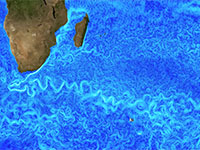
- Our Planet – A Virtual Telescope on the World's Oceans and Sea Ice
Scientists have produced 3D global “maps” of Earth's liquid and frozen places at unprecedented horizontal resolutions, providing an oceanic equivalent of a telescope to reveal the state of the entire ocean/sea-ice system in new detail. Get the story... 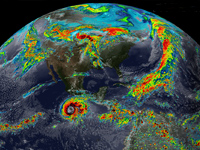
- Our Planet – Letting Nature Run Its Course
A new, ultra-high-resolution simulation of Earth's atmosphere captures how weather systems, carbon dioxide, aerosols, and other phenomena travel the globe and interact with each another. Get the story... 
- Space Exploration – Predicting Launch Environment Acoustics for Next-Generation Rockets
High-fidelity computational fluid dynamics simulations are improving predictions of launch environment acoustics to ensure safe liftoff conditions for NASA's next-generation heavy-lift Space Launch System. Get the story... 
- Astrophysics – New Simulations Revolutionize Theory of Galaxy Formation
Scientists are using a new code called ChaNGA to run realistic galaxy simulations that capture both gravity and gas hydrodynamics, providing insight into dark matter and black holes—revolutionizing our understanding of galaxy formation. Get the story...