
Our Planet – Letting Nature Run Its Course
A new, ultra-high-resolution simulation of Earth's atmosphere captures how weather systems, carbon dioxide, aerosols, and other phenomena travel the globe and interact with each other. This two-year computational portrait comes from NASA's GEOS-5 climate model running on the Discover supercomputer at the NASA Center for Climate Simulation (NCCS). Discover's processing power enables a 7-kilometer global resolution, with GEOS-5 solving equations inside cubes 7 kilometers wide throughout the atmosphere. The only inputs to this synthetic world are observed sea-surface temperature, sea ice, and emissions data. GEOS-5 then runs on its own to simulate nature as it develops within the model. Scientists call this modeling technique a "Nature Run." With a resolution capable of creating global weather at local scales, this Nature Run will serve in NASA experiments testing how new satellite instruments might aid weather and climate forecasts.
"High-resolution global atmospheric models like GEOS-5 provide a unique tool to study the role of weather and the effects of carbon dioxide and aerosols within the global climate system."
William Putman, meteorologist, Global Modeling and Assimilation Office, NASA Goddard Space Flight Center
Quick Facts
- The Nature Run simulates global weather and chemistry at 30-minute intervals for May 2005–June 2007.
- The simulation follows meteorological fields (including winds, clouds, and water vapor), aerosols (dust, sea salt, sulfate, and black and organic carbon), and trace gases (ozone, carbon monoxide, and carbon dioxide).
- The 7-kilometer resolution of the Nature Run is approximately 64 times greater than that of typical high-resolution global climate models, which run at 50 kilometers for multi-year simulations.
- The Nature Run used 7,680 Intel Xeon Sandy Bridge processor cores in 75 days of dedicated computational time on the Discover supercomputer, consuming nearly 13 million processor-hours.
- Producing nearly 4 petabytes of data, the 7-kilometer Nature Run is the biggest computation ever run at the NCCS.
Key Image
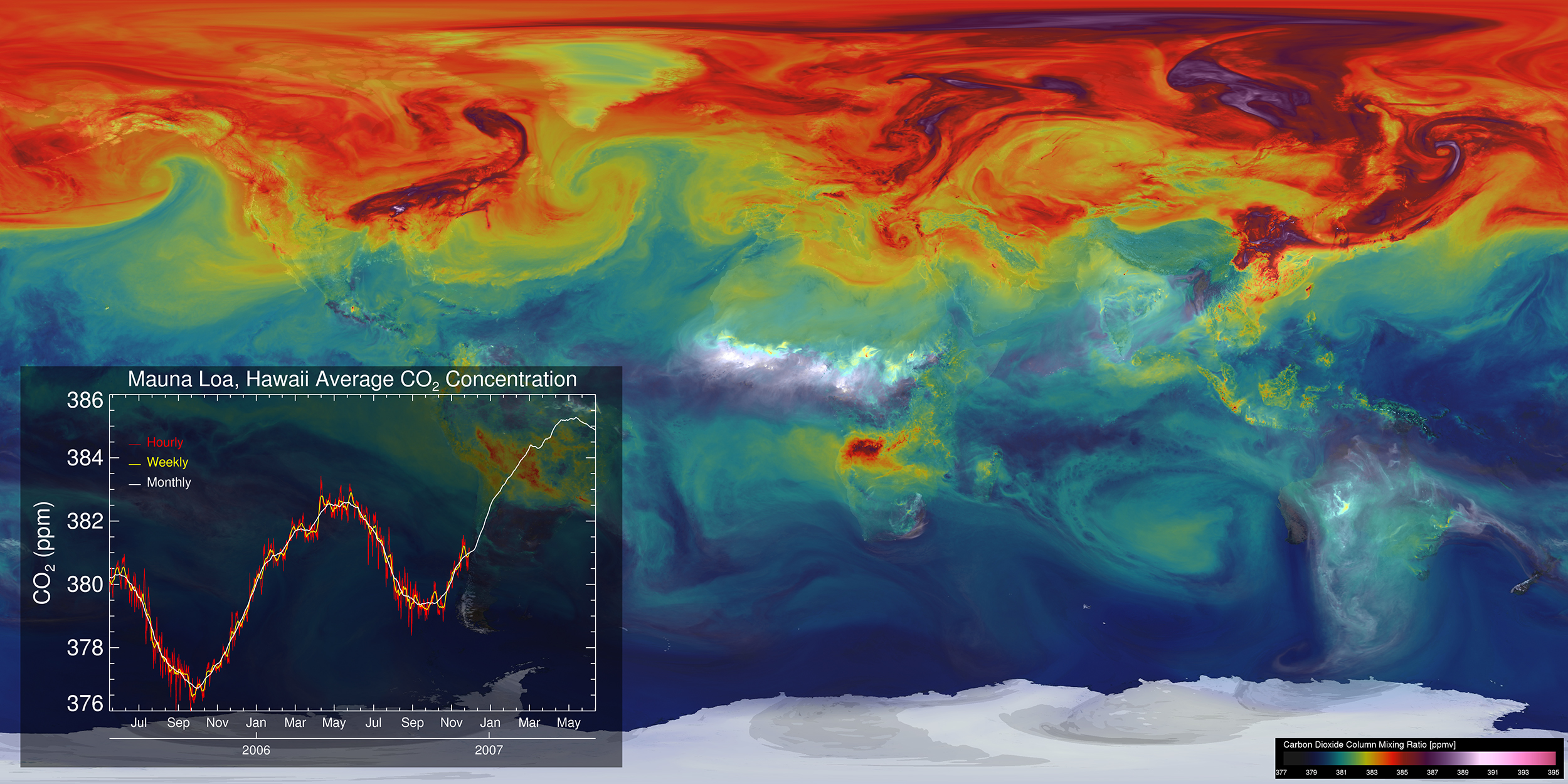
Image Caption
This image shows carbon dioxide (CO2) concentrations at Mauna Loa, Hawaii, and column CO2 mixing ratios as they are dispersed by weather systems within the large-scale flow in a 7-kilometer global simulation with the Goddard Earth Observing System Model, Version 5 (GEOS-5). High-resolution models like GEOS-5 and new observations from instruments including the Orbiting Carbon Observatory-2 (OCO-2) will work closely together to determine when and where observed CO2 came from and improve our understanding of carbon flux processes. William Putman, NASA/GoddardDownload High-Res Image (2.1MB)
More Media
See additional videos related to this demo in our media gallery.
Contacts
William Putman, NASA Goddard Space Flight Centerwilliam.m.putman@nasa.gov