
High-Performance Science at the NASA Center for Climate Simulation
Overview
NASA researchers continue to push the envelope of scientific inquiry to ever-greater heights. Taking inputs from an extensive fleet of Earth-observing satellites, scientists are running global climate simulations at extremely high resolutions for long periods of time to answer questions about climate change. In addition, remote sensing data is being used to study everything from tracking the movement of water across the Arctic boreal regions of North America to creating a high-resolution gravity map of the Moon. All of this research requires large-scale, high-performance computing, storage, and networking technologies specifically designed to meet NASA's unique requirements.
Project Details
The mission of the NASA Center for Climate Simulation (NCCS) is to expand scientific and engineering frontiers by providing advanced, usable, agile, and efficient high-performance computing (HPC) services. The NCCS architecture is designed to enable high-performance science through three major components: the Discover supercomputer, mass storage, and a data analysis platform.
Discover has a scalable design built around a shared and highly parallel data storage environment. This fall, engineers at the NCCS are integrating a total of 1,680 compute nodes with Intel "Haswell" processors into the Discover cluster environment.
The NCCS also focuses on providing services to both store and analyze large-scale data. In December, the NCCS will increase its disk storage by 15 petabytes (PB), increasing the total spinning disk within the NCCS to approximately 35 PB. The very large ratio of storage capacity to computational capability is needed for large-scale climate simulations and other NASA science.
Last, the NCCS offers a High-Performance Data Analysis Platform (HPDAP) to address the "big data" problem faced by scientists trying to cull through vast amounts of data to find answers to key questions. The HPDAP is an ideal mixture of HPC and cloud technologies that provides an agile platform for large-scale data analytics.
Results and Impact
The results being generated at the NCCS are addressing highly relevant scientific questions from climate change to the formation of the Moon, and contribute to important research, including:
- A global, two-year, 7-kilometer-resolution simulation of the Earth's climate with the Goddard Earth Observing System, Version 5 (GEOS-5) model, which will support Observing System Simulation Experiments (OSSEs) to help design the next generation of Earth-observing systems.
- In collaborations across NASA, researchers are developing techniques for downscaling climate results in order to better understand very high-resolution, local effects.
- The Arctic Boreal Vulnerability Experiment (ABoVE) for studying climate change throughout the Arctic and boreal regions of the U.S. and Canada to better measure the carbon uptake and its effect on climate through high-resolution imagery, models, and remote sensing measurements.
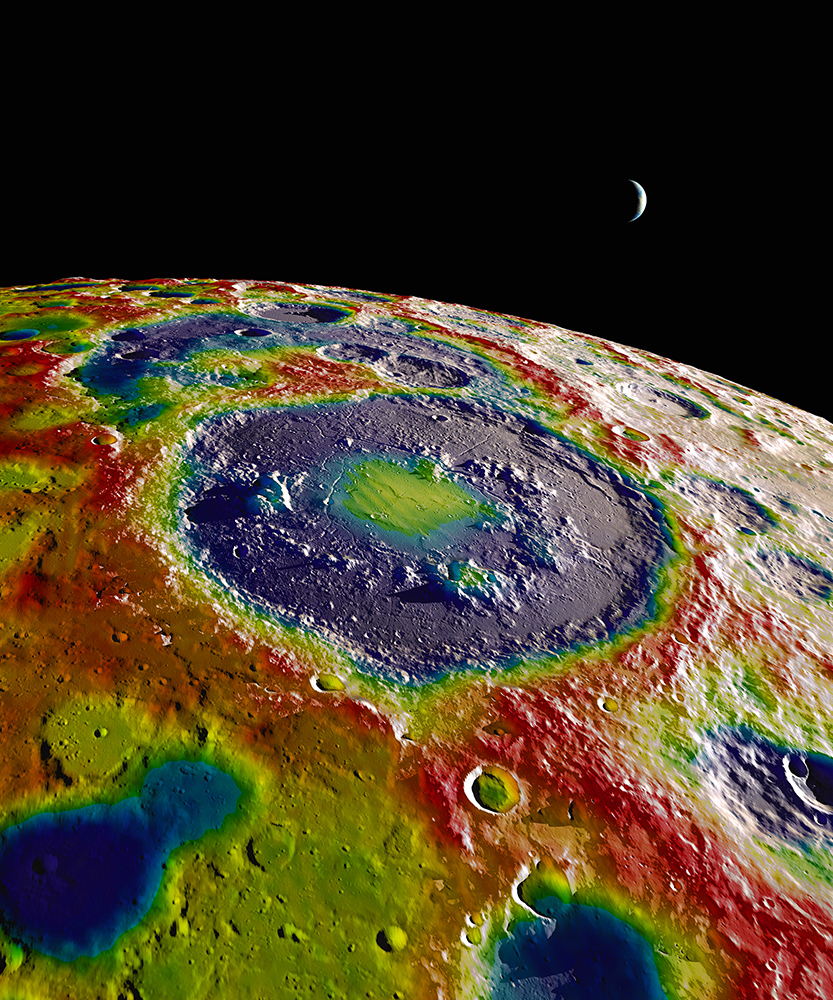
- Data from the Gravity Recovery and Interior Laboratory (GRAIL) twin spacecraft that orbited the Moon (in 2011 – 2012) is being processed into the highest-resolution maps of lunar gravity ever created, revealing unknown details about the Moon's crust and interior.

Why HPC Matters
High-performance computing, storage, and networking technologies are critical tools for reaching NASA scientific goals. The systems and services supplied by the NCCS enable researchers to dramatically push the limits of science and ask bigger, more complex questions while reducing the burden of information technology from the scientific process.
Daniel Q. Duffy, NASA Goddard Space Flight Centerdaniel.q.duffy@nasa.gov Ellen Salmon, NASA Goddard Space Flight Center
ellen.m.salmon@nasa.gov